CONTENT
Wild Animal Transportation: Protocols, Animal Selection, Marking & Welfare
Wild animal transportation requires careful planning to minimize stress, injury, and other risks associated with restraint, confinement, loading, unloading, and movement between locations. Proper protocols should address animal selection, identification and marking, weather and climate conditions, transport logistics, and record-keeping. This article outlines key considerations for the safe, humane, and professional transportation of wild animals.
Exchange of animals between zoos and acquisition of animals from the wild necessitate their transportation between various locations. Wild animals often experience high levels of stress during restraint, capture, confinement, loading, unloading, and transportation, as well as while adapting to the new environment to which they have been moved.
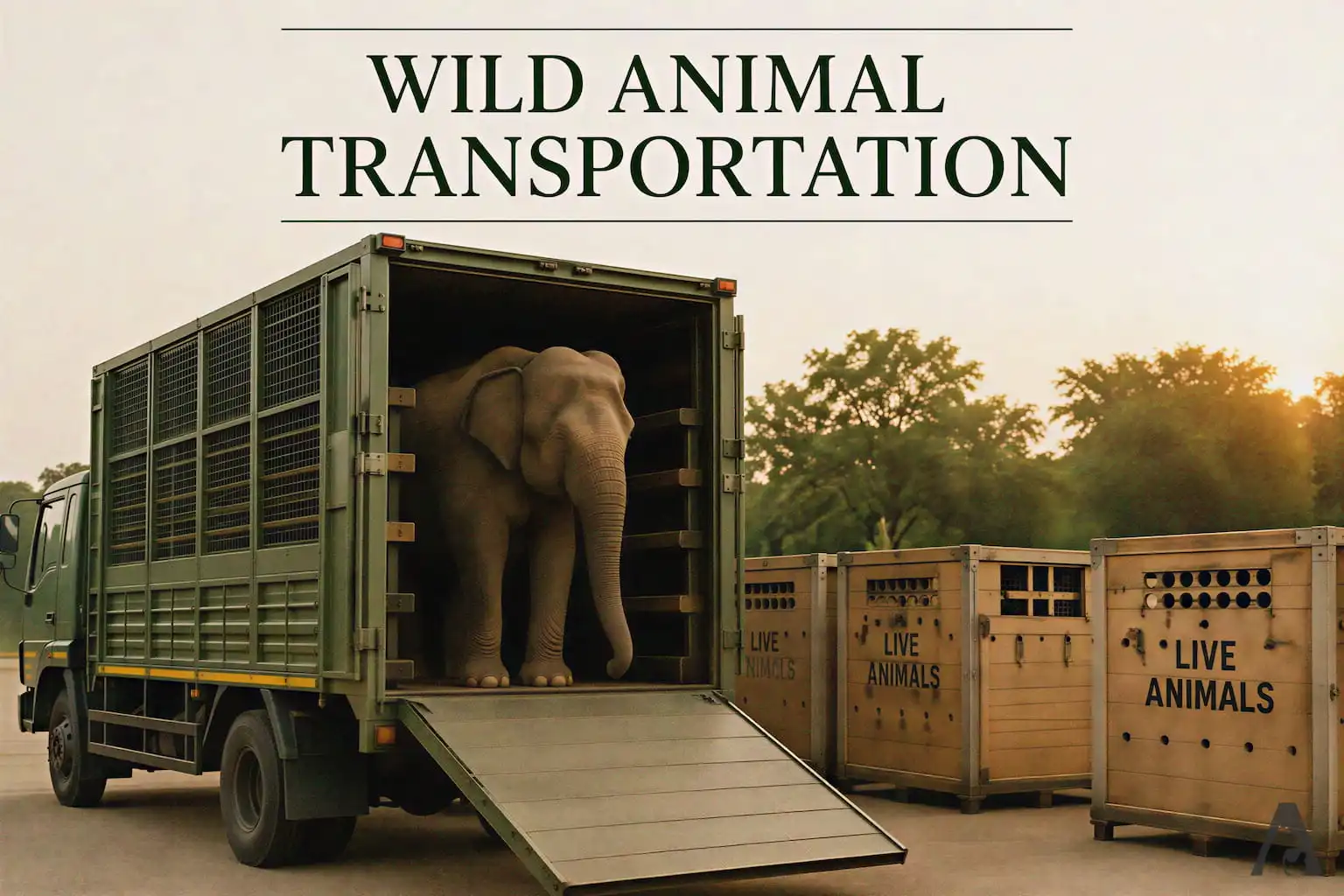
There has long been a need to develop protocols for the transportation of animals that address the major issues involved. Safe, humane, ethical, and professional protocols for the transportation of wild animals need to be developed.
Selection of Individuals
- Selection of animals is critical in any planned operation involving transportation. The selected animal should be in good health and have a clean health record. Preferably, it should not have any questionable medical history.
- Only adults and sub-adults should be transported. Pregnant, geriatric, lactating, suckling, sick, weak, injured, or deformed animals and stags (deer species) in velvet should be avoided during planned transport. As far as birds are concerned, juveniles that have recently fledged should be preferred for transportation. Transport of adults, if necessary, should be carried out after the breeding season is over.
- If young animals unable to fend for themselves must be transported, they should be transported along with their mother. Young animals that are being hand-reared should be accompanied by keepers/handlers from the donor and recipient zoos.
Marking of Selected Individuals
Prior to transport, the animal identified for transportation should be appropriately marked. The veterinarians of the recipient and donor zoos should ensure that proper identification and marking of the selected animal are carried out. These should be uniform for the species.
Natural photographic records showing the natural identification features of each animal should be maintained. Details of the site and type of marking should be recorded and made available to the recipient zoo.
- Microchips and/or ear tags and/or tattoo markings with permanent dye may be used for identification of ungulates, primates, and large mammal species.
- Carnivores should be marked with microchips (transponders). Ear tags may also be used for convenience if available.
- Birds should be marked with color bands. Birds larger than a myna or pigeon should also be microchipped. Microchips should be injected into their breast muscles. This is essential because the rings can come off or break during transportation.
- Reptiles (turtles and crocodiles) may be notch-marked, whereas snakes must have microchips. Underbelly scale notching can also be carried out on reptiles. The assistance of a person trained in microchipping reptiles should be obtained while performing this procedure.
Weather and Climate Considerations
- A complete record of the weather and climatic conditions should be maintained prior to initiating transport. Extreme climatic conditions, such as peak summer and monsoon conditions, should be avoided for transportation.
- If transportation is planned during the summer, it should be carried out strictly during the cooler hours of the day, preferably in the early morning or late evening, unless the vehicle transporting the mammals, birds, or reptiles is air-conditioned. Necessary provisions for effective cooling and ventilation should be in place when such journeys are undertaken. During winter, it should be ensured that animals are not exposed to excessive cold and are maintained in a comfortable environment throughout the journey. During summer, crates could be covered with wet hessian sacks/gunny bags that can be moistened; similarly, winter transport containers/crates could be lined with Styrofoam.
- Abrupt changes in weather conditions should be anticipated and provisions should be made accordingly. Transportation logistics should be carefully planned, with a backup and support vehicle always available on call.
Animal Transport Considerations
The animal’s health and well-being should be the highest priority during transport. The corresponding measures depend on the species and should essentially be considered prior to movement.
The mode of transport should be identified, and a reconnaissance should be carried out well in advance. Preparations should be made accordingly. The driver/team undertaking the transportation should familiarize themselves with the route that will be taken. Stops en route should be pre-planned and identified well in advance to minimize the duration of transport.
The cage should be positioned in the vehicle in such a way that the animal always faces the direction in which the vehicle is moving.
In the case of transportation of elephants by truck, it is best to cover just 250 km a day, halt, and take the elephants out for medications (muscle relaxants, vitamins/glucose), water, walking, feeding, and resting until the next morning.
Record-Keeping Considerations
- Copies of the studbook and breeding records of the animals being transported should accompany the animals to indicate the pedigree and prevent inbreeding.
- Copies of the animal report, including all details of health, breeding, and temperament, as well as medical history sheets and medical records, should be sent to the recipient zoo along with the animals.