CONTENT
Wildlife Glossary: Important Terms in Wildlife Management and Conservation
Wildlife terminology encompasses a wide range of concepts related to wildlife management, conservation, ecology, habitats, population dynamics, and animal behavior. A clear understanding of these terms is essential for veterinary and wildlife science students. This glossary provides important definitions and concepts commonly used in wildlife science and wildlife management.
Wildlife
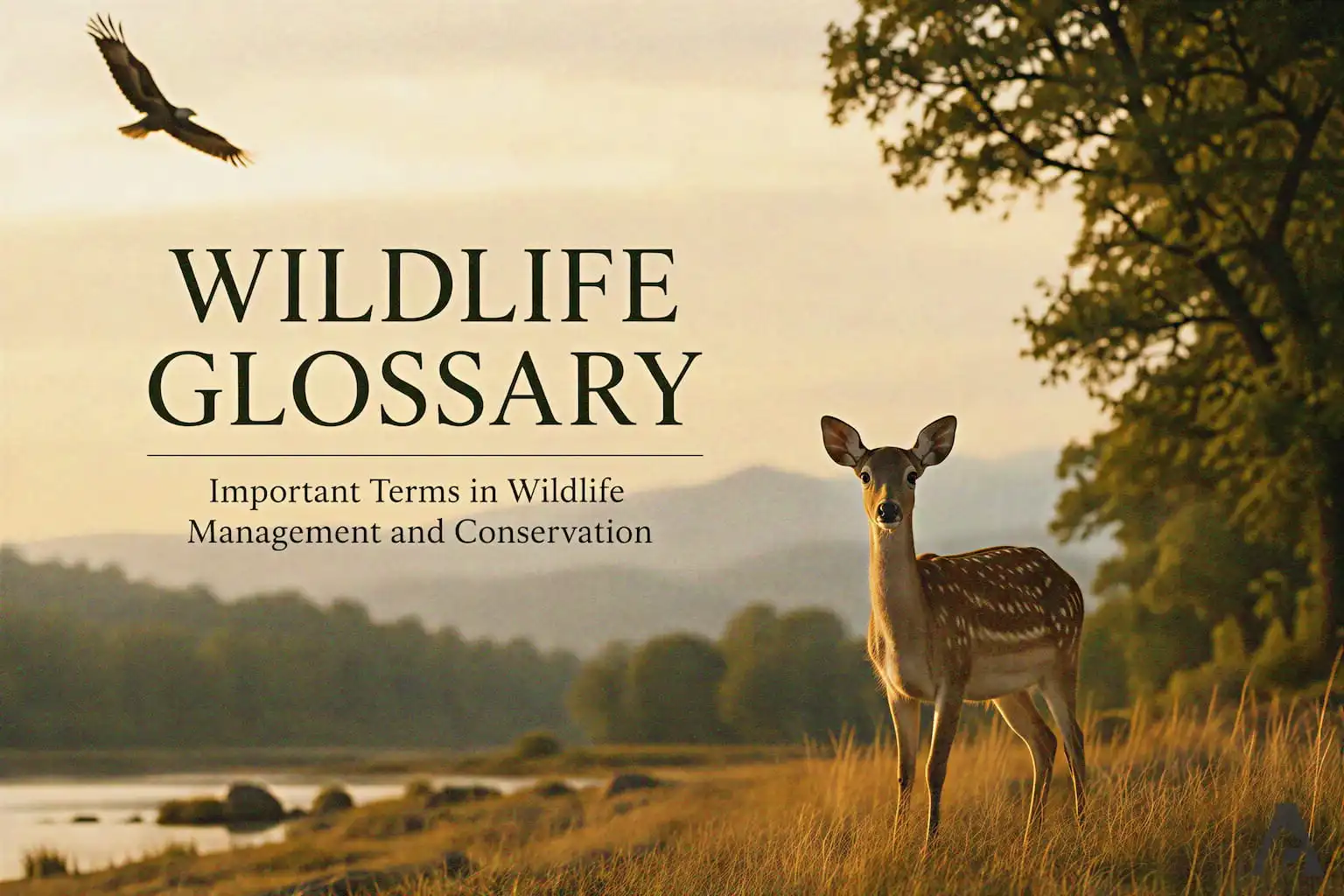
Wildlife includes all free-ranging vertebrates in their naturally associated environments. Other definitions of wildlife are much broader and may include all plants (flora) and animals (fauna) in wild ecosystems.
Domestication
The condition wherein the breeding, care, and feeding of animals are more or less controlled by humans. Under modern husbandry practices, complete control of breeding and maintenance is typical. Domestication involves some biological, i.e., morphological, behavioral, and/or physiological, changes in animals.
Taming
The elimination of tendencies to flee from humans. Wild animals may be tamed, whereas individuals of most domesticated species require taming only if their association with humans is limited during early life.
Feral Animals
Domestic animals that have reverted to the wild state.
Wildlife Management
The art of making land produce valuable populations of wildlife. It includes the control of pest populations to limit the negative impacts of wildlife.
There are two general types of wildlife management:
- Manipulative Management
- Custodial Management
1. Manipulative Management
Manipulative management acts on a population, either changing its numbers by direct means or influencing numbers by indirect means, such as altering food supply, habitat, density of predators, or prevalence of disease.
This is appropriate when a population is to be harvested, or when it declines to an unacceptably low density or increases to an unacceptably high level.
2. Custodial Management
Custodial management is preventive or protective. The aim is to minimize external influences on the population and its habitat. It is appropriate in a national park where one of the stated goals is to protect ecological processes.
Wildlife Conservation
A social process encompassing both ordinary and professional activities that define and seek to attain the wise use of wildlife resources and maintain the productivity of wildlife habitats.
Biosphere
The habitat sphere of Earth occupied by living organisms.
Environment
All the materials and processes in the surroundings of an organism or population. The naturally associated environment of a species is the kind of environment in which the species has evolved.
Environmental Factor
One of the materials or processes in an environment. Factors may be groups of materials or processes (soil, food, weather, biotic succession, etc.) or may be more specific (temperature, soil moisture, etc.).
Environmental factors are often classified as:
- Biotic: Food quality and quantity, predation, disease, etc.
- Physical: Temperature, precipitation, humidity, etc.
- Edaphic/Soil: Depth, moisture, texture, chemistry, etc.
Ecology
The study of relationships between organisms and the environment. Wildlife management is largely an application of knowledge from this science.
Habitat
Habitat is the kind of biotic community, or set of biotic communities, in which an animal or population lives. e.g., A marsh is a habitat for a muskrat population.
Zoogeography
Zoogeography is the study of past and present animal distributions, including the evolution, spread, recession, and extinction of species.
Geographic Range
Geographic range is the broad area in which a species occurs. It is usually illustrated by irregularly shaped shaded areas on maps.
Ecologic Range
Ecologic range includes the habitats within a geographic range where a species occurs.
Ecological Balance
The constant and perfect balance maintained between various organisms in the environment under natural conditions.
Biotic Community
Biotic community refers to the existence of plants and animals in a common habitat.
Ecosystem
The combination of a biotic community and its physical environment.
Ecological Niche
The set of habitat resources (food, cover types, water, etc.) used by a species, as determined by its geographic and ecological range and its adaptations.
Ecological Succession
The progressive development of a biotic community, involving replacement of species and modification of the physical environment, until a community with a relatively stable species composition is reached. The terminal, relatively stable community is termed ‘climax’.
Carrying Capacity
The number of animals of a specified quality that a habitat can support while sustaining a specified, but not progressively increasing, level of impact on habitat resources.
Population Dynamics
Population dynamics refers to the variation in population size and also in sex-age composition, reproduction and mortality rates, and qualities of animals in populations. It is the study of how this variation results from interactions among animals and between animals and their environment.
Sylvatic
Sylvatic is a term referring to forests.
Adaptations
Biological changes that fit an animal for survival and reproduction within a particular environment or within a limited range of environments.
Natural Resource
Any material provided by nature from which living things draw their sustenance.
Home Range
The area traversed by an animal or population in its normal daily activities. An animal must find all its habitat requirements within its own home range; otherwise, it must extend it.
Critical Areas
Parts of the home range where limiting habitat resources are located. They are also termed ‘key areas’. e.g., Areas near water sources on which desert wildlife may depend during dry seasons.
Territory
Part or all of the home range that is defended to the exclusion of other animals, especially conspecifics. Territories may be defended by individuals, breeding pairs, or social groups, either year-round or seasonally.
Dispersal (or Emigration)
Dispersal (or emigration) is the permanent abandonment of home ranges and movement, perhaps wandering, in search of suitable habitat for a new home range.
Cruising Ability
An animal’s maximum ability to traverse an area in search of its habitat requirements.
Homing
Homing is the ability to return to a home range when displaced from it.
Migration
A two-way movement, usually between seasonally used home ranges.
Natality
Natality refers to the production of new individuals by birth or hatching. The natality rate is the number of young produced per female.
Recruitment
Recruitment refers to the production of sexually mature animals. The recruitment rate is the number of sexually mature animals produced per female or per adult. Recruitment has also been used to indicate the production of self-sufficient animals (regardless of sexual maturity) by a population.
Productivity
The rate at which a population increases or the rate at which harvestable surpluses of animals are produced. Productivity may be expressed as a number of animals per unit time or as a percentage of the total population.
Monogamy
Pairing of one male and one female for at least one breeding season. It is common in birds and some canid species.
Polygamy
It includes polyandry (pairing of one female with several males; rare), polygyny (pairing of a dominant male with several females), and promiscuity (pairing of several males with several females).
Extinction
In biology and ecology, extinction is the cessation of existence of a species or group of taxa, reducing biodiversity. The moment of extinction is generally considered to be the death of the last individual of that species (although the capacity to breed and recover may have been lost before this point).
Zoological Garden
A zoological garden, zoological park, or zoo is a facility in which animals are confined within enclosures and displayed to the public, and in which they may also be bred. The term was first used in 1828 for the London Zoological Gardens, soon abbreviated to “zoo”.
Menagerie
Menagerie is the term for a historical form of keeping wild and exotic animals in human captivity and, therefore, a predecessor of the modern zoological garden. The term was first used in seventeenth-century France, originally for the management of household or domestic stock, but later primarily for an aristocratic or royal animal collection. Later, the term was also used to refer to traveling animal collections that exhibited wild animals at fairs across Europe and the Americas.
Safari Park
Safari parks are specialized zoos where captive animals are housed in large, naturalistic enclosures, and visitors are allowed to enter the enclosures to view the animals from close quarters in a mechanized vehicle or along a predetermined route.
Zoolatories
Religious places where wild animals are maintained for ritualistic purposes. e.g., Elephants in Guruvayoor Temple in Kerala.
Circus
A circus is most commonly a traveling company of performers that may include acrobats, clowns, trained animals, trapeze acts, and other entertainment acts. The word also describes the performance that they give. A circus is held in an oval or circular arena with tiered seating around its edge; in the case of traveling circuses, this location is most often a large tent.
Museum
An institution that collects, documents, preserves, exhibits, and interprets material evidence and associated information for the public benefit. Museums of natural history and natural science typically exhibit works related to the natural world.
The focus lies on nature and culture. Exhibitions may educate the public about dinosaurs, ancient history, and anthropology. Evolution, environmental issues, and biodiversity are major areas in natural science museums.