CONTENT
Wild Animal Restraint: Physical Restraint Methods
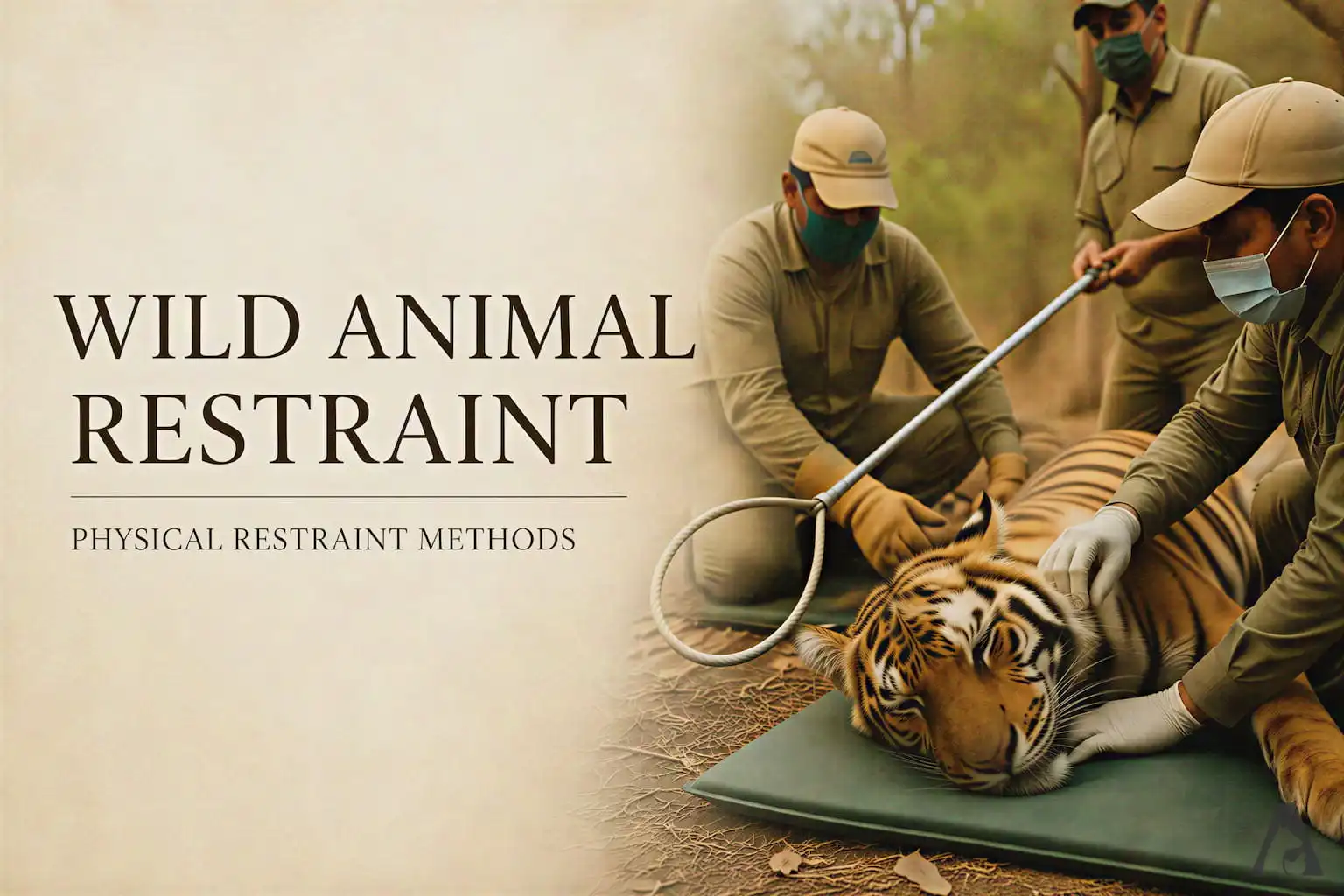
Wild animal restraint is an essential component of wildlife veterinary practice, allowing veterinarians and trained personnel to safely perform clinical examination, treatment, sample collection, translocation, and other necessary procedures. Physical restraint methods involve the use of specialized tools and techniques to restrict an animal’s movement while minimizing stress and the risk of injury to both the animal and the handler.
Common physical restraint tools include catch poles, ropes, gloves, nets, blankets, traps, squeeze cages, and snake hooks.
Purpose of Restraining Wild Animals
- For treatment of sick animals.
- For periodic clinical examination of wild animals.
- For obtaining clinical specimens, e.g., collection of blood, CSF, urine, etc.
- For translocation.
- For biological research and research related to wild animal health.
- For assessment of environmental effects, as wild animals can serve as indicators of environmental hazards.
- Whenever wild animals become accidentally trapped by humans.
- When wild animals pose a significant threat to human safety, making restraint necessary, e.g., man-eating tigers.
Physical Restraining Tools
Snares or Catch Poles
Catch poles and snares are commonly used and come in various styles and lengths. They have a stiff handle with an adjustable loop of rope or cable on one end. Use a catch pole that is between 3 and 5 feet long.
A shorter one will not be an effective “extension of the arms,” while a longer one will be too difficult to handle properly.
Long-Handled Tongs
Long-handled tongs can be used to catch an animal around the neck or body and can be used for snakes, cats, and other small animals.
Ropes
Ropes are an excellent means of extending the arm. They are basic tools used for many manipulative procedures on wild and domestic animals.
Gloves
Gloves of various thicknesses are used for effective control of wild animals, especially small mammals, various avian species, and primates.
Nets
Nets can work well in some situations, particularly for capturing birds or small primates. Nets can be attached to poles or used loose so they can be thrown over the animal. They can be difficult to use because most animals can easily avoid a net. They are also expensive, difficult to store, and require continual repairs.
By placing the net over the animal, many manipulative procedures, such as injection with sedatives, medication, examination, or obtaining samples for laboratory work, can be carried out.
Blankets/Towels
Blankets, large towels, or other heavy cloths can be placed over an animal. Use a blanket that is thick enough so the animal cannot tear it, but thin enough that you can still grasp the animal.
Blankets help calm the animal and may protect you from bites because animals are less likely to attack a flat surface.
Many animals may be calmed by the darkness created when they are covered with a blanket. A blanket is useful when handling large birds because the wings, talons, and beaks can all be covered.
Make sure the blankets and towels are washed after each use to prevent disease transmission.
Traps
Traps are useful tools for capturing animals. Use traps to capture animals when a close approach is difficult, such as when animals have access to a large public space or have a strong flight response. Traps can also be used to capture nocturnal animals, such as skunks, raccoons, and opossums.
Squeeze Cages
Squeeze cages are extremely valuable restraint tools for wild animals. Squeeze cages are useful for vaccinating and examining animals. Simply slide the squeeze panel forward until the animal is firmly held between the panel and the side of the cage.
The galvanized metal bottom can be removed for easy cleaning. The handles fold flat and lock into place for easy storage, and a sliding rear door is available for easy release of the animal. These cages are mainly used for effective restraint of captive felids (lions, tigers, panthers), bears, hyenas, jackals, wild dogs, foxes, etc.
Hook
The snake hook, in its various forms, is utilized for handling all species of reptiles.
Chemical Restraining Method
Chemical restraint includes any method that primarily uses a chemical agent or “drug” to restrict an animal’s freedom of movement, i.e., walking, running, and aggressiveness. We will learn more about this in the “Chemical Restraint of Wild Animals” post.