CONTENT
Feeds and Feeding of Captive and Wild Animals: Feeding Schedule
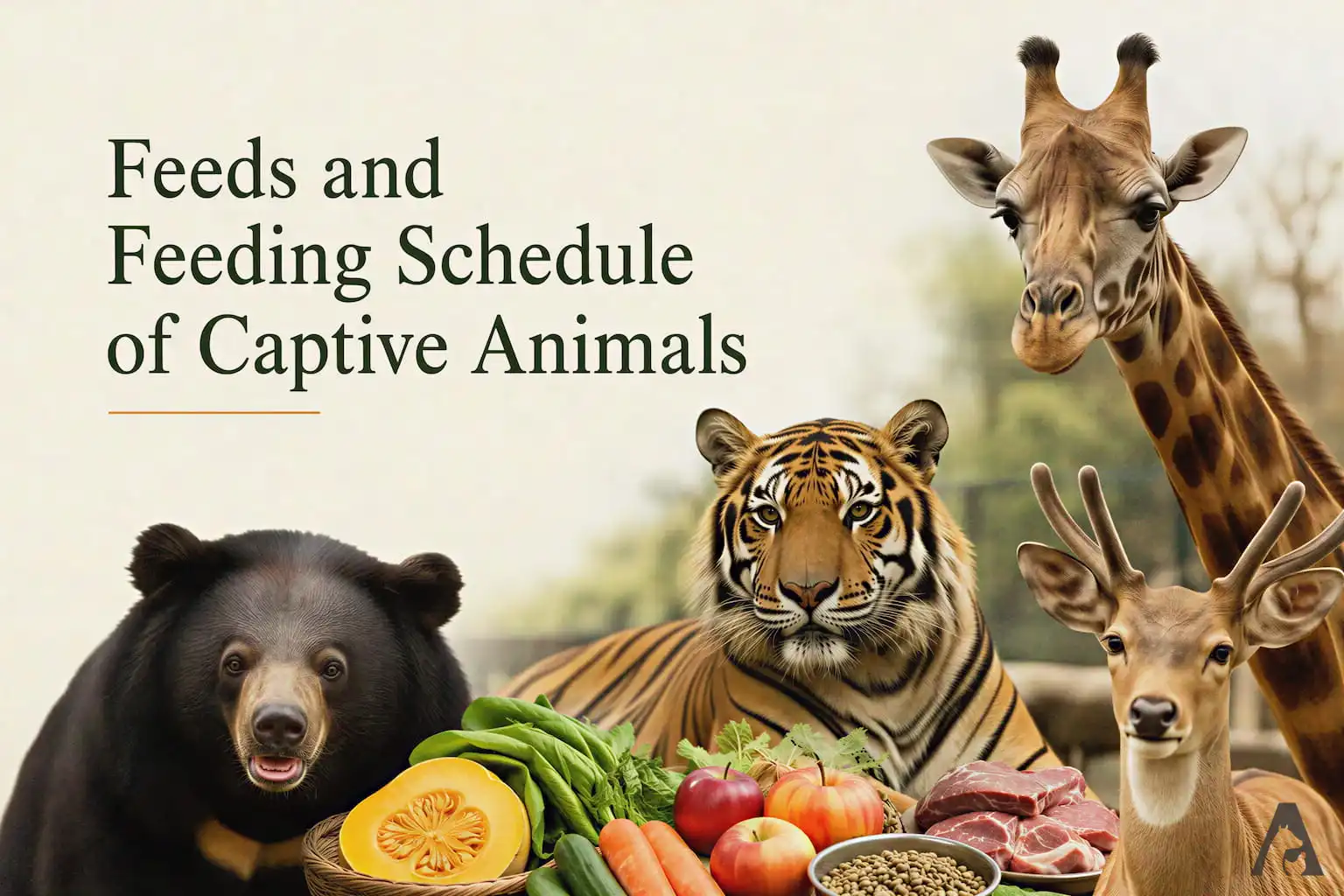
Proper nutrition is essential for maintaining the health, welfare, longevity, and reproductive performance of wild animals in captivity. Feeding programs must consider species-specific nutritional requirements, life stage, natural feeding behavior, food availability, and practical management constraints. This article covers feeding strategies for captive animals, approaches to wildlife nutrition, feeds of choice under free-range conditions, and commonly followed feeding schedules for various zoo animals.
The goals of feeding programs in a zoo should be:
- Improve the overall nutrition of animals in captivity,
- Gather information on the nutrient requirements and feeding considerations of animals at different life stages, and
- Provide for the physiological needs and well-being of exotic animals in captivity.
Recommended Feeding Strategy
- Aim to provide a nutritionally balanced diet.
- Provide a diet that reasonably stimulates natural feeding behaviors.
- Provide a nutritionally balanced diet that the animal consumes consistently.
- Provide a diet that meets all of the above criteria and is practical and economical to feed.
Constraints of Feeding Animals in Captivity
- Lack of knowledge about the feeding behavior of animals in captivity.
- Lack of knowledge about wildlife ecology.
- Difficulties in providing in situ meat or fodder.
Approaches to Wild Animal Nutrition
Feeding wild animals is complex. Therefore, domestic animal nutrition is taken as a model for wildlife nutrition.
| Domestic animals | Wild animals |
|---|---|
| Cattle, sheep, and goats | Deer, giraffes, llamas, hippopotamuses, antelopes, bison |
| Pigs | Wild pigs |
| Horses | Zebras, elephants, rhinoceroses |
| Dogs and cats | Large carnivores |
| Human beings | Apes (gorillas, hoolocks, gibbons) |
Feeding Animals in Free-Range Conditions
The variation in food habits differs according to age, sex, and geographical region. The carrying capacity of a habitat depends on the quantitative and qualitative availability of food, the presence of water, soil type, topography, and cover.
Carnivores generally do not suffer from deficiencies in the quality of their food, but quantity is more important. Herbivores usually subsist on plants and their parts, and they can obtain sufficient food to fill their stomachs. Thus, the quality of food is the major limitation for them.
Different feeds of choice for wild animals under free-range conditions:
| Species | Feed of choice | Species | Feed of choice |
|---|---|---|---|
| Tiger | Spotted deer and young animals | Elephant | Top of bamboo |
| Lion | Spotted deer and young animals | Musk deer | Lichen, mosses, ferns, and tender leaves |
| Leopard | Rabbit and live chicken | Bear | Insects, honey, bananas, and fruits |
| Jackal | Chicken neck, entrails, and meat | Rhinoceros | Paddy and grasses |
| Wolf | Rabbit and live chicken | Kangaroo | Grasses |
| Fox | Chicken neck, entrails, and meat | Giraffe | Leaves and branches of trees |
| Rodents | Peanuts | Nilgai | Grasses, cereals, and legume crops |
| Porcupine | Carrots, vegetables, and salt | Hippopotamus | Grasses |
| Civet | Fish, chicken, and entrails | Yak | Grasses |
| Hares | Cabbage, carrots, and vegetables | Monkey | Bananas, fruits, and insects |
| Snakes | Fish | Crocodiles | Petrified or decomposed flesh |
| Python | Rats, frogs, and live chicken | Birds | Grains |
Feeding in Captivity
Knowledge of zoo animal nutrition has considerably improved, but challenges still remain in meeting nutritional requirements at all physiological stages of life to achieve desirable results.
Feeding wild animals in captivity does not only involve the provision of balanced diets but also requires skillful feeding management.
Feeding chart commonly followed:
| Animal | Body weight | Diet |
|---|---|---|
| Tiger | Adult | 15 kg buffalo meat |
| Lion | 125 kg | 15 kg buffalo meat |
| Leopard | 45 kg | 4 kg buffalo meat + 2 eggs |
| Leopard cat | 4 kg | 500 g chicken |
| Wolf | 25 kg | 3 kg bone meat |
| Hyena | 25 kg | 3 kg bone meat |
| Jackal | 8 kg | 1 kg bone meat |
| Fox | 4 kg | 500 g bone meat |
| Zebra | Adult | 20 kg greens + 1 kg wheat |
| Crocodile | 125 kg | 1 kg live fish/week |
| Python | 40 kg | 2 guinea pigs/month |
| Himalayan bear | Adult | 3 kg vegetables + 3 kg fruits + 2 eggs + 0.5 L milk |
| Sloth bear | Adult | 2 kg vegetables + 1 kg fruits + 2 eggs + 0.5 L milk |
| Monkey | Adult | 400 g vegetables + 200 g fruits |
| Baboon | Adult | 600 g vegetables + 200 g fruits |
| Langur | Adult | 500 g vegetables + 200 g fruits |
| Sambar | 150 kg | 20 kg greens + 1.5 kg cattle feed |
| Spotted deer | 60 kg | 10 kg greens + 750 g cattle feed |
| Chinkara | 30 kg | 5 kg greens + 500 g cattle feed |