CONTENT
Housing Management of Captive Animals in Zoos: Enclosures, Safeguards & Space Requirements
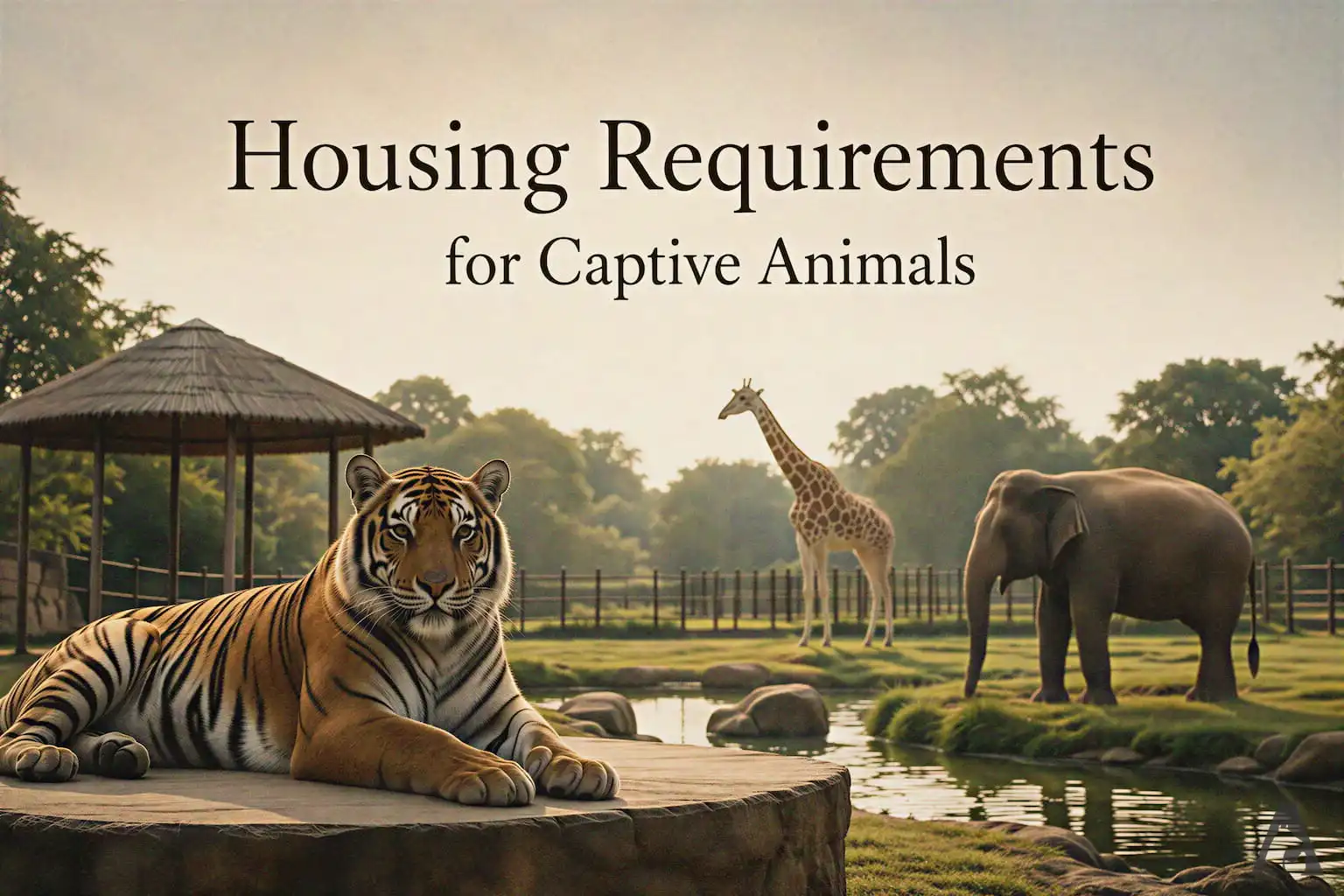
Housing management of captive animals in zoos involves designing and maintaining enclosures that provide safety, adequate space, and a near-natural environment while allowing effective animal observation. Proper enclosure design, barriers, landscaping, and safety measures help prevent escapes and injuries while promoting appropriate housing and welfare of captive animals.
*ADVERTISEMENT*
Contact hello@mkvisuals.org to advertise here
It is desired that the display of animals in a zoo should be based on the concept of nature-immersive enclosures, with the following objectives:
- The landscape around every animal exhibit/enclosure should comprise plantings of appropriate tree and shrub species of adequate extent and of such shape that the enclosure should not be visible to visitors from any place other than the animal viewing areas.
- All the hard exteriors of the enclosure, i.e., the enclosure barrier and the frontage of the feeding cells and feeding kraals, should be effectively camouflaged through the planting of bamboo, dwarf tree species, and shrubs.
- Planting of appropriate trees and shrubs should be done around the animal viewing areas to break up visitors into small viewing groups.
- Visitors should be made to move through the green landscape around the enclosure for reasonable distances.
- Planting of appropriate tree species should be done in the enclosure to ensure that the entire animal enclosure is not visible to visitors from any of the viewing points. The animal should be seen by visitors in its near-natural setting.
- Enclosure Barrier — The barrier of every enclosure should be of a design, dimension, and material that can effectively contain the animals housed within the enclosure and safeguard against any animal escaping from the enclosure. Due care should also be taken to ensure that the shutters and doors fitted in the enclosure, kraal, and feeding cell are of such material and design that they cannot be broken or opened by the animals housed in the enclosure. The barriers of all the enclosures, except in the animal viewing area, could comprise natural cliffs (if any), walls, glass, electric fences, chain-link fences, etc., of prescribed dimensions. However, in animal exhibit enclosures, provision of a moat could be made in the animal viewing area to facilitate visitors in having an unobstructed view of the animals without getting close to them. Wet moats shall normally not be used as enclosure barriers for the viewing area except in the case of water-loving animals. The total land area under the moat should not exceed 20% of the land area of the enclosure.
Other Safeguards
- Due care should be taken to ensure that no power line/power cable passes over any animal enclosure.
- The enclosure barrier should be erected/constructed at a safe distance from such trees that can aid the animals in escaping from the enclosure or damage the enclosure barrier.
- Where walls are used as enclosure barriers, due care should be taken to plaster them with an appropriate proportion of cement mix so that the plaster does not wither away, leaving gaps that could be used by the animal as footholds for escaping from the enclosure.
- Live-wire overhangs or chain-link fencing should be used to prevent the animals from escaping from the enclosure.
- Water pipelines and sanitary fittings should be fixed within the enclosure in such a manner that they cannot be used by the animal as an aid to escape from the enclosure.
- An adequately deep foundation should be provided for enclosure barriers housing burrowing species.
- Attention should be given to different barrier materials, fixtures, shutters, etc., to ensure that they are safe and cannot be broken or cause injuries to animals.
Minimum Prescribed Sizes for Feeding/Retiring Cubicles for Important Exotic Mammalian Species and Birds
| Name of the species | Minimum size of the outdoor enclosure (sq. m) | No. of animals to be housed | Size of the feeding cubicles/night shelter (m) (L × B × H) for each animal/bird | Minimum size of the water body (m²) |
|---|---|---|---|---|
| Flightless birds, Emu, Cassowary | 500 (up to 10 nos.) | 1:1 | 3 × 2 × 2.5 | – |
| Exotic Pheasants | 80 Size (3 × 3 × 6 m) | 1:3 | – | – |
| Flying birds | 80 Size (3 × 3 × 6 m) | 2:2 | Aviary height: 6 m | – |
| Parrots, Macaws, Cockatoos, Conures, Rosella | 80 Size (3 × 3 × 6 m) | 2:2 | Aviary height: 5 m | – |
| Baboon, Capuchin | 500 | 1:1 | 2 × 1.5 × 2.5 | – |
| Marmosets, Squirrel monkey | 50 | 1:1 | 1 × 1.5 × 2 | – |
| European bear | 1000 | 1:1 | 2.5 × 1.8 × 2.5 | – |
| Cape buffalo | 1500 | 1:1 | 3 × 2 × 2.5 | – |
| Chimpanzee, Orangutan, Gorilla | 1000 | 1:1 | 2.75 × 1.8 × 3 | – |
| Fallow deer, Sika deer, Lechwe deer | 1000 | 2:3 | 3 × 2 × 2.5 | – |
| African elephant | 5000 | 1:1 | 8 × 6 × 5.5 | – |
| Giraffe | 1500 | 1:1 | 8 × 5.5 × 6 | – |
| Hippopotamus | 1000 | 1:1 | 5 × 3 × 2.5 | – |
| Jaguar | 500 | 1:1 | 2 × 1.8 × 2.5 | – |
| African lion | 1000 | 1:1 | 2.75 × 1.8 × 3 | – |
| African rhino/White rhino | 2000 | 1:1 | 5 × 3 × 2.5 | – |
| Tapir | 500 | 1:1 | 2.5 × 1.5 × 2.5 | 100 m² |
| Tigers (other than Bengal tiger) | 1000 | 1:1 | 2.75 × 1.8 × 3 | – |
| Zebra | 1500 | 1:1 | 3 × 2 × 2.5 | – |
| Wallaby | 300 | 1:1 | 2.5 × 1.5 × 2.5 with ramp | – |
| Crocodiles/Alligators African Dwarf, American, Australian Freshwater, False gharial, Morelet’s, Nile, Siamensis, Snouted, African Slender, West African Dwarf Gavial, False Caiman, Spectacled Caiman, Yacare & Dwarf | 500 | 1:1 | – | 200 (with a depth of 2 m) |
| Iguana | 100 (covered partly by chain-link) | 1:2 | No house required | May also keep a reptile house/glass terrarium-type enclosure |
| Giant Aldabra tortoise | 200 | 1:1 | With 20 sq. m (small shade from rain & heat) | – |
| Small aviary birds (Lovebirds, finches, Lorikeet, Java sparrows, Munia, Budgerigar) | 15 | 2:3 | Earthen pots of appropriate size for nesting and shelter should be provided. | – |
Minimum Prescribed Size for Feeding/Retiring Cubicle for Important Mammalian Species of Captive Animals
| Name of the species | Size of the feeding cubicle/night shelter for each animal (m) (Length × Breadth × Height) | Name of the species | Size of the feeding cubicle/night shelter for each animal (m) (Length × Breadth × Height) |
|---|---|---|---|
| Tiger, Asiatic lion | 2.75 × 1.80 × 3.00 | ||
| Common leopard, Clouded leopard & Snow leopard | 2.00 × 1.80 × 2.5 | Musk deer, Nilgiri Tahr, Chinkara, Four-horned antelope, Bharal, Goral, Wild sheep and Markhor | 2.5 × 1.5 × 2.5 |
| Small cats | 1.8 × 1.50 × 2.0 | Mouse deer | 1.5 × 1.0 × 1.5 |
| Sloth bear, Himalayan black bear, Brown bear, Malayan sun bear | 2.5 × 1.8 × 2.5 | ||
| Monkeys and Langurs | 2.0 × 1.5 × 2.5 | ||
| Civets, Binturong, Otters, Ratel, Hogbadger, Martens, Red panda, Wolf, Jackal and Wild dog | 2.0 × 1.5 × 2.5 | ||
| Elephant | 8.0 × 6.0 × 5.5 | Slow loris and Slender loris | 1.0 × 1.0 × 1.5 |
| One-horned Indian rhinoceros | 5.0 × 3.0 × 2.5 | ||
| Wild buffalo, Yak, Indian Gaur and wild ass | 3.0 × 2.0 × 2.5 | ||
| Brown-antlered deer, Hangul and Swamp deer | 3.0 × 2.0 × 2.5 |
Minimum Prescribed Sizes for Outdoor Open Enclosures for Important Mammalian Species in Captivity
| Animals/Species | Minimum size of outdoor enclosure (per pair) (m²) | Minimum extra area per additional animal (m²) |
|---|---|---|
| Tiger and Lion | 1000 | 200 |
| Panther, Clouded leopard and Snow leopard | 500 | 100 |
| One-horned Indian Rhinoceros | 2000 | 400 |
| Brown-antlered deer, Hangul, Swamp deer | 1500 | 100 |
| Wild buffalo, Indian bison and Wild ass | 1500 | 200 |
| Bharal, Goral, Wild sheep and Serow | 500 | 100 |
| Sloth bear, Himalayan black bear, Brown bear and Malayan sun bear | 1000 | 100 |
| Red panda, Jackal, Wolf and Wild dog | 400 | 100 |
| Monkeys and Langurs | 500 | 100 |
Minimum Prescribed Sizes for Outdoor Enclosures for Important Birds in Captivity
| Animals/Species | Minimum size of aviary (m²) | Minimum height of the aviary (meters) | Minimum size of the water body within the aviary (m²) |
|---|---|---|---|
| Birds of prey | 300 | 8 | 10 |
| Pheasant* | 80 | 3 | 3 |
| Water birds (mixed species enclosure) | 300 | 8 | 60 (with a depth of 0.5 m) |
| Flying birds (mixed species enclosure) | 300 | 8 | 20 |
| Flying birds (single species) | 80 | 6 | 2 |
* In the case of peafowl, the aviary size should be kept at 160 sq. m.
Minimum Prescribed Sizes for Outdoor Open Enclosures for Important Reptiles and Amphibians in Captivity
| Animals/Species | Minimum size of the enclosure (m²) | Minimum size of the water body within the enclosure (m²) |
|---|---|---|
| Crocodile/Gharial | 400 | 150 (with a depth of 2 m) |
| Python | 80 | 6 |
| Cobra, Rat snake, Vipers | 40 | 4 |
| Sand boas | 40 | 4 |
| Monitor lizards* | 80 | 6 |
| Chameleons and Small lizards | 40 | 4 |
| Tortoises | 40 | 4 |
| Turtles | 80 | 40 (with a depth of 2 m) |
| Amphibians | 10 | 4 (with a depth of 0.5 m) |
* In the case of the water monitor lizard, the size of the water body should be kept at 40 sq. m with a depth of 1.5 m.
Note:
- The dimensions have been given only in respect of species that are commonly displayed in zoos.
- No dimensions for outdoor enclosures have been prescribed for Chinkara and Chowsingha because of the problem of injuries resulting from infighting. The enclosure for these species could be a group of small-sized enclosures with fewer animals in each. Care should be taken to ensure that there are no competing mating males in each small enclosure.
- The designs of enclosures for endangered species not covered by this Appendix should be finalized only after approval of the Central Zoo Authority.
*ADVERTISEMENT*
Contact hello@mkvisuals.org to advertise here