CONTENT
Chemical Restraint of Wild Animals: Methods, Equipment, Advantages & Disadvantages
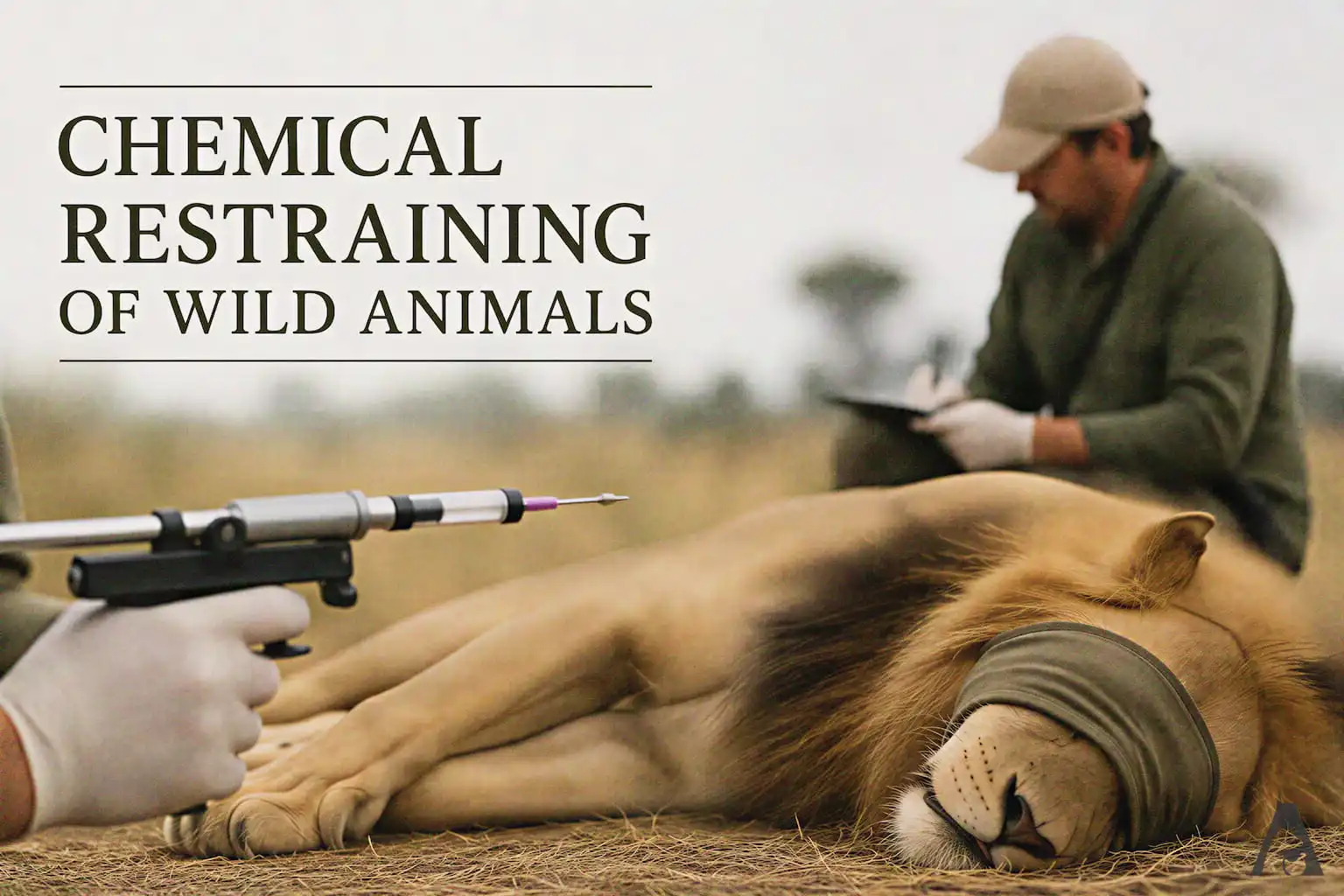
Chemical restraint is an important technique in wildlife veterinary practice that allows wild and captive animals to be safely immobilized, tranquilized, or anesthetized for capture, handling, veterinary care, translocation, research, and population management.
This article discusses the principles, purposes, advantages, and limitations of chemical restraint, along with commonly used drug-delivery equipment and methods, including hand-held syringes, jab-sticks, darts, blow-pipes, blow-guns, and other projectile systems.
Chemical Restraint
Chemical restraint includes any method that primarily uses a chemical agent or ‘drug’ to restrict an animal’s freedom of movement, i.e., walking, running, and aggression. The state of restraint can vary from immobilization (arresting movement) and tranquilization (calming) to anesthetization (complete loss of consciousness). Drug delivery may range from simple oral administration or hand-held injection to more complicated methods using remotely projected syringes or ‘darts,’ as used in many wild animal chemical capture techniques.
Purpose of Chemical Restraint
Chemical restraint methods are used for the following purposes:
- Capture of problematic animals or animals in distress.
- Veterinary care of wild and captive animals.
- Population building and control; e.g., translocation, reintroduction, hormonal implants, and sterilization.
- Research studies; e.g., radio-collaring and surgical implantation.
- Drug experimentation.
Advantages
The advantages of chemical restraint over other traditional methods of restraint are that:
- It can be used in various situations.
- It enables the capture of carefully selected individuals.
- It enables selection of the time of capture.
- The equipment is easy to carry and transport from one place to another in the field.
Disadvantages
Chemical restraint may have the following disadvantages, which, however, can be minimized or eliminated by careful observance of precautions:
- Occasional equipment failure; e.g., faulty charges or other equipment faults.
- Operator error.
- Occasional undesirable drug side effects because of the unknown physiological status of the animal.
- Drug induction delay due to oblique impact of the dart and subsequent unsuccessful location of the animal.
- Animal injury due to dart delivery at the wrong site or due to the use of a charge greater than required for the particular distance.
- It cannot be used for capturing animals on a large scale.
Equipment Used in Delivering Chemical Agents
A wide range of equipment is available for delivering chemical agents or drugs to animals.
Drug delivery to the animal’s body can be done in various ways:
- Oral—mixed with food or water.
- Hand-held syringes—with an ordinary syringe or jab-stick.
- Projected syringe or ‘dart’—blow-pipe, blow-gun, crossbow, gas- or powder-charge gun or pistol.
Oral Delivery
The drug is mixed in food or water in the form of bait to which the animal is lured. However, such oral administration of chemical agents to free-ranging wild animals is usually not effective, and certain difficulties may be encountered; e.g.,
- Non-target species may ingest the drugged bait.
- Aggressive animals may ingest more bait than desired, while timid animals may take less than the amount needed for restraint.
- Animals may regurgitate the bait.
- Difficulty in maintaining contact with an unrestrained animal when using a small drug dose may occur.
However, trapped or captured animals may be successfully sedated by oral administration.
Ordinary Syringe
A hand-held syringe is similar to the ordinary syringe used by a medical practitioner. Made of metal, glass, or plastic, it has an anterior needle, middle drug chamber, and rear piston or plunger operated by hand for delivering drugs to trapped, caged, and captured animals. An intramuscular injection (IM) can be administered by inserting the needle into the muscle at the appropriate site and simultaneously pressing the plunger.
The syringe should be kept concealed when approaching primates or carnivores. If the animal is in a cage, wait until the animal presents a suitable muscular area near the side of the cage. Intravenous injection is possible only if the animal is hand-held, docile, or restrained in a squeeze cage.
Jab Sticks
A jab-stick is an extension for a syringe that allows the operator to remain outside the animal’s attack range. Drug delivery is achieved by injecting and maintaining pressure against the animal until all the drug has been injected or until the animal jumps away. If the animal jumps away before the entire drug has been injected, a second injection may be necessary.
Different kinds of jab-sticks, made of aluminum, steel, plastic, and fiberglass, are available commercially. Particularly interesting models are the extra-long jab-sticks, which can be extended up to 4.5 m for delivering drugs to captive animals on a rooftop or in a tree.
Modern jab-sticks are fully automated, with a gas-filled cylinder that can administer repeated injections of the required quantity. Many improved jab-sticks have a protective shield around the needle and hub, with only the tip of the needle exposed. This is intended to prevent the animal from biting off and swallowing the syringe or kicking it out, causing the needle to break and potentially injuring itself.
The needles in hand-held syringes are usually categorized according to gauge number, i.e., diameter and length. The smaller the gauge number, the larger the needle diameter.
The needles commonly used are:
- 16 gauge—used on jab-sticks.
- 18 gauge—used on jab-sticks or hand-held syringes.
- 20 gauge—used with hand-held syringes and for withdrawing drugs from vials.
- 22 gauge—used for hand-held injection of low-viscosity drug preparations.
Usually, the shortest needle, 1 inch in length, is adequate for most work, except in very thick-skinned or fat-bearing species.
Projected Syringe or Dart
A dart has three basic components: an anterior needle, middle drug chamber or barrel, and rear stabilizer. Projection can be achieved by air pressure, compressed gas cartridges, or power charges. A wide range of equipment is available under this category: blow-pipe, blow-gun, crossbow, power-charge gun, and pistol.
Blow Pipe
This is the simplest type of dart projector, made of PVC or aluminum tubing anodized on the outside for longer life. The blow-pipe has the advantage of projecting the dart silently and minimizing animal disturbance. The length of the tube is generally 1–2 m. It can propel a small plastic dart a little over 10 m and is mainly used for small, thin-skinned animals under captive conditions. The range can be increased by using a special mouthpiece or joining two pieces together. The projectile carries up to 3–5 mL of drug.
The dart works on the principle of compressed air or gas pressure. The needle hole is covered with a rubber sleeve before filling the drug and pressurizing the dart. After the drug is loaded into the syringe, pressurized, and the tail is fixed, the dart is placed in the proximal end of the blow-pipe. Taking this end into the mouth, the blow-pipe can be aimed toward the most muscular part of the animal, and with a deep breath, the dart can be propelled and embedded.
Blow Gun
The dart is similar to a blow-pipe in structure but is larger and can carry a drug load of up to 5.0 mL. The blow-gun is quite versatile for use in captivity and in the wild, particularly on thin-skinned animals, with an accuracy range of 30 m. It has the added advantages of silent projection and low maintenance cost. However, the blow-gun is limited by its small syringe capacity and lightness, which makes the dart susceptible to drifting in crosswinds.
This equipment is commercially available under the trade name ‘Telinject’. The gun stock has a compression chamber that can be pressurized by connecting it to an air pump or through a CO2 gas cartridge. The pressure developed in the compression chamber can be measured with a pressure gauge built into the gun or at the foot pump. The pressure requirement varies according to the size of the syringe and the distance to the target. An air pressure of 4–8 bar is sufficient to propel a dart up to 20–30 m. Some pressure gauges have a dial indicating the target distance and the corresponding pressure to be built up. However, this can also be measured and adjusted during target practice using practice syringes. The needle of a blow-gun has a side hole for drug delivery that is kept closed with a rubber sleeve during dart pressurization. Interchangeable barrels of different sizes, according to the requirements of the drug-dart combination, are available for use.
Cap-Chur Gun or Dist-Inject
Cap-Chur or Dist-Inject projectiles inject the drug automatically and instantaneously into the animal’s body upon impact. This is achieved by a small explosive charge known as a Cap-Chur charge or syringe charge. When the dart hits the animal, the impact generates reverse pressure on the drug inside the syringe barrel, causing the charge to explode. The expanding gas pushes the rubber plunger forward, injecting the drug into the animal instantly.
Palmer Cap-Chur Equipment
There are three types of Palmer projectors:
- Short-range projector (pistol)—range 13.7 m.
- Long-range projector (rifle)—range 32 m.
- Extra-long-range projector—range 73 m.
The short-range (pistol) and long-range (rifle) projectors are powered by compressed CO2 contained in a special adapter. The extra-long-range projector is powered by percussion caps. Both the short-range (pistol) and long-range (rifle) projectors are loaded with the filled syringe.
The breech (mechanism) is closed, and the weapon is cocked, sighted, and fired. When using the extra-long-range projector, the syringe is placed in the barrel with a special adapter inserted behind it. A 0.22 blank charge is placed in the adapter. The breech is closed, and the weapon is cocked, sighted, and fired.
Crossbow
The crossbow has been adapted for use with various types of syringes. Although a crossbow is accurate and silent in operation, because of its size and weight, it is very cumbersome to use in the field from a vehicle. Also, the equipment is not suitable for species under 100 kg because of its high impact capacity. The crossbow is not widely used now.