CONTENT
Welfare and Protection of Performing Animals: Care, Safety & Transport
The welfare and protection of performing animals are essential to ensure that animals used in entertainment are handled, trained, housed, transported, and cared for humanely. Performing animals may be exposed to unfamiliar environments, training procedures, travel, crowds, special effects, and other potentially stressful situations. Appropriate welfare practices help minimize the risk of injury, pain, distress, fear, and other adverse effects while supporting the physical and psychological well-being of the animals. This article discusses key considerations for the care, safety, housing, nutrition, exercise, transport, and handling of performing animals.
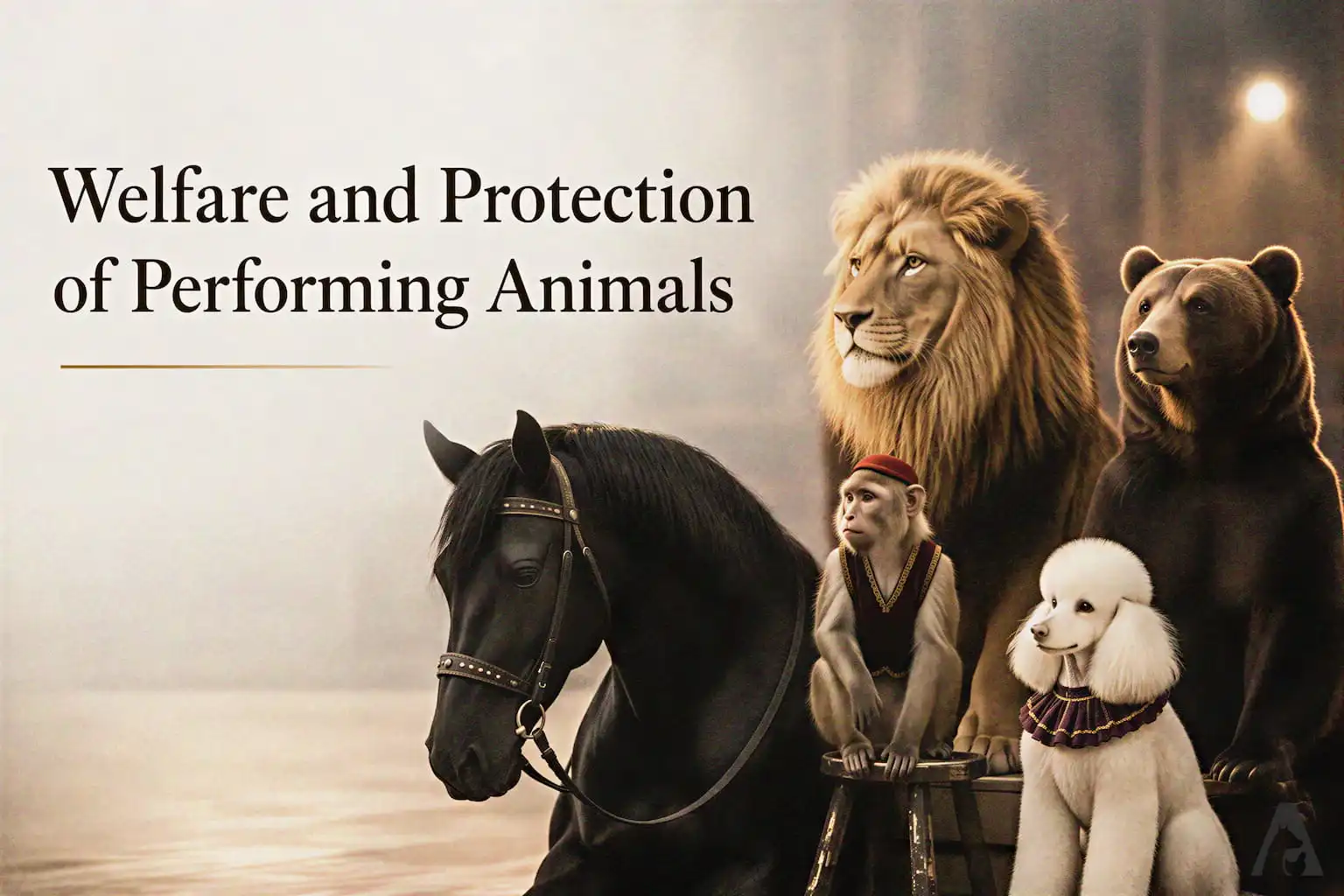
Animals trained to perform unusual acts for human entertainment may be subjected to cruel procedures, and the animals could be brutalized to perform painful movements. Of some importance is the imposition by humans of training in tricks that are demeaning to the animals and hold them up to ridicule. The list of animals considered performing animals includes bears, monkeys, tigers, panthers, lions, and bulls.
Performing Animal Welfare
Following good welfare practices not only reduces risks to a production but also protects animals and helps those using animals stay within the law.
- The production will be responsible for animals used at its direction. It can delegate day-to-day responsibility for animal care to staff or contractors with suitable expertise and experience, but will remain responsible for animal use under its instruction.
- An owner is always responsible for the care of their animal. An owner can delegate responsibility to another person, but it is the owner’s responsibility to ensure that whoever they delegate that responsibility to fully understands the requirements for providing for the needs of that animal and protecting it from harm.
- In addition, the production must ensure that while animals are used under its instruction, it makes clear who is responsible for each of the animals’ needs at all times.
- We suggest that the following roles are agreed upon in writing prior to the start of a production and that all staff on a production understand these roles.
Animal Handler (Trainer)
Each animal involved must have one or more persons who are responsible for providing for the needs of that animal at all times. This would include:
- Before on-site work has begun
- During transport to and from the production site
- At the production site
- During resting periods between performances
- After a production is complete
The animal handler, trainer, and any experts must have the right to voice any concerns about animals they think are becoming distressed, fatigued, anxious, fearful, uncontrollable, behaving abnormally, or at risk of harm. They should know that a performance can be halted immediately as a result. Work should not start again until everyone involved agrees that the animal has recovered.
Health and Safety Considerations for Animals
Many of the usual health and safety precautions that are relevant to production staff also apply to animals. For example, floors should not be slippery or should have non-skid mats, and fire extinguishers must always be available.
It is important that the site is secure and escape-proof, especially for animals that can fly or climb, and this should be regularly checked by the animal handler. Potential hazards need to be removed (e.g., low-hanging branches, machinery, obstacles on riverbeds) or made safe (e.g., electrical cables that could be chewed).
Platforms should be strong enough to support the animal’s weight, and flooring should be suitable for the animal and its speed of movement (e.g., using shock-absorbent material rather than tarmac for cantering or galloping horses).
If hazardous or toxic substances are involved in the production, washing facilities and emergency treatments for animals should be provided close to the site, and data sheets need to be completed and circulated as required. These must be given to the attending veterinarian in the event of an accident that results in an animal touching, breathing in, or eating such a substance.
The handler should stay with the animals at all times while on-site. Actors and other production staff should not be allowed to play with or feed an animal without the approval of the handler, who should supervise such interactions.
Production staff working close to animals should be aware that some species are highly sensitive to certain chemicals (e.g., rodents are very sensitive to strong odors).
Weather Conditions
If animals are going to encounter interchangeable weather conditions, either simulated or real (e.g., dust, rain, snow, blizzards, intense heat, or cold), they must be properly prepared and/or trained to cope with these conditions beforehand.
Animals need to be protected against injury, pain, distress, or discomfort (e.g., by providing ear and eye protection or sunscreen and/or by limiting the length of time the animal is exposed). Speak to an expert for information on methods and equipment appropriate to the species used.
Special Effects
Ideally, smoke and photographic dust should not be used around animals. If their use is considered essential, appropriate safety precautions need to be devised and implemented beforehand for each animal involved.
Carbon dioxide (used to produce dry ice) and artificial smoke can be harmful to and are disliked by many species. Their use should be avoided if possible when animals are present, and they should never be used around birds. If their use is considered essential (for use around species other than birds), appropriate safety precautions need to be devised and implemented beforehand. For further advice, speak to an expert.
Trip wires or similar devices and pitfalls should not be used for or around animals.
Using Animals Together
Animals should only work together if they are accustomed to each other and none of the animals show signs of aggression, fear, distress, or a desire to hunt. This is particularly important when predator and prey species are used together.
Animals from different social groups should not be mixed during performance or while waiting to go on set. Any introductions should be conducted by those responsible for the animals, with prior consent from all parties.
Where possible, camera techniques such as superimposition and mega-zoom should be considered as alternatives to mixing unfamiliar animals.
Animals must not be used to goad others in order to achieve an effect. Remember, it is illegal to stage fights between animals or between an animal and a person. All fighting and baiting scenes must be simulated. Males should not be worked with females of the same species when those females are in season or estrus.
Animal Housing
All animals must be provided with a suitable environment that meets their physical and psychological needs. This should be in place before the animal arrives at the production site. Every animal that will be working on a production for longer than 72 hours should be housed off-site when not in use. All animals involved (for any length of time) should be provided with on-site housing and/or rest areas.
The type of housing and rest area required will depend on the kind of animal being used. There should be enough separate rooms or securely partitioned areas to avoid unfamiliar animals being mixed together. Wherever possible, the animal’s normal housing should be used (e.g., a hamster or reptile in its own cage).
All housing should be:
- Secure (predator-proof, escape-proof, and preferably lockable)
- Clean and free from parasites and vermin
- Free from hazards (e.g., sharp projections and edges)
- Ventilated (or oxygenated for aquatic species)
- Sheltered from extremes of weather at a temperature, humidity, and light level suitable to the species of animal
- Sheltered from all noises to which the animal is sensitive so that they can rest undisturbed (some animals are able to hear ultrasound, while others are sensitive to infrasound—for more information, speak to an expert).
- Capable of providing a darkened sleeping period, where needed
- A comfortable resting area that all animals housed together can use at the same time
- A suitable amount of clean bedding material of a type suitable for the species and individual animals
All housing should allow an animal to:
- Lie fully stretched out (with the exception of certain species, such as long snakes that need a three-dimensional environment).
- Turn around without touching either the walls or the ceiling.
- Stand in their natural posture, move in their natural manner (e.g., walk, run, climb, swing), rest comfortably, and hide from human view or other animals in the enclosure.
- Animals should be allowed to express natural behaviors. This may require the provision of environmental enrichment, such as objects and substrates (e.g., bedding), or designing the housing to provide certain physical (e.g., perches) or environmental (e.g., humidity level) requirements.
Diet
- Animals should be given the same diet and feeding schedule as in their home environment unless they are being more active than normal, in which case they may need more food and water.
- Animals should be fed the right type and amount of food. This depends on the kind of animal as well as its condition, health status, age, and activity level or lifestyle.
- Animals should not be fed live vertebrate prey.
- An animal’s feeding, defecating, and urinating habits should be regularly monitored by the handler, and any irregularities should be reported to a veterinarian for advice.
Access to Water
- All animals need to have ready and frequent access to clean drinking water.
- Water should be provided in a manner with which the animal is familiar.
- Water consumption should be regularly monitored by the handler, and any abnormalities should be reported to a veterinarian.
- Access to water for bathing or swimming should not be withheld for longer than is normal for the species.
Exercise
- If animals can’t move fully in their enclosure (i.e., use their natural full range of movements, such as running and flying), they should be given the chance to do so at least once each day. Performance is not a substitute for exercise.
- It is important to remember that animals need to exercise their minds as well as their bodies. They should be given enough appropriate items to occupy them during the day (e.g., rodents should be given gnawing blocks; grazing animals should have food available for the greater part of the day and night).
Transporting Animals to the Production Site
Transport is known to be stressful for a wide range of animals, even those transported many times, and especially for animals that are particularly sensitive to it. It is essential to optimize conditions and keep transport to a minimum, both in terms of duration and frequency.
Animals should be sourced locally, if at all possible, or consideration should be given to moving a production as close to the animal’s home as possible. Journeys of more than eight hours should be avoided; if animals are transported over greater distances, rest days should be built into the route plan and schedule. Animals should also be given sufficient time to recuperate in an appropriate environment before being transported again.
All legal requirements that apply to the transport of animals between their usual home and production sites must be met, and statutory codes of practice should be followed.
- Those people transporting animals should obtain transport authorizations where necessary and keep records up to date.
- There are specific requirements that apply to moving animals for commercial use, which includes films and other productions.
- An expert can advise on all relevant health checks and disease control measures that need to be undertaken before animals from different locations are brought together.
- Sufficient time should be given to allow the required measures to take effect.
- Every animal needs to be checked for signs of injury, illness, distress, or fear immediately before and after transportation and should receive prompt treatment and/or rest as required. An animal should not be transported if it is showing any signs of injury, illness, distress, or fear.
- There should be regular scheduled breaks to give the animals drinking water and, depending on the type of animal, food, exercise, and the opportunity to eliminate.
- Transporters/drivers should be competent in the transportation and handling and/or movement of the type of animal they are transporting. Only people skilled in loading and unloading the type of animals being transported should do this job.
- Animals should be loaded and unloaded calmly and left to make their own way in and out of the vehicle (within confined channels or secure areas). If possible, animals transported in containers should be unloaded in these as well.
- Electric shock devices or other aversive methods must not be used to move, load, unload, or control animals.