CONTENT
Summer and Winter Management of Poultry Birds
Seasonal changes can significantly influence poultry performance by affecting feed intake, metabolism, water consumption, and overall productivity. Effective environmental management helps birds adapt to periods of heat and cold while minimizing physiological stress and maintaining flock performance. Appropriate housing, ventilation, nutrition, and management practices are therefore essential components of poultry production throughout the year.
Chickens are very sensitive to environmental temperature. Their growth, egg production, and health are severely affected during extremes of weather. Therefore, within economically feasible limits, an ideal temperature should be provided to the birds in order to obtain optimal growth rates and returns.
For optimum feed efficiency, an ideal temperature range of 70–75°F (21–24°C) is needed. However, in tropical climates, this temperature range may be obtained only during winter.
During other seasons, especially summer, the ambient temperature rises several degrees above the ideal range, causing severe reductions in growth rate and egg production and thereby leading to substantial economic losses for poultry producers.
With proper summer management, these losses can be overcome to a great extent.
Methods of Heat Loss
During the summer months, when daily temperatures are high, it becomes critical for birds to dissipate body heat to the surrounding environment. Poultry do not sweat and therefore must dissipate heat in other ways to maintain their body temperature at approximately 106°F (41°C).
Body heat is dissipated to the surrounding environment through:
- Radiation
- Conduction
- Convection
- Evaporation
The first three avenues are known as sensible heat loss. These methods are effective when the environmental temperature is below or within the thermoneutral zone of the bird (55–75°F or 12–24°C).
The proportion of heat lost through radiation, conduction, and convection depends on the temperature difference between the bird and its environment. The bird loses heat from surfaces such as the wattles, shanks, and unfeathered areas under the wings. To maintain body temperature through sensible heat loss, the bird does not need to drastically alter its normal behavioral patterns, feed intake, or metabolism.
The purpose of poultry house ventilation is to maintain a sufficiently high air velocity or a sufficiently low temperature in the house so that the birds can maintain their body temperature through sensible heat loss. Once the environmental temperature reaches approximately 77°F (25°C), the method of heat loss begins shifting from sensible to evaporative heat loss, as shown in the figure.
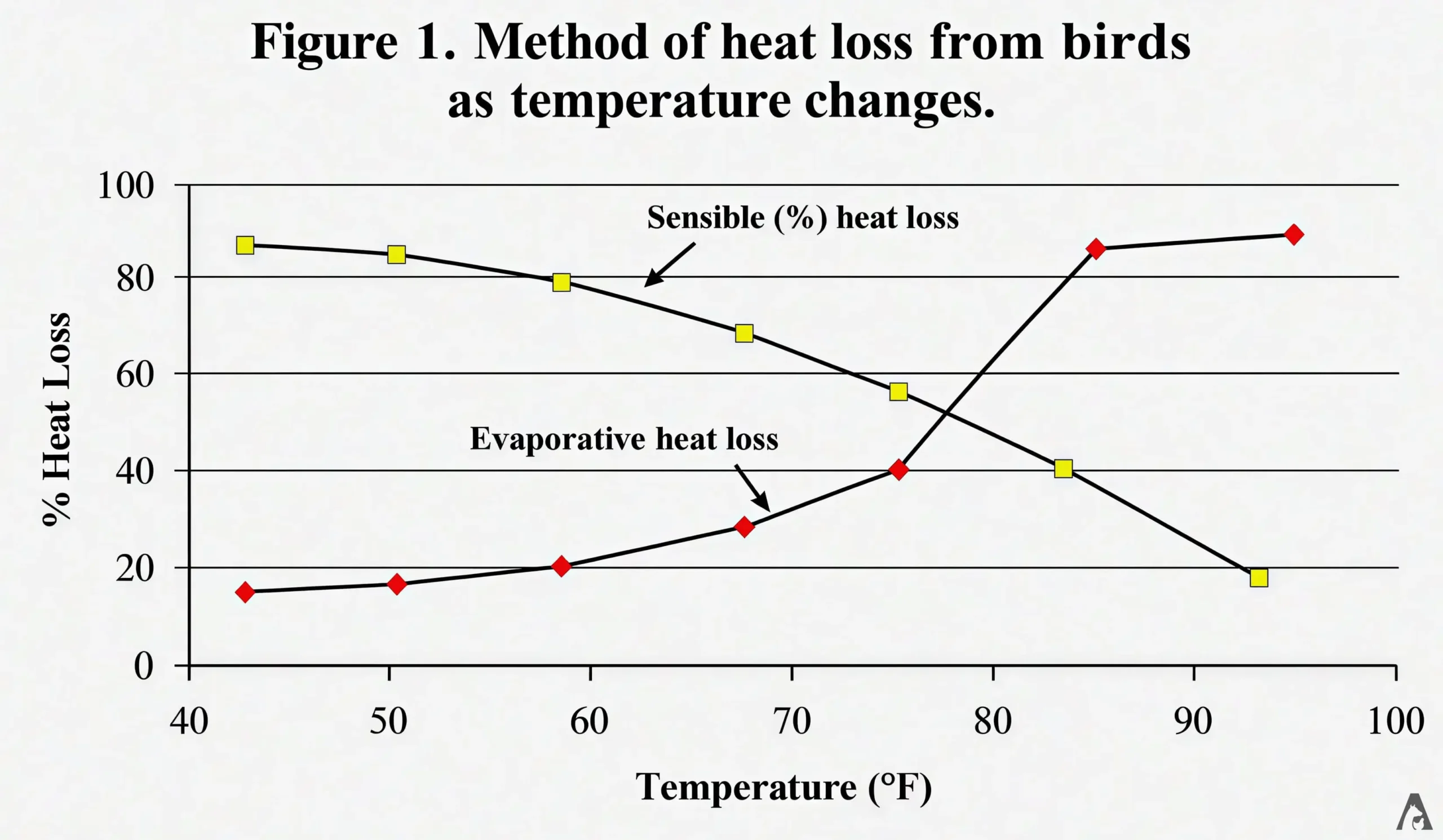
Dissipation of body heat through the evaporative process requires the bird to expend energy by panting (hyperventilation), which begins to occur at about 80°F.
Temperature Zones
The comfort zone is defined as the temperature zone in which birds are able to keep their body temperature constant with minimal effort. This temperature zone also depends on the feeding level and housing conditions. The behavior of birds will change when temperatures rise above the comfort zone, as they will begin to pant and change their body position.
When temperatures are below the comfort zone, birds will also change their body position and huddle together. The thermoneutral zone is defined as the temperature zone in which birds are able to keep their body temperature constant with the help of physical heat regulation. This temperature zone depends on the feeding level, housing conditions of the birds, and other factors. The lowest temperature in the thermoneutral zone is called the lower critical temperature (LCT).
If the temperature falls below this level, the bird will begin to use feed energy to warm itself (i.e., maintain its body temperature) and will consequently consume more feed. The highest temperature in the thermoneutral zone is called the upper critical temperature (UCT).
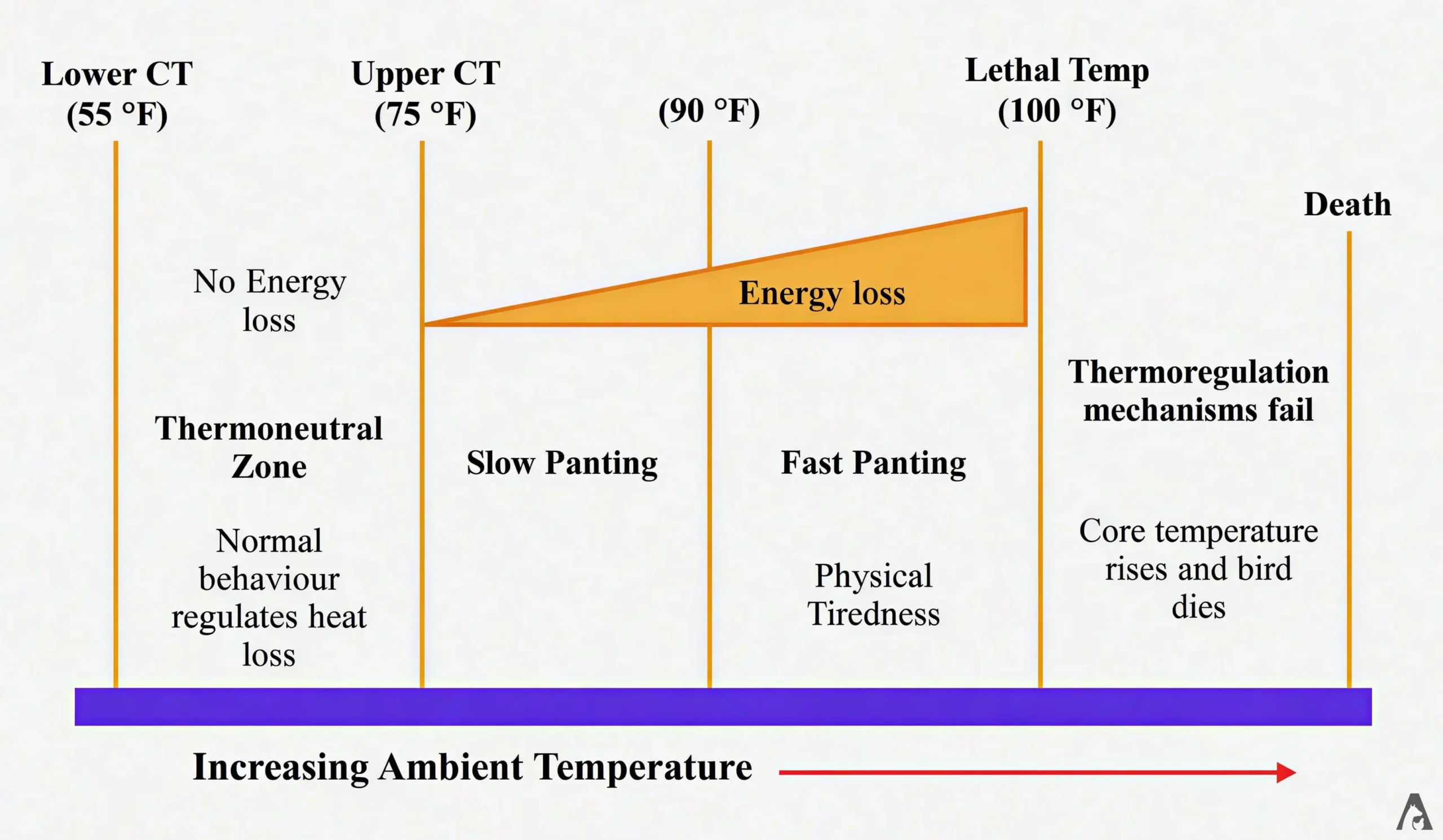
If the temperature rises above this level, the birds can no longer dissipate their heat effectively. They will begin to consume less feed, and production will decline as a result.