CONTENT
Heat Stress in Poultry: Effects and Management
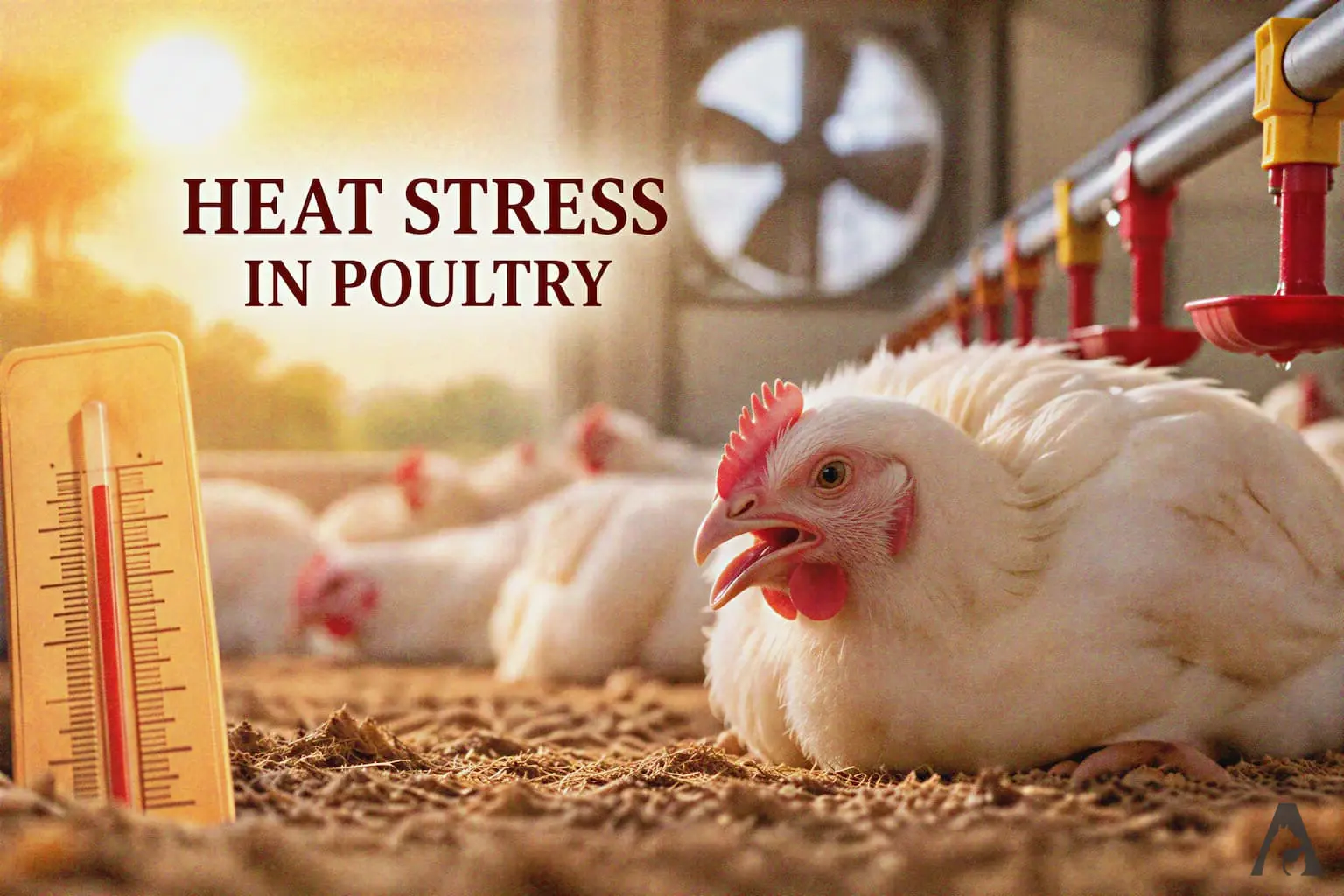
Heat stress is a major environmental challenge in poultry production, particularly in regions with prolonged periods of high ambient temperature and humidity. Because poultry have limited physiological mechanisms for dissipating excess body heat, unfavorable thermal conditions can affect their health, welfare, productivity, and overall flock performance.
Understanding the response of birds to thermal stress is therefore important for implementing effective nutritional, housing, and management strategies during hot weather.
Adverse Effects
The various physiological and pathological changes that take place in the flock during high summer temperatures are as follows:
- Energy intake and thereby feed consumption and intake of other nutrients decrease as the environmental temperature increases. This is because birds need less energy for maintenance of body temperature when the ambient temperature is high. Consequently, the growth rate and body weight of birds will decrease.
- There will be nearly a two-fold increase in the water consumption of birds during summer because, during high environmental temperatures, the major way to lose excess heat produced in the body is through the loss of water vapor in expired air.
- High ambient temperature increases the respiratory rate and body temperature. Since there are no sweat glands in poultry, they will start panting vigorously in order to lose the excess body heat produced. As the outside temperature increases, heat production as well as heat loss from the body decreases.
- For every 1°C increase in ambient temperature, heat production in the body decreases by about one percent.
- On the other hand, water loss through respiration increases with an increase in ambient temperature.
- High environmental temperature, on the other hand, decreases oxygen consumption, blood pressure, pulse rate, thyroid size and activity, blood calcium level, and body weight.
- Problems with ectoparasites will be more common during summer and the following monsoon season.
- Moreover, high environmental temperature associated with high relative humidity (>70%) may lead to outbreaks of coccidiosis.
- Low feed intake and thereby low coccidiostat consumption will further aggravate coccidiosis outbreaks.
- The incidence of Fatty Liver Hemorrhagic Syndrome and other metabolic disorders such as heat stroke and liver rupture is higher during summer, especially in heavy broilers.
- Birds will shed more feathers during summer in order to lose excess body heat.
- At high environmental temperatures nearing the body temperature of the birds, vaporization of body water through respired air is the only way to lose a substantial amount of heat from the body. However, this is possible only when the inspired air has very low moisture levels. If both temperature and relative humidity are high, birds will not be able to lose excess body heat and may ultimately die of heat prostration.
- Fatty birds succumb first, perhaps because their air sacs are relatively constricted and thereby unable to evaporate moisture and produce cooling efficiently.
- Caged birds and birds reared on slatted floors will suffer more due to high environmental temperatures than birds reared on litter floors because birds on litter can cool themselves to some extent by dusting themselves in the litter.
- Heavy mortality due to heat stroke will be observed among heavy broilers in the late afternoon and evening.
- Temperature affects egg breakage. Elevated environmental temperature is associated with a decrease in shell quality.
- The reduction in shell thickness caused by heat stress is apparently due to respiratory alkalosis, which lowers the partial pressure of carbon dioxide in the lungs and raises blood pH.
- As the ambient temperature increases above 26°C, egg size declines.
Alleviating Measures
The above adverse effects due to high environmental temperatures can be overcome to a considerable extent by proper management of the flock, housing, feed, etc., during summer, as indicated below:
- With proper roofing, the temperature inside poultry houses can be kept 5°–10°C below the outside temperature.
- Thatched roofing about six inches thick provides better comfort to birds during summer than other roofing materials. However, due to the risk of fire, lower durability, greater depreciation, and rodent problems, thatched roofing is not preferred, especially on large farms.
- On large farms, aluminum roofing is preferred due to its durability, resale value, and heat-reflecting properties.
- In non-insulated houses, the roof must be raised to a sufficient height above floor level because the higher the roof, the cooler the poultry house will be.
- The minimum height between the floor and the roof must be 4.0 and 3.5 meters at the ridge and eaves, respectively.
- The roof eaves should project at least one meter on all four sides as an overhang to prevent direct sunlight and rainwater from entering the house.
- Provide “ridge ventilation” such as a “half-monitor” or “full monitor.”
- Furthermore, where summers are very severe, the roof may be insulated either by covering it with a layer of thatch or by painting the upper surface of the roof with white paint, such as white waterproof paint, or aluminum paint to reflect the sun’s rays. The inner surface may be painted with black paint or tar to absorb heat from within.
- In the tropics, to prevent direct sunlight from entering poultry houses, the long axis of the houses should face north and south; i.e., the houses should be oriented east to west, with a slight tilt toward the south on the eastern side and toward the north on the western side. This type of orientation also prevents severe drafts and rainwater from entering poultry houses during the monsoon season.
- Open-type, cross-ventilated housing is recommended in the tropics. Except for a 20 cm high wall, all four sides up to the roof should be provided with 12 mm, 18-gauge chicken wire mesh or 25 mm chain-link mesh.
- As far as possible, the width of poultry houses should not exceed 10 meters. If the width of the poultry house exceeds 10 meters, cross-ventilation alone may not be effective in providing adequate airflow. In such cases, “ridge ventilation” in the roof or mechanical ventilation should also be provided.
- Provide tunnel ventilation along with cooling pads and/or foggers to produce evaporative cooling.
- During hot summers, mechanical ventilation with evaporative coolers should operate from 10 a.m. to 6 p.m. However, evaporative coolers will be less effective in areas with high humidity.
- Sprinklers may be installed on top of the roof and operated continuously from 10 a.m. to 6 p.m. to cool the roof.
- Foggers may be installed inside the broiler house and operated during hot, dry weather to provide evaporative cooling.
- Grow “fast-growing” shade trees around poultry houses to reduce the severity of summer heat waves and also to reduce strong wind drafts during the monsoon season.
- Rear relatively more heat-tolerant strains of broilers suitable for tropical climates.
- During hot weather, birds consume approximately twice the amount of water they normally consume. Therefore, double the watering space in poultry houses during summer. Provide plenty of fresh, clean, and cool drinking water during hot weather. Water pipes should not be exposed to direct sunlight. Change the water two or more times a day if it becomes warm.
- To encourage feed intake in birds during summer, reduce the energy content of the feed by about 10 percent.
- It is also advisable to add one or two percent protein and slightly increase the levels of vitamins, minerals, essential amino acids, and coccidiostat.
- Since feed consumption generates more body heat, avoid feeding broilers over four weeks of age during hot weather.
- If automatic winchable feeders are used, lift the feeders between 9 a.m. and 6 p.m. To compensate for this loss in feeding hours, feed broilers during nighttime and the cooler hours of the day.
- Nearly 10 to 15% of the calories (energy) in the feed derived from carbohydrates and protein may be replaced by energy from fat/oil by adding 2 to 3% oil or fat. However, this should not increase the total calories in the feed and should only replace energy of carbohydrate origin.
- Large farms in hot and dry climates may opt for environmentally controlled houses.
- Drugs and chemicals such as electrolytes, ascorbic acid, sodium bicarbonate, tranquilizers, sodium salicylate, paracetamol, chlorpromazine hydrochloride, and cyproheptadine hydrochloride may be administered through feed or water to help birds withstand hot weather.
- Thick and wet litter produces more heat. Therefore, during summer, litter thickness should not exceed 6 cm. Moreover, remove caked and wet litter immediately from the poultry house to prevent excess heat production.
- Avoid overcrowding. Increase floor space by at least 10% during summer.
- If mechanical ventilation is provided, increase the airflow rate and air exchange by at least 25% during summer.
- Do not disturb the birds or cause them to panic during hot weather.
- For birds kept in cages, the center height of the building should be a minimum of 14 feet.
- Addition of 0.48 percent potassium chloride to drinking water has been reported to reduce heat stress in layers.
- Add 1 kg of sodium bicarbonate to one metric ton of feed to reduce heat stroke and increase shell thickness.