CONTENT
Poultry Rearing Systems: Intensive, Semi-Intensive and Scavenging Systems
Poultry rearing systems vary according to the level of management, housing, feeding, health care, infrastructure, and production intensity. The major systems include intensive, semi-intensive, and scavenging systems, each differing in flock size, housing conditions, feed resources, health programs, marketing, and technology.
Housing in modern poultry production is an important input, accounting for a major component of the initial capital investment. In modern poultry enterprises, structures are constructed and designed with consideration for bird welfare and production efficiency. Housing for rural poultry is at a rudimentary stage. Where housing is provided for village chickens, the houses are made with locally available materials such as wood, mud bricks, sugarcane leaves, bamboo, and cereal stovers.
Systems of Poultry Rearing
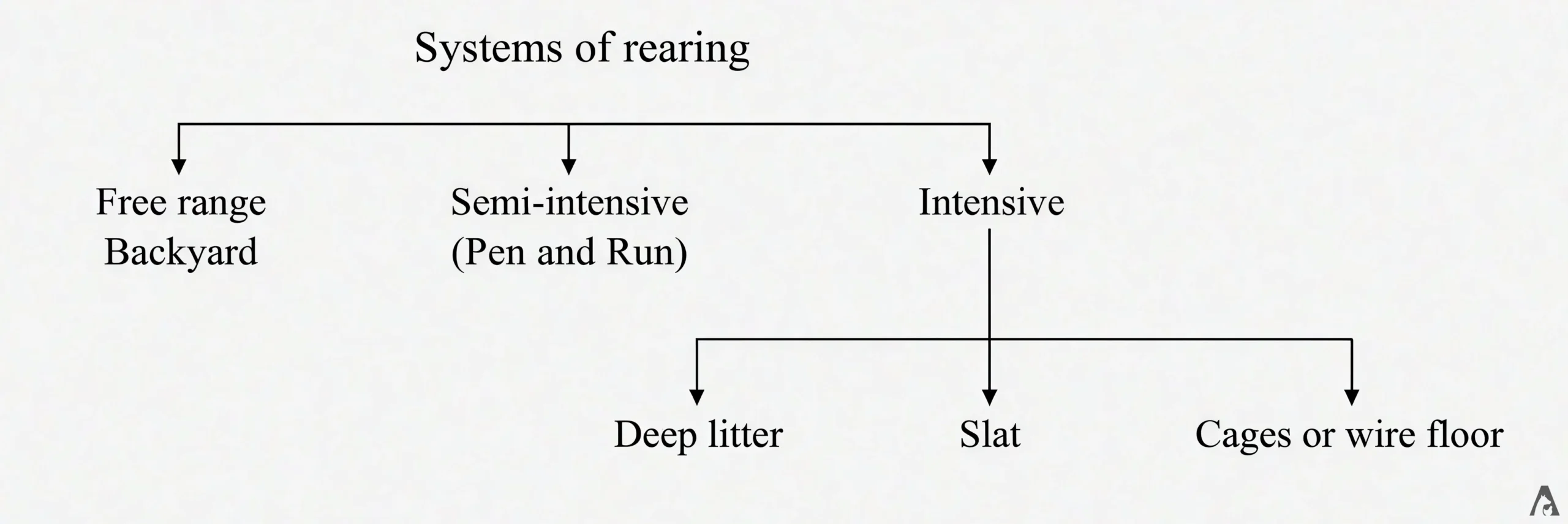
Characteristics of Various Systems of Poultry Production
| Characteristics | Intensive | Semi-intensive | Scavenging |
|---|---|---|---|
| Breed and flock size | Specialized breeds: 1,000–50,000 | Specialized and dual-purpose breeds: 50–200 | Local indigenous type: < 50 |
| Housing | Modern housing, generally with concrete walls and a regulated internal environment | Varies from modern houses to simple housing made from locally available materials | Specific poultry houses are rare |
| Feed resource | Commercially compounded feeds | Commercially compounded feeds, homemade mixtures, and scavenging | Scavenging and occasional feeding with home grains and household refuse |
| Health program | Standard and regular poultry health program | Disease control and health programs at varying levels | No regular health program or disease control measures |
| Market | Integrated system of input and output distribution | Input and output distribution is based on existing trading centers | No formal marketing channels |
| Infrastructure | Water, electricity, and communication available | Modest infrastructure depending on proximity to urban centers | Underdeveloped infrastructure |
| Product storage and processing | Products refrigerated; dressed birds and table eggs refrigerated | Minimum refrigeration; occasional dressing of birds | No refrigeration; sales of live birds and eggs |
| Technology/information | Formal training and extension services available; information disseminated through producer and consumer associations | Moderate formal training and extension services | Local knowledge, with moderate or no extension services |