
CONTENT
Poultry Medication and Routes of Drug Administration: Water, Feed, and Injection
Effective medication practices are essential for maintaining flock health and ensuring safe, consistent treatment outcomes. The choice of administration route depends on factors such as flock condition, drug characteristics, and practical considerations during treatment.
Judicious use of medications is an important part of poultry management. However, improper use of medications can be costly, ineffective, and sometimes harmful.
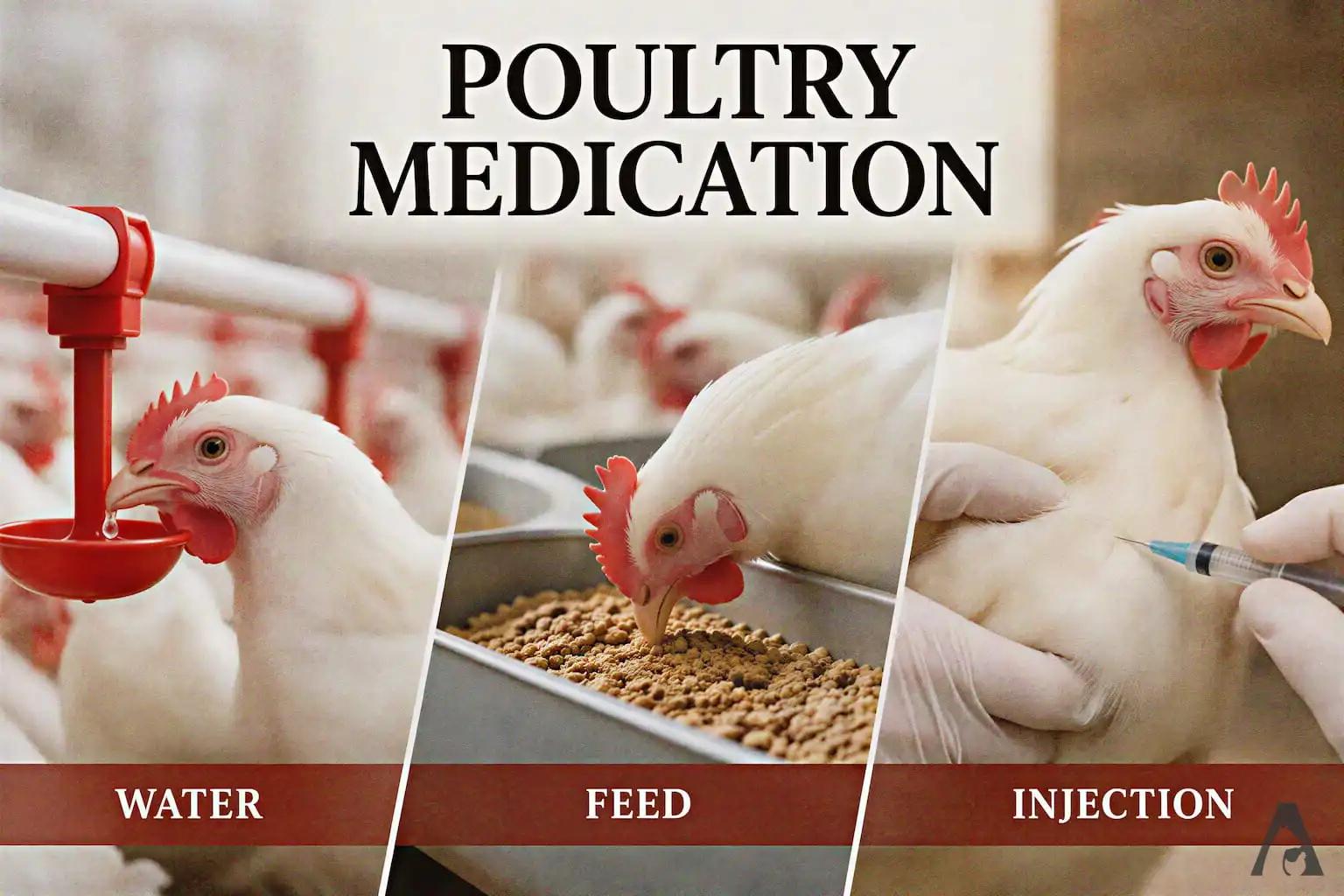
Proper use requires consideration of:
- Class of bird (breeder, layer, or broiler)
- Age of the bird
- Potential residues
- Disease diagnosis
- Sensitivity of the disease agent to the medication
- Other ongoing treatments
Routes of Administration of Drugs
Through Water
Administration of drugs in drinking water is the preferred method of delivery in most cases. During a disease outbreak, some birds may not eat, but they will often continue to drink.
Chickens can be encouraged to drink by removing water for one to a few hours before administering medication. However, water removal must be carefully monitored to avoid dehydration. Administration of medication in the water requires consideration of the factors affecting water consumption.
The drugs used for water medication either form solutions or suspensions when added to water. Solutions are especially well suited for administration in drinking water because they completely dissolve in water.
Through Feed
Apart from water-soluble drugs, water-insoluble drugs can also be administered through feed. The amount of medication added to the feed is calculated based on the drug’s optimal dose and an assumed average feed consumption for the type of bird being medicated.
Injections
Medications are rarely given to commercial poultry by injection because, although it is a highly effective method of drug delivery, it is very labor-intensive.
In addition, training workers to administer injections properly may be time-consuming and expensive. Injections are usually given subcutaneously or intramuscularly in poultry.
Subcutaneous injections are commonly given under the skin of the neck or in the skin fold of the leg. The thigh and leg are commonly used for intramuscular injections.