CONTENT
Poultry Housing Systems: Types, Advantages and Disadvantages
Poultry housing systems are designed to provide birds with suitable environmental conditions, adequate space, and access to essential resources while supporting efficient production and management. The choice of housing system depends on several factors, including land availability, cost, type of farming activity, climatic conditions, and labor availability. Broadly, poultry housing systems are classified into free-range or extensive, semi-intensive, and intensive systems.
Poultry can be housed under different systems based on the following factors:
- Availability of land
- Cost of land
- Type of farming activity
- Climatic conditions
- Availability of labor
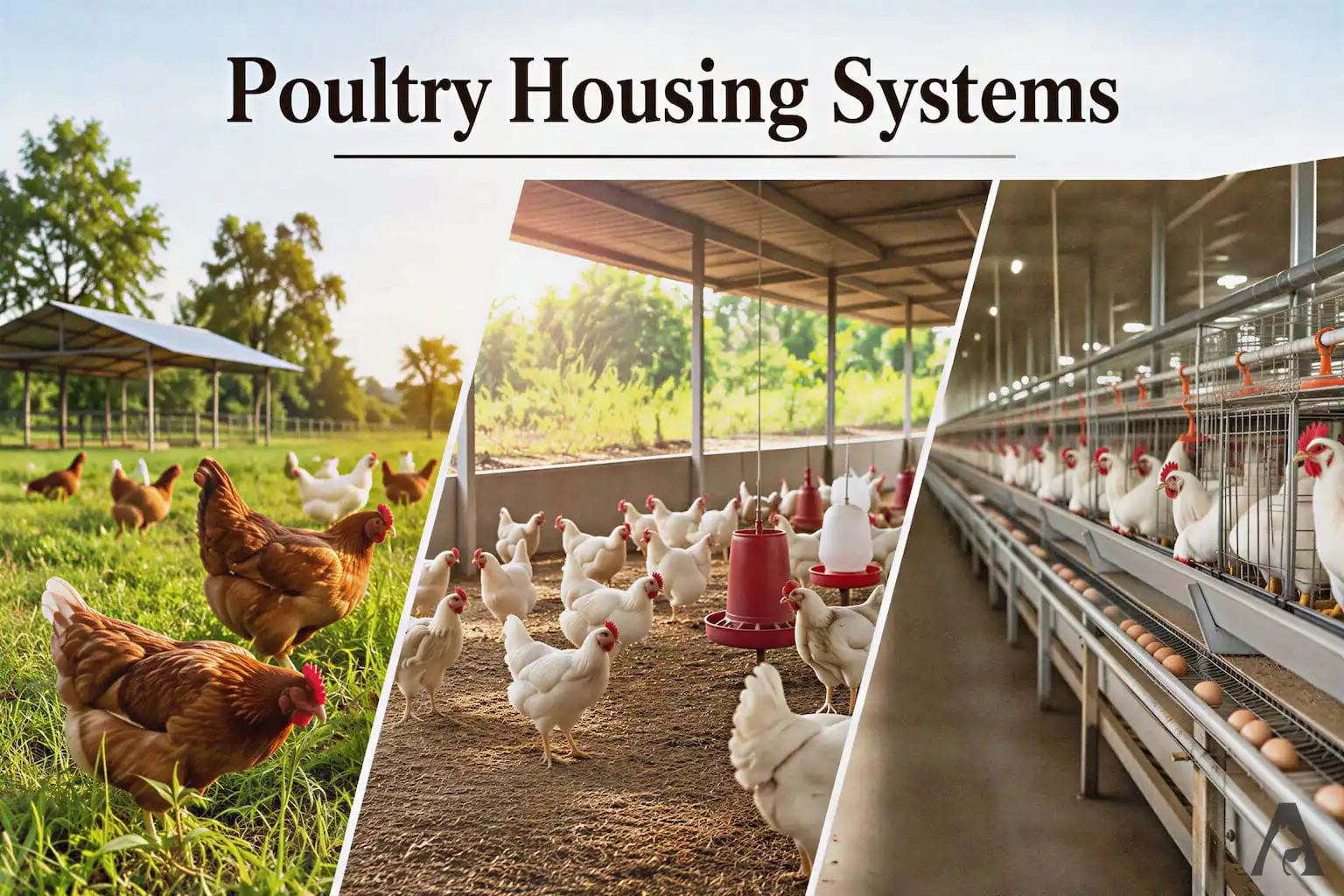
Broadly, poultry housing systems are classified into three systems:
- Free-range or extensive system
- Semi-intensive system
- Intensive system
- Deep-litter system
- Slatted-floor system
- Slat-cum-litter system
- Cage system
1. Free-Range or Extensive System
This system is adopted only when adequate land is available to ensure the desired stocking density while avoiding overcrowding. About 250 adult birds can be reared per hectare. A range provides shelter, greens, feed, water, and shade. Foraging is the major source of feed for birds. Shelter is usually provided by temporary roofing supported by ordinary poles. The fields are generally used on a rotational basis after harvesting of crops by moving birds from one field to another, depending on the cropping program. All categories of birds can be reared in this system. This system is commonly preferred for organic egg production.
Advantages
- Less capital investment.
- Cost of housing is low.
- Feed requirements are lower since birds can consume a fairly good amount of feed from grassland.
- Soil fertility can be maintained.
Disadvantages
- Scientific management practices cannot be adopted.
- Eggs may be lost when laid in dense grass unless special nests are provided.
- Losses due to predatory animals are greater.
- Wild birds may introduce diseases unless proper care is taken.
2. Semi-Intensive System
As the name indicates, birds are reared partly in houses and partly on the ground or range, i.e., birds are confined to houses at night or as needed and are also given access to runs. The houses have solid floors, while the runs consist of outdoor areas. The success of rearing depends on maintaining the condition of the runs to reduce contamination. Runs can also be used on a rotational basis. The average stocking density for adult birds is 750 per hectare. This system is commonly adopted for duck rearing. Feeding and watering facilities are provided in the pen.
Advantages
- More economical use of land compared with the free-range system.
- Protection of birds from extreme climatic conditions.
- Scientific management practices can be controlled to some extent.
Disadvantages
- High cost of fencing.
- Need for routine cleaning and removal of litter material from the pen.
3. Intensive System
Birds are totally confined to houses, either on the ground/floor, on wire-netting floors in cages, or on slats. It is the most efficient, convenient, and economical system for modern poultry production involving large numbers of birds.
Advantages
- Minimum land is required for farming.
- Farms can be located near market areas.
- Day-to-day management is easier.
- Production performance is higher as more energy is conserved due to restricted movement.
- Scientific management practices such as breeding, feeding, medication, culling, etc., can be applied easily and accurately.
- Sick birds can be detected, isolated, and treated easily.
Disadvantages
- Bird welfare may be affected. Birds cannot perform natural behaviors such as roosting, spreading their wings, and scratching the floor with their feet.
- Since they are not exposed to outdoor sunlight or external feed sources, all nutrients should be provided in a balanced manner to avoid nutritional deficiency diseases.
- There is a greater chance of disease spread.