CONTENT
Poultry Deep Litter System: Advantages, Disadvantages and Management
The poultry deep litter system is a common method of housing birds in which birds are maintained on a layer of litter material inside the poultry house. Proper litter management is essential for maintaining bird health, controlling moisture and ammonia, and ensuring efficient decomposition of litter and droppings. This article covers the advantages, disadvantages, built-up litter, litter management, nutrient recycling, and qualities of good litter material.
In this system, the birds are kept inside the house at all times. Arrangements for feed, water, and nests are made inside the house. The birds are kept on suitable litter material at a depth of about 3” to 5”. The word litter is used for fresh litter material spread on the floor. Usually, rice hulls, sawdust, peanut hulls, chopped rice straw, or wood shavings are used as litter materials.
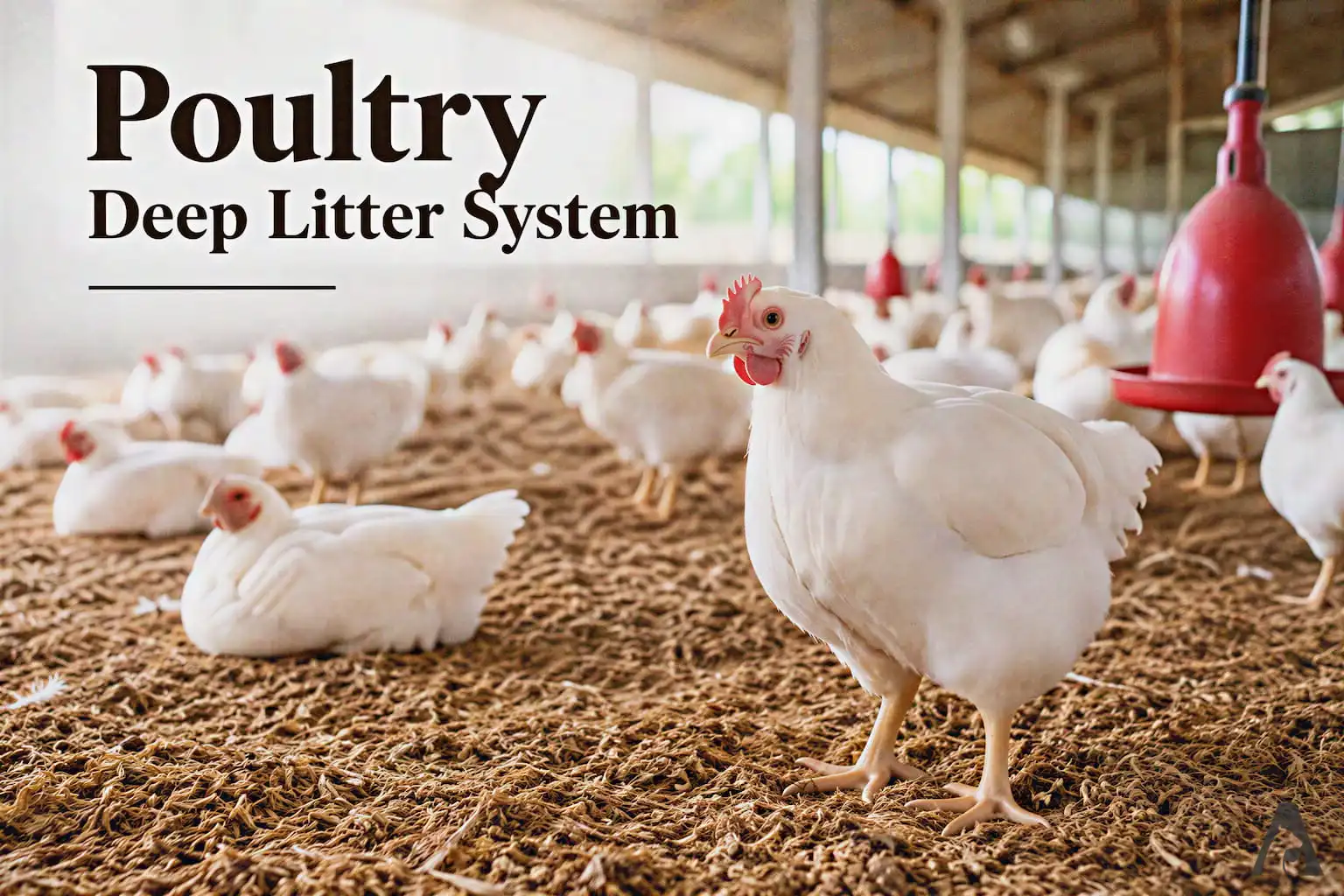
This arrangement saves labor involved in frequent cleaning of fecal matter (droppings); however, it requires periodic stirring. The litter is spread on the floor in layers of 2” in height every two weeks until the required depth is achieved.
Advantages
- Vitamin B2 and Vitamin B12 are made available to birds from the litter material through bacterial action.
- The welfare of birds is maintained to some extent.
- The deep litter manure is a useful fertilizer.
- There is less nuisance from flies compared with the cage system.
Disadvantages
- Because of direct contact between birds and litter, bacterial and parasitic diseases may be a problem.
- Respiratory problems may develop due to dust from the litter.
- The cost of litter is an additional production expense.
- Faults in ventilation can have more serious consequences than in the cage system.
The Built-Up Litter
Deep litter or built-up litter is the accumulation and decomposition of litter material and excreta until it reaches a depth of 8” to 12”, after starting with an initial depth of 3” to 5”. Bacterial action decomposes the litter and excreta into a crumbly form, and heat is produced during decomposition, which keeps the litter dry and warm. If the amount of droppings exceeds the amount of litter, fresh litter should be added to reduce the amount of exposed droppings.
Periodic stirring of the litter should be carried out for effective functioning of built-up litter. After one year, the litter is changed, and the decomposed litter is used as good-quality manure. The best built-up litter should be dry, friable, and free from objectionable odors.
Litter Management
Although litter will function more efficiently on an earthen floor, a concrete floor is advised for effective disinfection at the end of each batch. About 3-5” of litter should be put into the house initially and, as this breaks down, more should be added until a depth of about 8-12” is reached. Before adding fresh litter material, remove caked and wet litter material. Rake the litter thoroughly to break up the clumps with the help of a litter rake and allow it to dry.
Sprinkle a mixture of wood ash and fertilizer-grade superphosphate in a ratio of 4:1, at a rate of 5 kg per 10 m2 of area, before raking the litter to prevent ammonia gas release from the litter. The addition of slaked lime may be avoided because it increases the pH of the litter, which in turn releases more ammonia from the litter and also favors the growth of E. coli, one of the common pathogens of poultry.
At the beginning, the litter contains only 12% moisture. If the moisture level exceeds 30% due to poor ventilation, too many birds, irregular stirring, or a damp floor, the litter will cease to function efficiently because the manure-digesting bacteria can be active only within a moisture level of 30% in the litter.
Sometimes, many birds will have “balls” made of litter material at the tips of their claws. Ball formation is a sign of poor litter management. Built-up litter has a very important role in providing warmth to the birds in winter. In winter, the litter depth can be increased to 10-12”, while in summer, it may be reduced to 2.5-4”.
Recycling of Nutrients in Deep-Litter System
Droppings from chickens, when mixed with litter, contribute to the synthesis of riboflavin (Vitamin B2) and Vitamin B12 through chemical and bacterial actions. Built-up litter also contains niacin, phosphorus, potassium, magnesium, sodium, and calcium. Birds in deep-litter systems often peck at and eat a small quantity of litter material, which contains these nutrients.
This phenomenon is known as recycling. Even if the poultry feed is slightly deficient in some nutrients, birds on deep litter may not show deficiency symptoms due to the recycling of nutrients.
In cage rearing, the recycling of nutrients is completely absent. Therefore, all nutrients, including calcium, phosphorus, and sodium, must be balanced meticulously in the poultry ration.
Qualities of Good Litter Material
- It must absorb moisture from droppings quickly.
- It must release moisture and dry rapidly.
- It must have a low tendency to form cakes.
- It must be free from mold growth.
- It must be free from sharp objects and other objectionable materials.
- It must be non-toxic, inert, and compressible.
- It should possess good insulating properties and protect chicks from extremes of climate.
- It must be inexpensive and readily available.
- It must be biodegradable, supply some nutrients to the birds, and form good-quality manure later.
- It must have a medium particle size and be soft and lightweight.
The quality of a litter material is tested by picking up a handful of litter material and pressing it tightly. A good litter material is one that breaks apart when the hand is opened, whereas litter material with excessive moisture will form a ball in the hand. Excessively dry litter material causes dustiness in the poultry house.