CONTENT
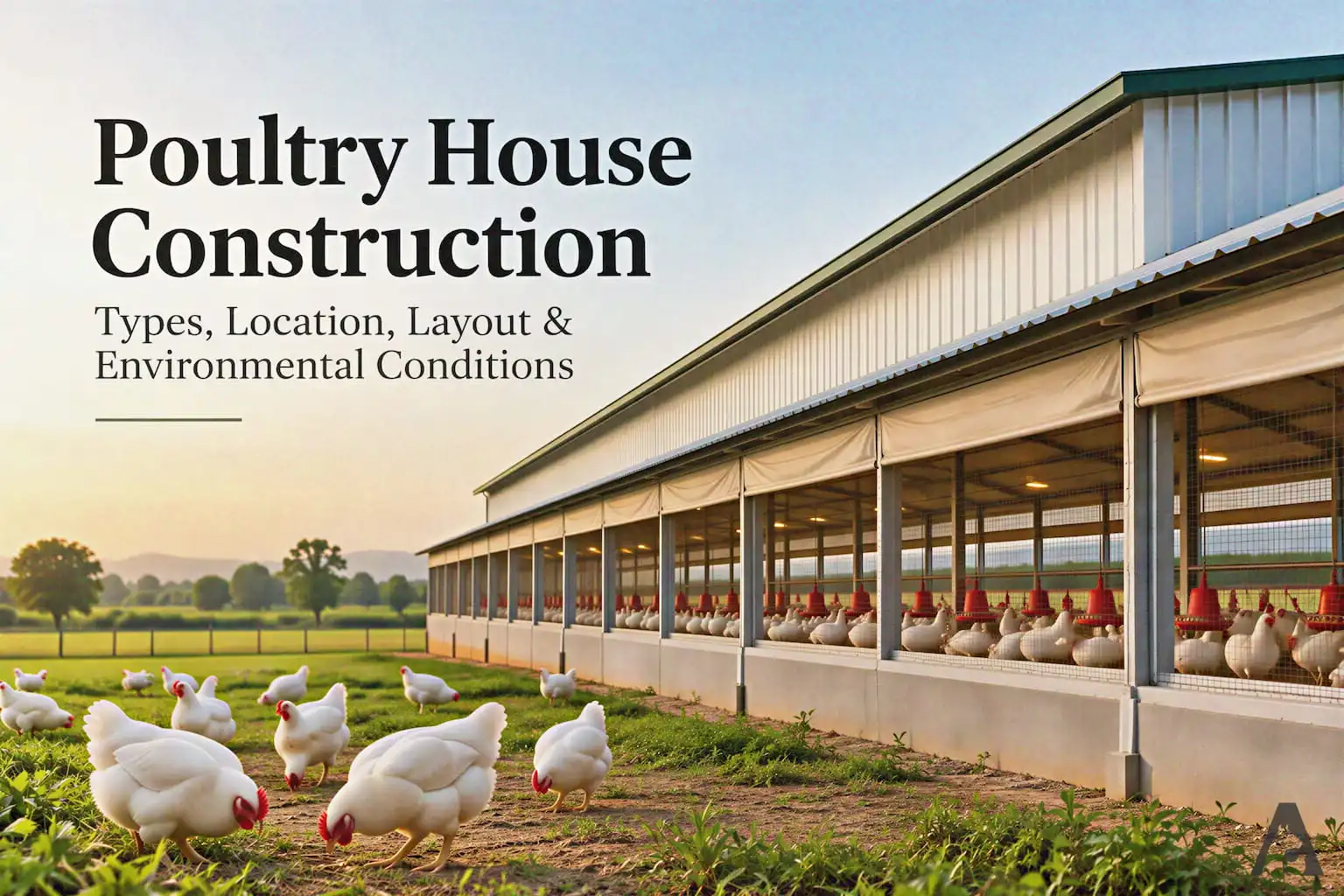
Poultry House Construction: Types, Location, Layout & Environmental Conditions
Poultry house construction is an important aspect of poultry production because proper housing provides birds with a suitable environment for growth, production, health, and overall performance. The design and layout of a poultry house should be planned according to the type and age of birds, climatic conditions, ventilation requirements, disease control measures, and ease of management.
This article discusses the need for poultry houses, different types of poultry houses, their location and layout, and the optimal environmental conditions required for rearing broilers.
Need for Poultry House
- To protect birds from adverse climatic conditions
- To ensure easy and economical operation
- To ensure scientific feeding in a controlled manner
- To facilitate proper microclimatic conditions in the immediate vicinity of the birds
- For effective disease control measures
- To ensure proper supervision
Different Types of Poultry Houses
- Brooder/Chick House: It is used to brood and rear egg-type chicks from 0 to 8 weeks of age.
- Grower House: It is used to rear egg-type birds from 9 to 18 weeks of age.
- Brooder-Cum-Grower House: Here, birds are reared from 0 to 18 weeks of age (the entire brooding and growing period of egg-type chickens).
- Layer House: It is used to rear birds over 18 weeks of age, usually up to 72 weeks of age.
- Broiler House: It is used to rear broilers up to 6 weeks of age.
- Breeder House: It is used to maintain both male and female breeders at an appropriate sex ratio.
- Environmentally Controlled (EC) House: In this type of house, the entire environment is manipulated in such a way as to provide optimum conditions for bird growth.
Optimal Environmental Conditions for Rearing Broilers
- Temperature: 22-300C (70-850F)
- Relative Humidity: 30-60%
- Ammonia Level: Less than 25 ppm
- Litter Moisture: 15-25%
- Air Flow: 10-30 meters/minute
Location
- The poultry house should be located away from residential and industrial areas.
- It should have proper road access.
- It should have basic amenities such as water and electricity.
- Farm labor should be available at relatively lower wages.
- The poultry house should be located in an elevated area, and there should be no waterlogging.
- It should have proper ventilation.
Layout of Poultry Farm
A small poultry farm does not require any special layout because it involves the construction of only one house. Medium- and large-scale farms require special consideration for the placement of buildings within the farm premises.
The basic principles to be observed for the layout are:
- The layout should not allow visitors or outside vehicles near the birds.
- The sheds should be located so that fresh air first passes through the brooder shed, followed by the grower and layer sheds. This helps prevent the spread of diseases from layer houses to brooder houses.
- There should be a minimum distance of 50-100 feet between the chick and grower sheds, and the distance between the grower and layer sheds should be a minimum of 100 meters.
- The egg storage room, office, and feed storage room should be located near the entrance to minimize the movement of people around the poultry sheds.
- The disposal pit and sick room should be constructed only at the extreme end of the site.