CONTENT
Poultry-Fish Culture: Fish Stocking and Management Practices
The application of poultry manure in the pond provides a nutrient base for a dense bloom of phytoplankton, particularly nanoplankton, which helps promote intense zooplankton development.
Zooplankton have an additional food source in the form of bacteria that thrive on the organic fraction of the added poultry droppings. Thus, this indicates the need for stocking phytoplanktophagous and zooplanktophagous fish in the pond.
In addition to phytoplankton and zooplankton, there is a high production of detritus at the pond bottom, which provides a substrate for the colonization of microorganisms and other benthic fauna, especially chironomid larvae. Another addition is the macrophyte-feeding grass carp, which, in the absence of macrophytes, can be fed green cattle fodder grown on the pond embankments.
The semidigested excreta of this fish provide food for bottom feeders. For the exploitation of the above food resources, polyculture of major carps and three exotic carps can be practiced in fish-cum-poultry ponds. The pond is stocked after the pond water is properly detoxified.
Considerations for Selection
- The selected species should be compatible with each other.
- The species and their combination ratios should be adjusted according to the amount of feedstuff and manure expected to be made available by the other subsystem.
- As far as possible, the species should be fast-growing.
- Selected fish should be hardy and resistant to common diseases and parasites.
- The species should be able to tolerate low oxygen levels and high organic content in the water.
The stocking rate may be 3,000 fingerlings per acre, and a species ratio of 45% surface feeders, 35% midwater feeders, and 20% bottom feeders is preferred for high fish yields.
The species combination and stocking ratio may vary according to local requirements and conditions. A general guideline on fish stocking density and species ratio in an integrated fish-cum-poultry farming system is given in the table.
| Type of Fish | Species of Fish | Stocking Ratio (%) |
|---|---|---|
| Surface Feeders | Silver Carp | 35 |
| Surface Feeders | Catla | 10 |
| Midwater Feeders | Rohu | 10 |
| Midwater Feeders | Grass Carp | 5 |
| Midwater Feeders | Thai Sarputi | 20 |
| Bottom Feeders | Mirror Carp/Common Carp/Mrigal | 20 |
| Total | 100 |
Recommended Size of Stocking Material
The size of the stocking material also depends on the level of management. In a well-prepared pond, fingerlings 5–10 cm in size may be stocked; otherwise, larger fingerlings of 10–15 cm should be stocked.
These guidelines are suitable for a semi-intensive production level based on a poultry subsystem. If the supply of organic waste from poultry falls short of the requirement, the stocking density of fish should be decreased; otherwise, supplementary feeding and manuring would be necessary.
If the fish subsystem is supported by other by-products or supplementary feeding, the stocking number can be increased with species that can best utilize the added by-products/feed.
Managing Proper Growth Rate in Integrated Pond
In most cases of integrated culture systems, the waste output from the livestock component remains constant during the production cycle, while during the initial phase of fish rearing, the biomass of fish is not large enough for full utilization of the available nutrients. As a result, the growth rate of fish is initially high.
The larger the fish, the greater the absolute amount of food required to sustain its potential growth and maintain its body weight. As soon as the biomass reaches the critical standing crop (the point at which the food requirements of fish and the natural supply of feed are in balance), the growth rate starts decreasing and may even reach zero.
In small-scale integrated systems, supplementary feeding is not usually required. As soon as sampling results show a pattern of decreasing growth, the biomass should be decreased by periodic partial harvesting.
In regions with severe winters, ponds should be stocked in March and harvested in October–November, as low winter temperatures affect the growth of fish. In regions with mild winters, ponds may be stocked from June to September and harvested after rearing the fish for 12 months.
Use of Poultry Litter as Manure
The fully built-up deep litter removed from the poultry farm is added to the fish pond as manure. Three methods are used for recycling poultry manure for fish farming.
- The poultry droppings from poultry farms are collected, stored in suitable places, and applied to the ponds at regular intervals. They are applied to the pond at a rate of 50 kg/ha/day every morning after sunrise. Litter application is deferred on days when algal blooms appear in the pond. This method of manure application is controlled.
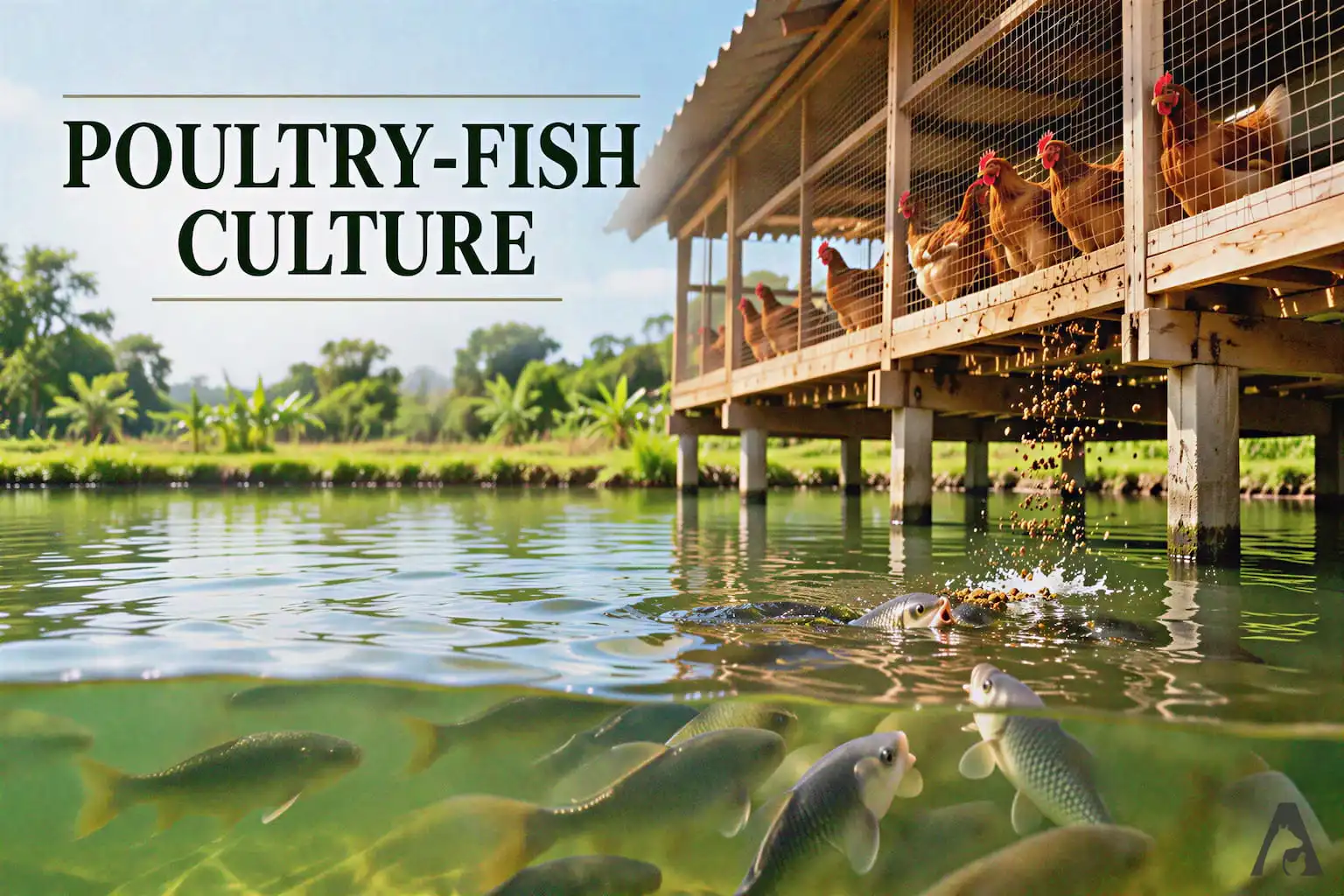
- Another method involves constructing the poultry housing structure so that it partially covers the fish pond and directly recycling the droppings for fish culture. Direct recycling and excess manure, however, can cause decomposition and oxygen depletion, leading to fish mortality. It has been estimated that one ton of deep-litter fertilizer is produced by 30–40 birds in a year. As such, 200 birds can produce about 20 kg of wet manure per day, which is adequate for one acre of water area.
- The fully built-up deep litter contains 3% nitrogen, 2% phosphate, and 2% potash. Built-up deep litter is also available from large poultry farms. Farmers who do not have facilities for keeping poultry birds can purchase poultry litter and apply it to their farms.
Periodic netting is carried out to check the growth of fish. If algal blooms occur, they should be controlled in the ponds. Fish health should be checked, and diseased fish should be treated.
Considerations While Constructing a Chicken Pen
A rectangular house has been found to be suitable from an overall management point of view. The house should be built on the side of the pond most protected from wind. Storms can cause serious damage to the structure.
If the house is constructed above the pond, it should be carefully ensured that the gap between the house floor and the pond water surface is at least 1 foot at the highest water level during periods of peak rainfall. The roof may be made of sheets, tiles, thatch, or any locally available material. Wall material can consist of bamboo mats, bamboo sticks, or wire mesh. The optimal height of the wall should be 120–160 cm.
If bamboo mats are used, the upper one-third of the walls should be left open and fitted with wire mesh for light and ventilation. The floor of a chicken house over the pond should be constructed with bamboo splits, slats, or wire mesh.
The gap between the bamboo splits should be wide enough (1.5–3 cm) to allow the chicken feces to drop into the pond water below, but should not be so wide as to cause injury to the legs of the birds. Three or four linked bamboo sticks serve well as a bridge for the caretaker and the chickens.
Poultry Husbandry Practices
Egg and chicken production in poultry rearing depends on multifarious factors such as the breed, variety, and strain of birds, good housing arrangements, balanced feeding, and proper health care.
In integrated fish-cum-poultry farming, the birds are kept under an intensive system. The birds are confined entirely to the house. The intensive system is further divided into two types: cage and deep-litter systems. The deep-litter system is preferred over the cage system due to the higher manurial value of the built-up deep litter. In the deep-litter system, 200 birds are kept, and the floor is covered with litter. Dry organic materials such as chopped straw, dry leaves, hay, groundnut shells, broken maize stalks, sawdust, etc., are used to cover the floor. The birds are then kept over this litter, and a space of about 1 square foot per broiler and 2 square feet per layer-type chicken is provided. The litter is regularly stirred for aeration, and lime is used to keep it dry and hygienic. In about 2 months, it becomes deep litter, and in about 10 months, it becomes fully built-up litter. This can be used as fertilizer in the fish pond.
If the poultry house is built over the pond, a wire- or slatted-floor house can be constructed 3–5 feet above the pond surface. The droppings can fall directly into and fertilize the pond. Birds that are proven for their ability to produce more and larger eggs, as in the case of layers, or to gain body weight rapidly, as in the case of broilers, are selected for integration with fish culture. Poultry birds under the deep-litter system should be fed regularly with a balanced feed according to their age. Grower mash is provided to birds 9–20 weeks of age at a rate of 50–70 g/bird/day, whereas layer mash is provided to birds above 20 weeks of age at a rate of 110 g/bird/day.
The birds are usually kept as layers up to 18 months of age. Improved varieties such as Namakkal Chicken-1 and Nandanam Chicken-4 can also be raised in the poultry component. If broiler farming is chosen, any commercial broiler or improved color-plumaged meat-type variety, such as Nandanam Broiler-2 or Giriraja, can be preferred.
Harvesting
Some fish attain marketable size within a few months. Considering the size of the fish, prevailing market prices, and demand for the fish in local markets, partial harvesting of table-size fish is carried out. After partial harvesting, the pond should be restocked with the same species and the same number of fingerlings, depending on the availability of fish seed. Final harvesting is done after 12 months of rearing. Fish yields ranging from 3,500–4,000 kg/ha/year and 2,000–2,600 kg/ha/year are generally obtained with six-species and three-species stocking, respectively.
Eggs are collected daily in the morning and evening. Each commercial layer bird lays about 300 eggs per year. Improved egg-type birds such as Namakkal Chicken-1 or Nandanam Chicken-4 lay around 160–200 eggs per year. The birds are culled after 72 weeks of rearing, as their egg-laying capacity decreases after that period.
Commercial broilers are ready for marketing at six weeks of age. Proper planning is required for regular replacement with a new batch of chicks.