CONTENT
Integrated Fish Cum Poultry Farming: Benefits and Management
Integrated fish farming is a system of producing fish in combination with other agricultural/livestock farming operations centered around the fish pond. The farming sub-systems, e.g., fish, crops, and livestock, are linked to each other in such a way that the byproducts/wastes from one sub-system become valuable inputs to another sub-system, thus ensuring the total utilization of the land and water resources of the farm, resulting in maximum and diversified farm output with minimum financial and labor costs.
The digestive tract of a chicken is very short, only 6 times its body length. Therefore, some of the ingested feedstuffs are excreted by the chicken before being fully digested.
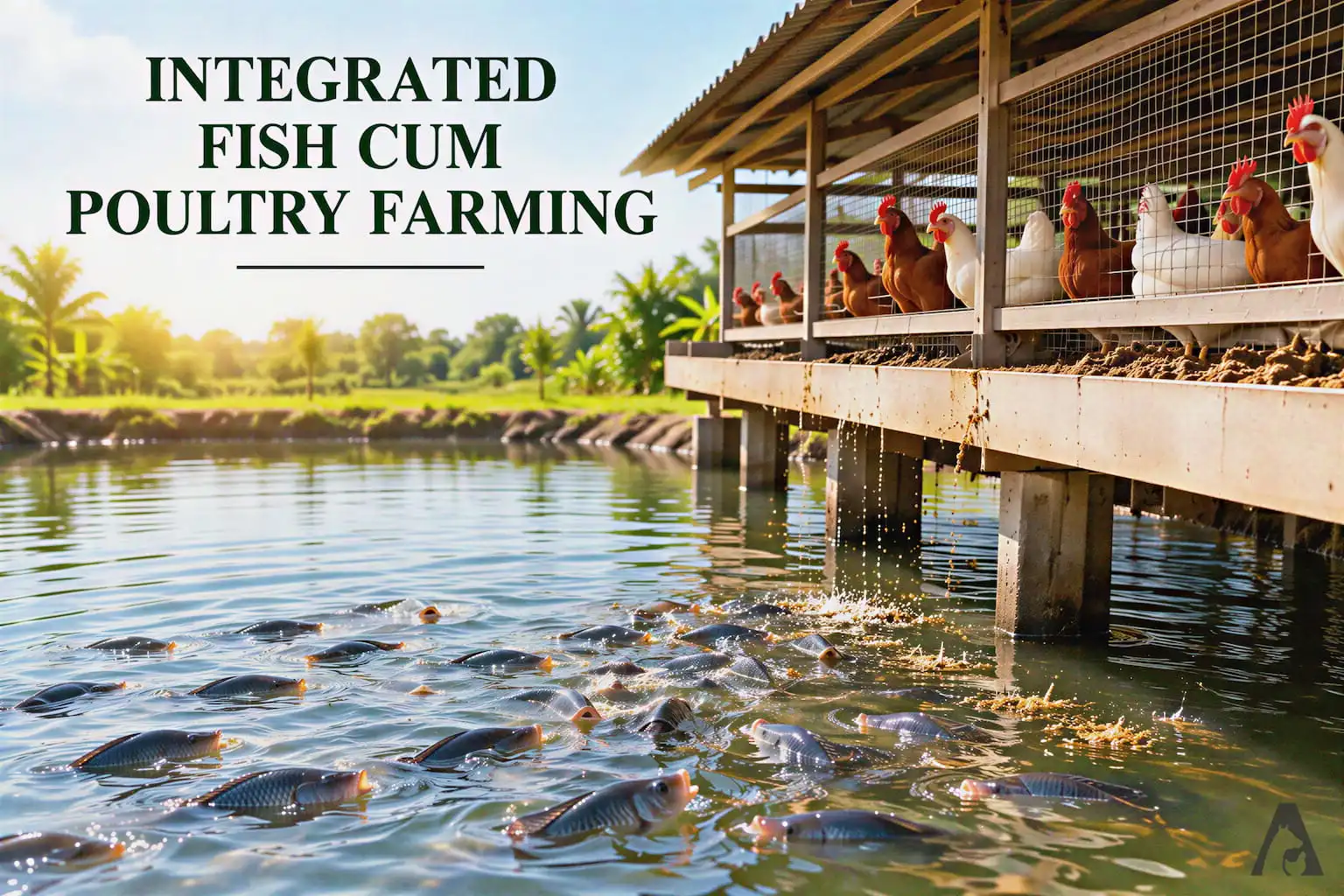
Research has shown that about 80 percent (by dry weight) of feedstuff is utilized and digested by poultry, leaving 20 percent for use by the fish in the integrated fish culture system. Chickens, while pecking, scatter about 10% of their feed on the ground. This wasted feed is utilized directly by fish.
In a proper fish, crop, and poultry integrated farming system, the possible inter-sub-system interactions are as follows: excreta and waste feed from the poultry sub-system act as manure and feed for fish and can also be used as manure for cropland. Byproducts/wastes of crops can be used as feed and manure for the fish pond and as feed for poultry.
Nutrient-rich bottom silt and pond water can be good sources of fertilizer for cropland. It thus appears that the different sub-systems in an integrated system are beneficially interlinked with each other in a limited area, minimizing production costs while resulting in diversified outputs, viz., fish, meat, eggs, vegetables, fruits, fuelwood, and fodder, which are the basic needs of a farm family.
Pigs can be used along with fish and poultry in integrated culture in a two-tier system. Chicken droppings form a direct food source for the pigs, which ultimately fertilize the fish pond. The upper tier is occupied by chickens and the lower tier by pigs.
Depending on the size of the fish ponds and their manure requirements, such a system can be built along the sides of the pond. The poultry litter falls into the pig house and forms feed for the pigs, while the pig excreta are washed away into the fish pond.
Considering consumer preferences and the local price structure, three types of poultry farming are normally economically viable for integration with fish production. They are:
- Layer production
- Duck egg production
- Broiler production
Benefits of Fish Cum Chicken Integration
Following are some of the additional advantages when fish culture is integrated with chicken raising on or near the pond dykes:
- The direct discharge of fresh chicken manure into the fish ponds produces enough natural fish feed organisms without the use of any additional manure/fertilizer.
- No transportation cost for the manure is involved.
- The nutritive value of applied fresh manure is much higher than that of manure that has been dried and mixed with bedding materials, e.g., sawdust or rice husks.
- Some parts of the manure are consumed directly by the fish.
- No supplementary feed is needed for the fish.
- No extra space is required for chicken farming. Chicken sheds can be constructed over the pond water or on the dyke.
- Greater production of animal protein can be ensured from the same minimum land area.
- Overall farm production and income will increase.
Size of Pond
Considering rural conditions, mainly the smaller ponds can be used for integrated fish culture. Majority of the homestead ponds are suitable for this purpose. Generally, 0.2-0.5 acre size is easily manageable by small farmers.
Depth of Pond
Any pond that retains 2-3 m water can be considered as suitable. However, the determining factor is the water depth in dry season. Minimum of 1.5m of water depths is essential even during the summer season. In low water depth the danger of organic over-loading is high from the poultry sub-system and