CONTENT
Poultry Farming in Hilly Areas: Rearing, Feeding and Management
Poultry farming in hilly areas requires management practices adapted to unique environmental conditions such as low temperatures, high altitudes, uneven terrain, and limited accessibility. Appropriate selection of poultry breeds, housing, nutrition, health care, and breeding practices is essential for maintaining productivity and minimizing the adverse effects of these conditions.
The dominant features of hill farming are small landholdings and sloping marginal land, along with poultry raising.
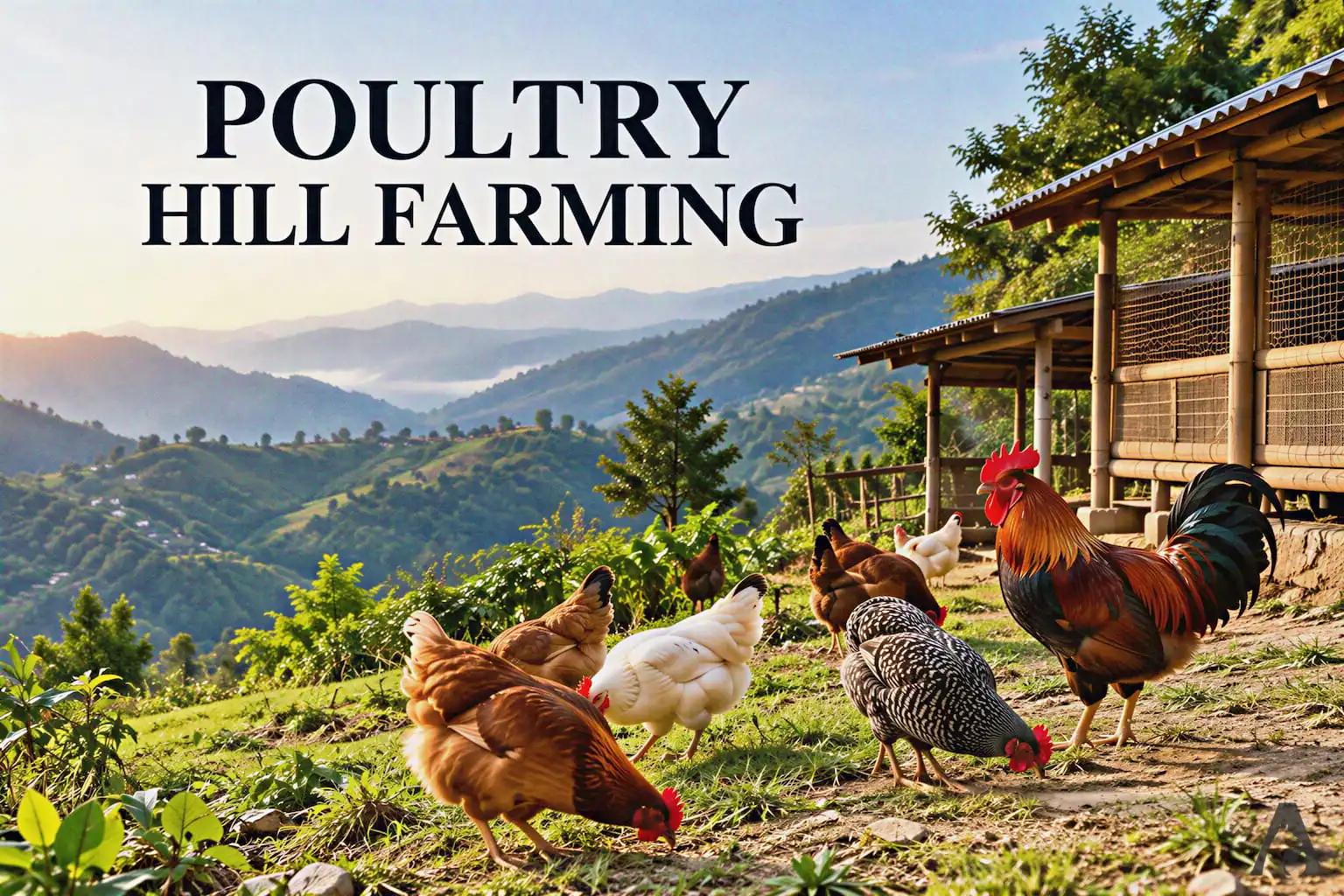
In high-hill temperature zones, it is more feasible to raise the available local/indigenous poultry breeds since they are best suited for scavenging on hilly tracts.
Constraints Under Hill Farming
- Undulating topography, small, fragmented, and scattered landholdings with limited availability of inputs.
- Slopes and soil erosion.
- The land is inaccessible, and infrastructure, communication, and mobility are affected by various physical, climatic, and socioeconomic factors.
- Water quality, natural hazards, and difficulties in marketing.
Hilly Areas-System of Rearing Poultry
Poultry provides economic and livelihood security to both landholding and landless hill families. Chickens are traditionally reared by tribal communities, and their husbandry is integrated within the whole farming system. In village communities, almost every farmer rears a few chickens near their homes, and the birds are mostly managed under a scavenging system.
Very little time and money are spent on rearing them, and they become a part of the family. In some hilly tracts, exotic birds have also been introduced, such as the Rhode Island Red, White Leghorn, New Hampshire, etc. Later, improved varieties of birds with indigenous blood were introduced and are doing well.
Under the scavenging system, particularly during the colder months, the birds are allowed to roam freely for part of the day (during the warmer part of the day) and are then confined and supplemented with extra feed. This system allows the birds to be protected from inclement weather and predators. Also, the manure from these birds is used to fertilize the soil. This system is adaptable to a range of flock sizes and is also able to produce more eggs and meat compared with the scavenging system.
In hill and mountain regions, where food grains are deficient, the scavenging system can provide eggs for the family without undue concern about feeding the birds. Local consumers prefer eggs and meat from indigenous birds rather than from exotic birds.
Under the semi-scavenging system, since the birds are reared indoors for a large proportion of the time, they are more prone to management-related diseases such as coccidiosis, and mortality and morbidity levels can be high. In this system, the farmer needs to construct a small house depending on the size of the flock. The house is low-cost and is made with locally available materials.
High Altitude and Hatchability
- A 10% decrease in hatchability has been observed for every 300-meter increase in altitude.
- There are reports that hatchability decreases to 30% at 2,000 meters.
- It has been observed that locally produced eggs may have lower shell porosity, which may restrict the diffusion of gases at lower atmospheric pressure.
- Adaptation can develop through a greater ability of the embryo to form hemoglobin in the red blood cells and through the development of a greater heart volume in the growing embryo to compensate for the lower oxygen level.
- In most cases, it may be preferable for birds to lay hatching eggs at a higher altitude and hatch them in a lower-altitude area. Transportation of eggs has to be carried out with great care.
Rearing of Broilers in Hilly Tracts
- Rearing broilers at higher altitudes reduces the growth rate and also increases mortality.
- Broilers, being fast-growing birds, have a high metabolism and a high oxygen requirement; therefore, they can be raised in environmentally controlled houses in high-altitude areas.
Intensive System of Rearing Birds-Hilly Tracts
In this system, due to the terrain, the houses have to be shorter in length and greater in number. In order to conserve heat, the planning and construction of poultry houses in hilly areas should be as square as possible.
- Under this system of rearing in hilly areas, the birds have to be fed a balanced diet, and the cost of feed increases as it has to be transported up the hill.
- As the temperature is cool, the feed requirement increases to maintain body warmth.
- During the cold seasons, the birds have to be protected from the ‘wind chill’ factor, and the open sides of the house are closed with burlap sacks or plastic sheets.
- The wind direction should be observed, and the curtains on that side must be closed more.
- The opening and closing of the curtains in the open-curtained house must be closely monitored to prevent a buildup of ammonia due to reduced ventilation.
- Small air inlets can prevent the house from becoming very cold, as cool air can otherwise drop directly onto the birds and chill them.
Health
The major problems in the intensive rearing of chickens in hilly areas are respiratory diseases and coccidiosis. Cold air falls rapidly to the floor, displacing warm air and leading to chilling. This cold air cannot absorb much moisture from the atmosphere, and therefore, as it falls onto the litter, the litter becomes caked. Due to reduced ventilation, there is an increase in ammonia, leading to respiratory disease. Wet litter can also contribute to coccidiosis problems. In young birds, the gut is chilled by contact with cold and humid litter, and this leads to enteritis.
Feeding
The bird has to maintain its body temperature and requires a high-energy feed. Chickens eat more feed when the environmental temperature is low. A practical rule for the extra feed required for body maintenance is to provide 1% more feed for each 1°C decrease in temperature below the required average house temperature of 18 to 20°C. Provide the birds with a balanced feed to control body weight and egg production. Prevent feather loss in these birds, as this could ‘chill’ the birds excessively.
Training
Farmers and those who intend to take up poultry farming in hilly areas must be trained. Training must be organized in such a way as to inform farmers of recent developments and suitable technologies concerning small-scale poultry production in hilly terrain.
Training on rearing meat and egg birds, selecting good layers, incubation and hatching methods, formulating rations with locally available ingredients, vaccination, and health care must be regularly planned.
Breeding
Breeder farms can be maintained at higher altitudes, but the hatchery must be built at a lower altitude. The frequency of egg collection must be increased to prevent chilling of the hatching eggs, which lowers hatchability.