
CONTENT
Laboratory Animals: Types, Uses and Importance in Research
Laboratory animals have played an important role in advancing biomedical and veterinary science by providing controlled models for studying biological processes, diseases, diagnostic methods, and therapeutic interventions. Different animal species are selected according to their anatomical, physiological, genetic, or behavioral characteristics and their suitability for a particular study. Their use in scientific research requires appropriate selection, management, welfare practices, and ethical consideration.
In the broadest sense, a laboratory animal is any non-human member of the animal kingdom that is kept in captivity for experimental or observational purposes.
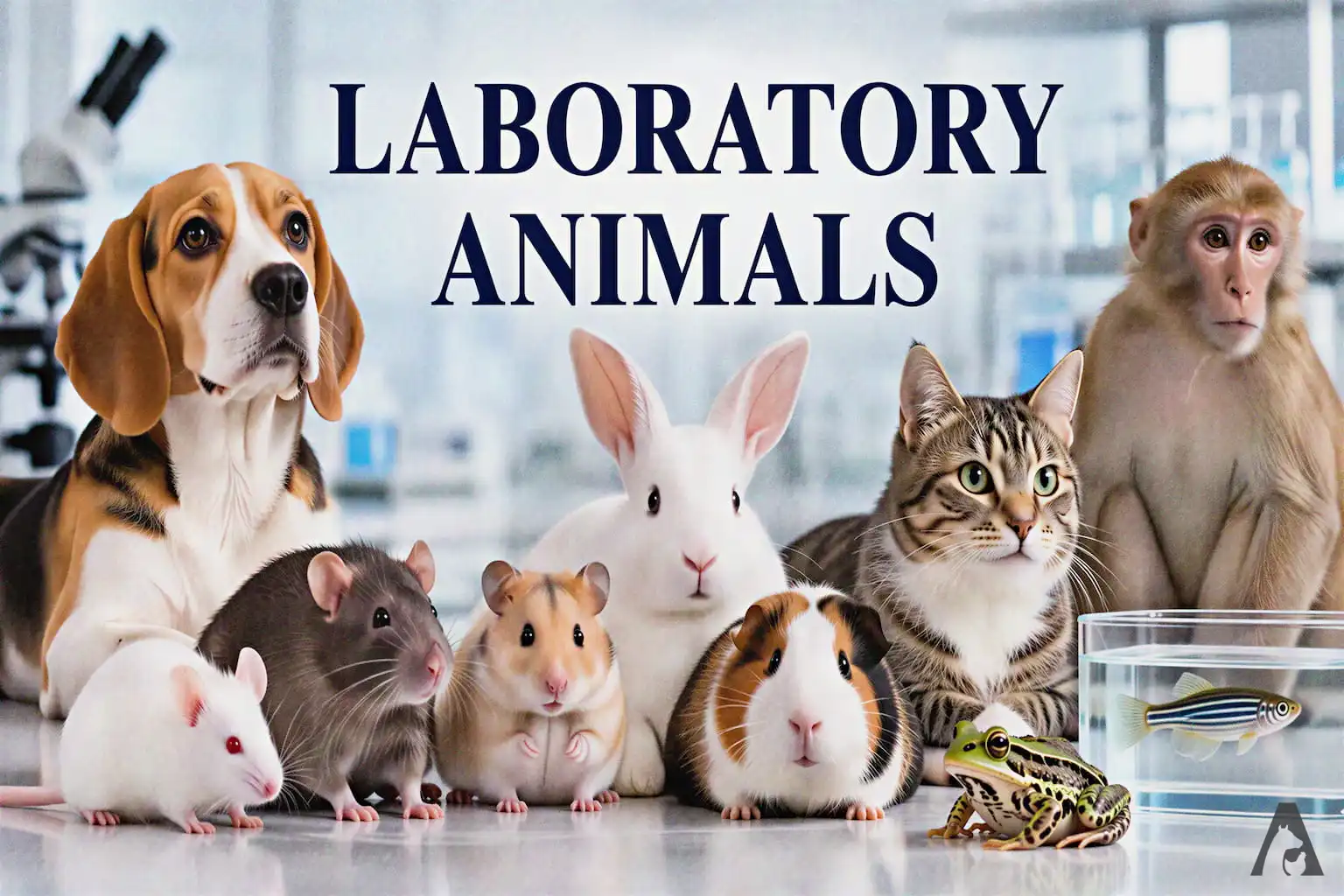
Laboratory animals cover a wide diversity of orders, from prawns to primates, and they range from domesticated species such as mice (bred specifically for use in laboratories) to wild species such as bats and snakes.
Any animal species that is used for experimental purposes in biomedical, veterinary, and other research should be considered a laboratory animal. However, in the usual sense, animals such as mice, rats, hamsters, guinea pigs, and rabbits, and, to a limited extent, dogs and monkeys, are considered laboratory animals.
Common Laboratory Animals
- The most commonly used invertebrate species are Drosophila melanogaster, popularly known as the fruit fly, and Caenorhabditis elegans, a nematode worm.
- Non-primate vertebrates include mice, rats, guinea pigs, hamsters, gerbils, rabbits, fish, and amphibians.
- Cats are most commonly used in neurological research.
- Dogs are widely used in biomedical research, testing, and education—particularly beagles, because they are gentle and easy to handle.
- Non-human primates are used in toxicology tests and studies of AIDS and hepatitis, neurology, behavior and cognition, reproduction, genetics, and xenotransplantation.
Why We Use Laboratory Animals
- They are smaller in size and therefore require minimal space and less feed.
- Therefore, the cost of production and maintenance is lower.
- Most laboratory animals are not natural hosts for many human or animal diseases; therefore, they can be used in microbiological (vaccine production, diagnosis, etc.) and virological research.
- The results obtained can be applied directly to human or veterinary medicine.
- Rats and mice are highly adaptable because of their omnivorous habits, robust physical constitution, prolific breeding, shorter generation intervals, and ease of taming. Moreover, they live in harmony with the human environment.
- Guinea pigs are very sensitive to a number of human pathogens and hence are used extensively in biomedical research.
- Rabbits are prolific breeders and have a relatively large body size compared with rats, mice, and guinea pigs. They are mainly used in therapeutic trials, for raising hyperimmune sera, and for identifying pyrogens in infusion fluids.
The Laboratory Animal Bureau was established in India in 1947 by the Medical Research Council in Bombay. This committee controls and supervises experiments on animals and also visits places where laboratory animals are reared.
It insists on proper feeding, housing, management, and humane treatment of laboratory animals. A society named the “Fund for the Replacement of Animals in Medical Experiments” (FRAME) aims to reduce the use of laboratory animals in medical and veterinary experimentation. It advocates the use of TC (tissue culture) techniques instead of live animals.