CONTENT
Layer Management in Poultry (21-72 Weeks): Housing, Cage Rearing, Lighting & Egg Production
Layer management from 21 to 72 weeks is essential for maintaining optimal egg production, flock health, and feed and water efficiency. During this period, proper housing, space allocation, cage management, lighting programs, and regular monitoring of production performance play a critical role in maximizing the productive potential of laying hens. This stage also requires appropriate management of feeders, waterers, nest boxes, and egg collection practices to minimize losses and maintain egg quality.
Grower birds are transferred to layer houses at the end of the 18th week after deworming, dipping, and protective vaccination against Ranikhet disease. Layers can be reared both on deep litter and in cages. When reared on litter, litter material has to be provided to a height of 12-15 cm.
Space Requirements
A floor space allowance of 2 sq. ft. (1800 cm2) per bird has to be given. Circular or linear feeders may be provided; a feeder space of 10-12 cm per bird has to be given. A linear feeder of 180 cm length and 10 cm depth will suffice for 35 layer birds; ad libitum feeding at all times has to be ensured.
Provide a waterer space allowance of 2.5 cm per bird. During the laying stage, 1000 birds will consume approximately 250 litres of water per day. A circular waterer of 45 cm diameter and 7 cm depth will be sufficient for 50 birds.
Circular plastic or aluminum water basins may be used. Use waterer guards on the waterers at all stages of rearing to prevent birds from standing on the edge and tilting the waterers. Provide fresh, cool water twice a day. Arrange the feeders and waterers alternately at equal distances; take care to adjust their heights to avoid feed wastage. Fill them only to 2/3rd of their capacity at any time.
Nest boxes made of G.I. or aluminum sheets may be provided at a height of 45 cm, with one for every three to five birds. The layers have to be trained to get into the nest box for laying eggs. Otherwise, eggs laid on the floor have a higher chance of breakage. The mouth of the box should be 30 cm wide with a depth of 20 cm. Some litter material may be spread inside the nest boxes. Some farmers even tend to use pots as nest boxes, as they provide a cooler environment for birds experiencing stress while laying.
Cage Rearing of Layers
Nowadays, cage rearing of layers is very popular. Cage rearing facilitates easy management, lesser space requirements, easy collection of eggs, a lower percentage of broken eggs, better egg weight, clean egg production, easy culling, and reduced mortality levels. Cages of various sizes are used to house 3-5 birds per cage. Currently, reverse cages are used with their longer side fitted to remain at the front. Further, raised platform houses are being constructed to facilitate quicker drying of droppings and their easy removal.
The following cage sizes may be made and fitted in rows:
- 45 x 30 cm – for 3 birds
- 45 x 40 cm – for 4 birds
- 50 x 35 cm – for 4 birds
- 55 x 45 cm – for 5 birds
- 60 x 37.5 cm – for 5 birds
These cages are arranged in two or three such rows, one above the other, on either side. They are termed Californian cages. A floor space allowance of 420-450 cm2 is allowed within cages. Conventionally, the bottom of the lowermost cage was fitted at a height of 75 cm from the floor. Nowadays, they are fitted at a height of 120-240 cm above the floor level, with walking platforms constructed on the sides. The layer cage will be 40 cm in height. The floor is fitted with 2.5 x 5.0 cm weld mesh of 14-gauge thickness. On the sides, 7.5 x 7.5 cm mesh of 16-gauge thickness is fitted.
The bottom floor is provided with a 1/6 slope downwards toward the front to facilitate the rolling of eggs to the cage front. The mesh rails on the cage floor should run from back to front and not sideways; otherwise, they will block the free movement of the eggs downward toward the front. Waterers are fitted above the feeders in the front. Automatic waterer nipples/buttons and feeders may be provided in the cages.
Cages are fitted in two or three tiers on either side of the row under the Californian system of arrangement. Two to three such rows of cages are arranged in a caged layer house. Depending on the number of rows and the number of tiers in each row, the breadth of a caged layer house ranges from 15-17 ft (5-8 m). There is no stipulation for the length of such houses, which can be adjusted according to the number of birds to be housed. No side walls are required for cage houses, with the mesh being stretched down to the floor level to facilitate better ventilation and drying of the moisture in the droppings.
Of late, “Elevated cage houses” or “Raised platform cage houses” are preferred, in which cages are fitted on platforms at a height of above 5-6 ft. This arrangement widens the gap between the birds and their droppings, facilitates quicker drying, and allows easy removal of droppings.
Lighting
Artificial lighting has to be provided during the laying stage at a minimum of one 60-watt bulb for every 200 sq. ft. of area. Additional artificial lighting of 20 minutes per week is given from the 17th week to reach a total photoperiod of 16 hours at around 28 weeks of age.
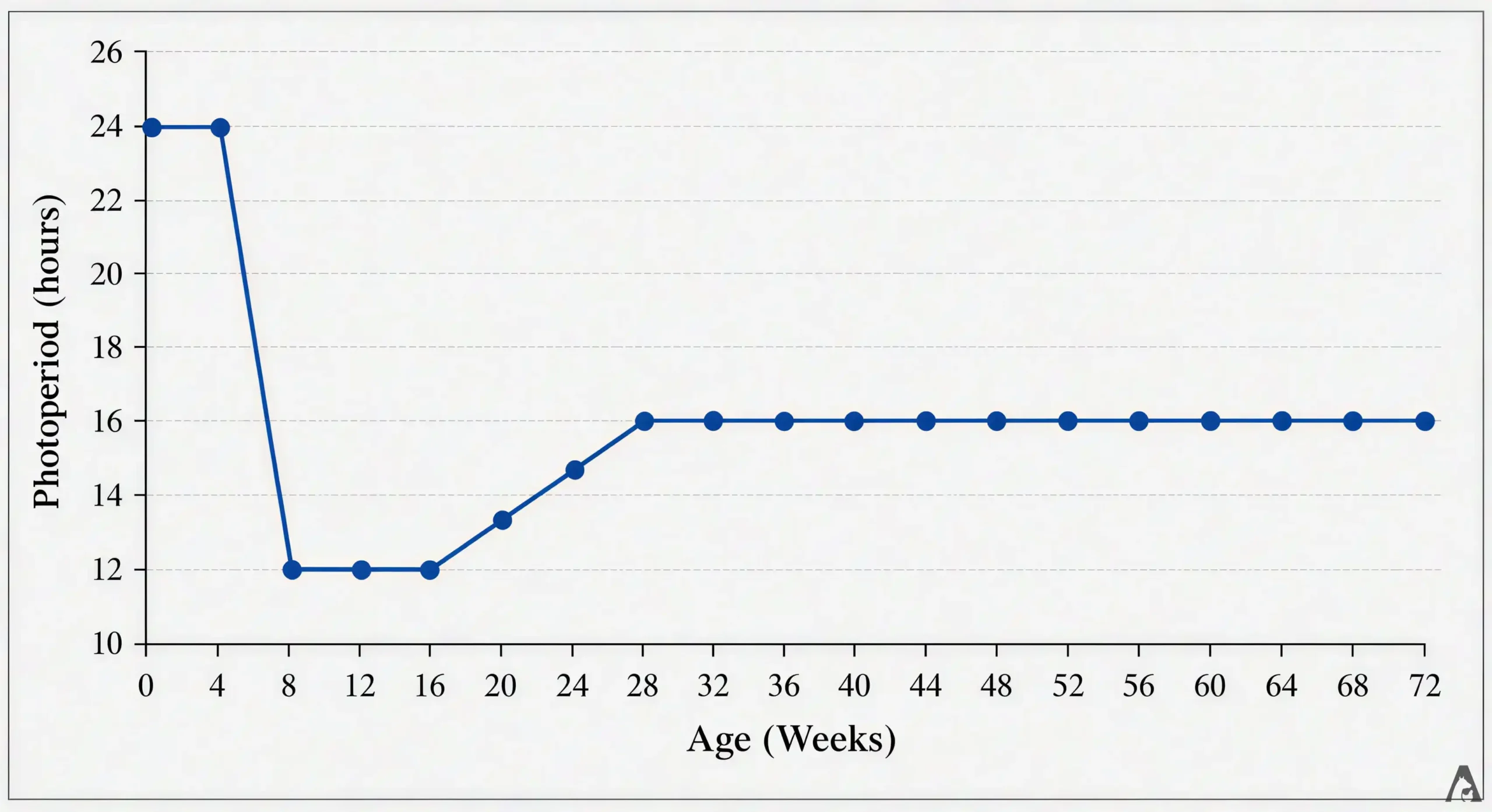
Providing an increasing day length in this manner is called a step-up lighting program. Thereafter, a 16-hour photoperiod is maintained throughout the laying period up to 72 weeks of age. Day length should never be decreased during the laying period. Reduction of the photoperiod during the laying period will affect egg production.
Egg Production
Egg laying starts at the 21st week, and the rate of laying (percentage production) increases every week to reach a level of 90% and above after 28 weeks of age, which is maintained well beyond 36 weeks of age, even up to 40-42 weeks. Afterwards, it declines slowly to reach 70% or below by 72 weeks of age.
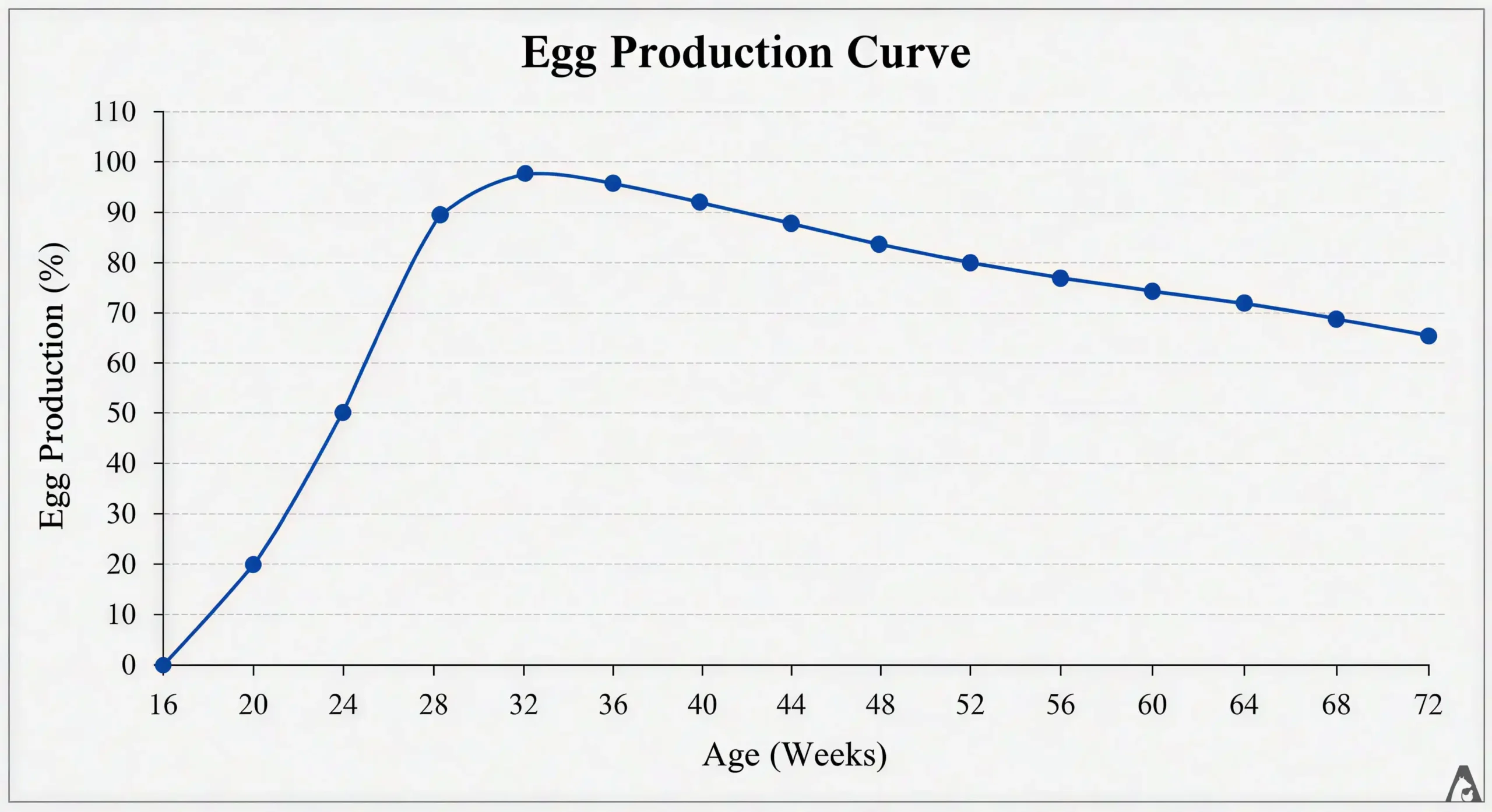
When egg production goes below 65%, it is uneconomical to retain the birds unless the egg price is exceptionally high. Egg production may be calculated as a percentage of the total number of birds available at the 21st week (hen-housed egg production) or based on the number of birds available on each day (hen-day egg production). Satisfactory egg production levels at different ages during the laying stage are given in the table to serve as a guide to verify whether the birds are producing at the optimal level.
Layer Performance Under Optimal Conditions
| Age in weeks | Hen-day egg production (%) | Feed intake/ 1000 birds (kg) | Water intake/ 1000 birds (litre) |
|---|---|---|---|
| 21 | 10 | 75 | 160 |
| 22 | 18 | 85 | 180 |
| 23 | 34 | 96 | 210 |
| 24 | 55 | 105 | 240 |
| 25 | 68 | 109 | 260 |
| 26 | 76 | 113 | 280 |
| 27 | 84 | 115 | 290 |
| 28 | 88 | 115 | 300 |
| 29 | 90 | 115 | 310 |
| 30 | 92 | 115 | 320 |
| 31 | 94 | 115 | 320 |
| 32-39 | 92 | 110 | 310 |
| 40-47 | 86 | 107 | 290 |
| 48-59 | 82 | 105 | 270 |
| 60-64 | 76 | 103 | 260 |
| 65-70 | 70 | 101 | 240 |
| 71-76 | 65 | 96 | 240 |
Collection of Eggs
The layer-type chicken will lay their eggs mostly during the forenoon. Eggs may be collected twice, in the morning and afternoon. The frequency of egg collection has to be increased to four to five times during peak summer. In large layer farms, it is preferable to have an air-cooled room for egg storage. Specially designed plastic/cardboard trays have to be used to collect eggs. Usually, 30-egg-capacity collecting trays/egg filler flats are used. It is not advisable to collect eggs in baskets.