CONTENT
Grower Management of Layer Pullets (9–20 Weeks): Feeding, Housing & Uniformity
The grower phase (9–20 weeks) is a critical period in layer management, as proper nutrition, housing, feeding, lighting, and flock uniformity during this stage directly influence subsequent reproductive development and egg production.
This guide covers essential grower management practices for layer pullets, including space requirements, restricted feeding, cage rearing, and methods for maintaining flock uniformity.
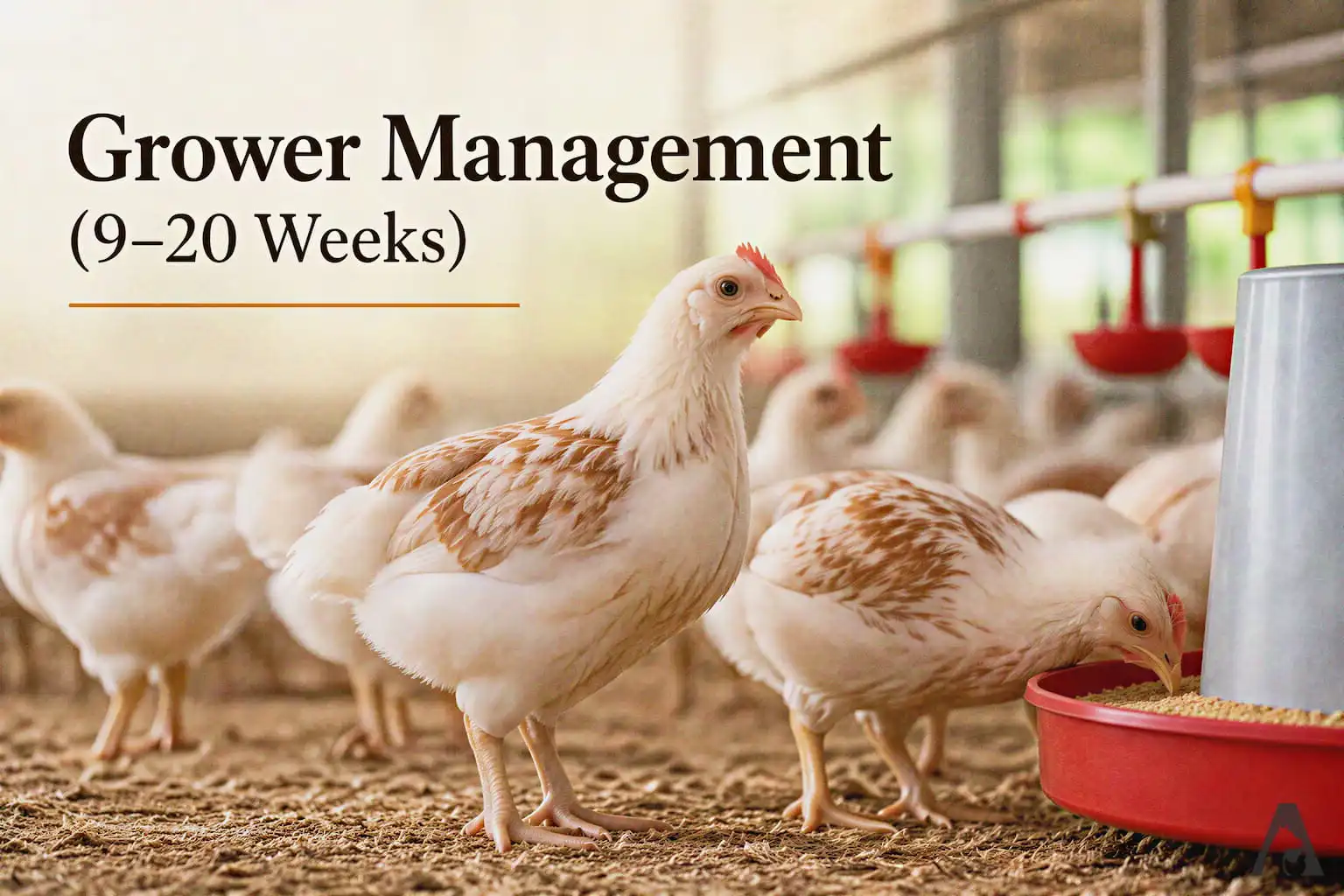
Farmers tend to neglect layer birds mostly at this age. However, it has to be kept in mind that the reproductive organs of the bird, which produce eggs later on, undergo proper growth only during this age, and therefore, it is necessary to provide appropriate care during the grower phase. Growers may be reared in separate grower houses or continued to be reared in brooder-cum-grower houses.
Space Requirements
Floor space has to be increased to 1.4 sq. ft. (1260 cm2) per bird. Feeder space to be provided is 6–8 cm per bird. One linear feeder of 120 cm length and 8 cm depth may be provided for 40 grower birds. Raise the height of the feeders as the birds age.
Waterer space allowance during the growing phase is 2 cm per bird. A circular waterer of 36 cm height and 8 cm depth, with a 6-liter capacity, may be provided for 50 growers. At this age, 100 birds will consume about 15–20 liters of water per day.
Feed them with grower mash containing 16% crude protein and 2600 kcal/kg of M.E. up to 20 weeks of age. They may consume approximately 60 to 80 g of feed per bird per day. It is not advisable to provide ad libitum feeding at this age, as the birds may tend to put on more fat, and their egg-laying rate may be affected later on.
- Proper cleaning and disinfection of the grower house are needed before the introduction of grower birds.
- Provide sufficient floor space, feeding space, and water space.
- Spread litter material to a height of 4 inches in the case of a deep-litter system.
- Arrange feeders and waterers in the grower house.
- Change the feeders and waterers according to need.
- Adopt a restricted feeding program during the growing period to prevent fattening of pullets and early sexual maturity and thus improve egg production.
- Follow good litter management to avoid diseases such as coccidiosis.
- Only a 12-hour lighting program is sufficient in open-sided houses. No artificial light is needed.
- Aim for uniformity of the flock. Sample weights are taken once a week to determine the average body weight according to the breeder’s recommendations.
- Strictly follow the recommended vaccination, medication, and other management programs, such as deworming and debeaking, for the growers.
Restricted Feeding
Restricted feeding is adopted during the growing period of layers or breeders. There are two types of restricted feeding:
- Quantitative Feed Restriction
- Qualitative Feed Restriction
1. Quantitative Feed Restriction
In this method, the amount of feed is reduced below the normal requirement of the birds. This can be done on a day-to-day basis, using a skip-a-day program, or using a skip-two-days-per-week program. However, this restriction depends on matching the flock’s average body weight with the standard body weight provided by the breeder.
2. Qualitative Feed Restriction
In this method, the quality of the feed is reduced below the standard requirement of the bird. This can be done by including unconventional feed ingredients or lower-nutrient feed ingredients in place of a high-protein or high-energy diet. Here, the quantity of feed allotted to the bird is not restricted.
During the restricted feeding program, provide a greater number of feeders and ensure that all the birds are taking feed simultaneously; otherwise, dominant birds will consume more feed, while weaker birds will be subjected to feed deprivation, and hence, flock uniformity will be affected.
Advantages of feed restriction during the growing period:
- A considerable saving on feed costs because only 80% of the calculated feed requirement will be offered.
- They are likely to consume less feed per dozen eggs even during the laying period when they are offered ad libitum feed.
- The pullets accumulate less fat and therefore produce more eggs.
- It is easier to identify weaker birds at an early age during feed restriction. Culling such birds helps not only save feed but also promote layer house survivability because healthier birds will be moved to the laying house.
- Layers that are feed-restricted during the growing period have been found to produce heavier eggs in longer clutches than those fed ad libitum.
Ensure that the mortality level during brooding is below 4% and during the growing phase is below 3%. Keep proper records of the number of chicks received, feed intake, mortality, day-to-day culling, medicines and vaccines given, etc.
Cage Rearing of Growers
Growers can also be reared in cages. The floor may be made of welded mesh of 1.25 × 5.0 cm size. In a cage of 180 × 90 cm size, 50 birds can be reared with a space allowance of 325 cm2 per bird. Feeders and waterers may be fitted lengthwise on the sides, one below the other.
Uniformity
At a given age, growing pullets should have an average body weight very close to the breeder’s recommendations, with at least 80% of the birds’ weights within 10% of the flock average.
Points to be considered for achieving uniformity among growing pullets are:
- Receive chicks of uniform weight.
- Provide proper feeding, watering, and floor space.
- Change the feeders and waterers according to age.
- The height of the feeder and waterer should be at the back height of the bird.
- Provide adequate energy in the diet.
- Take sample weights of the pullets at regular intervals and adjust the feed accordingly.
- Provide adequate feeding space so that all birds can consume feed simultaneously.
Coefficient of variation (CV) and standard deviation (SD) can also be used to measure flock uniformity.