CONTENT
Broiler Management in Poultry: Brooding, Space Requirements, Feeding, Litter & Lighting
Broiler management involves a combination of proper brooding, adequate space, balanced nutrition, effective water management, litter maintenance, growth monitoring, and appropriate lighting to support optimal growth and feed efficiency. Proper management practices throughout the production cycle help maintain a suitable environment, minimize stress and disease risk, and ensure efficient performance until market age.
Brooding arrangements for straight-run (unsexed) day-old broiler chicks received at broiler farms have to be made similar to those described earlier for layer-type chicks. The diameter of the brooder guard may vary from 150–240 cm for 175–300 chicks per unit, respectively. Newspaper spread over the litter may be removed after three days, and the chick guard arrangement may also be dismantled after eight days.
Space Requirements
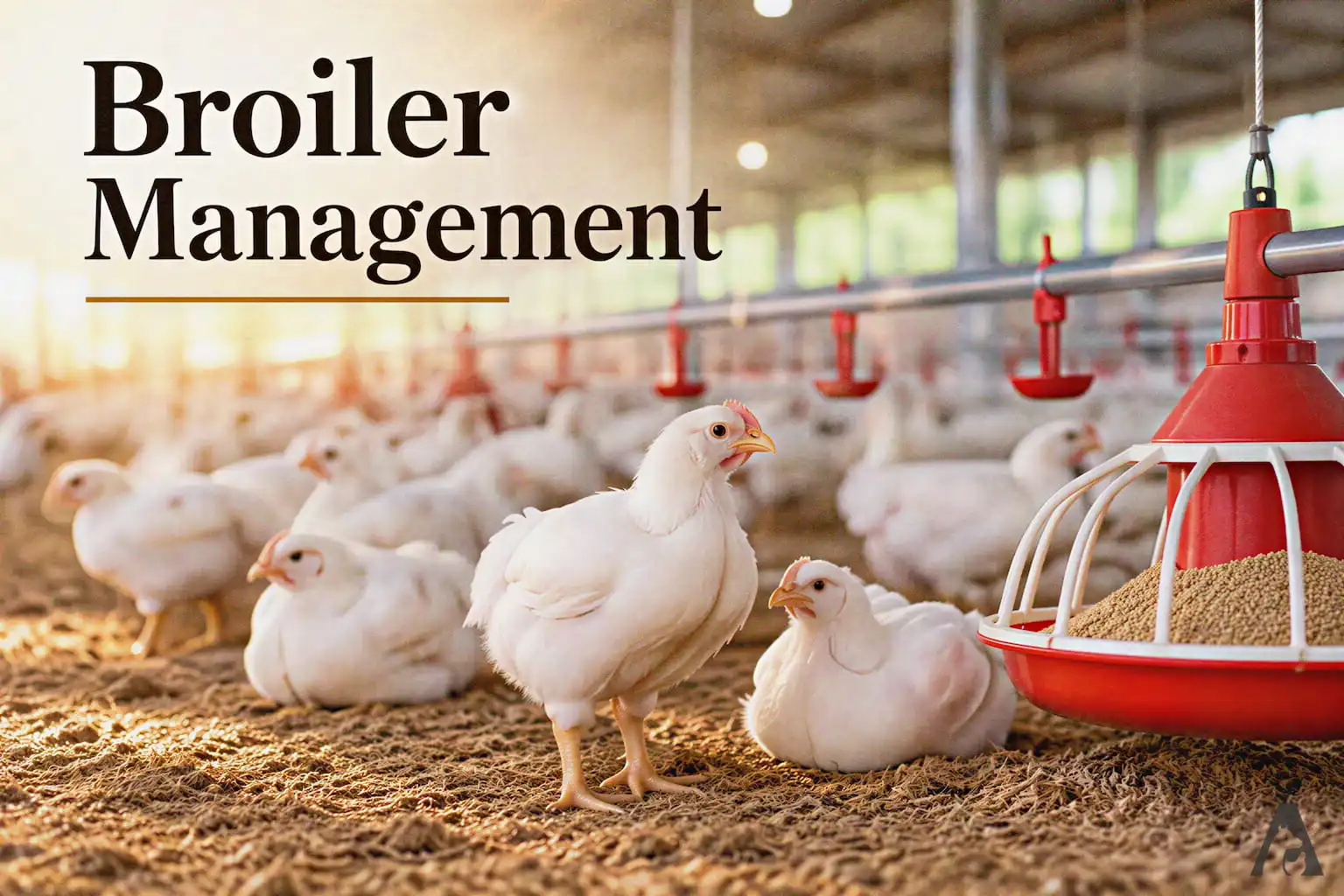
Floor space allowance for broilers is 450 cm² (0.5 sq. ft.) per bird up to 18 days and 1000 cm² (1.1 sq. ft.) per bird afterward up to market age. Feeder space allowance is 3 cm and 6–7 cm per bird, and waterer space allowance is 1.5 and 3 cm per bird for the above periods, respectively. The waterers and feeders may have to be changed after the second week and at the fifth week, and larger-sized equipment should be provided to ensure adequate feeder and waterer space allowances.
Clean, potable water should be provided. Early in the morning, as the first duty of the daily routine, empty the waterers, clean them, and provide fresh water. Watering may be done twice daily and feeding four times a day. Fill waterers and feeders to only two-thirds of their capacity. Take care to avoid spillage of water onto the litter. If conventional chick waterers and plastic basins are used, have one spare set of waterers and clean and sun-dry the used set every day.
Feeding of broilers may be done in two phases. During the first four weeks, broiler starter mash with 24% crude protein and 2900 kcal/kg of ME should be fed, and after four weeks, until they are marketed, broiler finisher mash with 21% crude protein and 2900–3000 kcal/kg of ME should be given. The method of preparing broiler mash is described separately. Broilers may also be fed in three phases: 0–2 weeks, 3–5 weeks, and from the sixth week to market age. Accordingly, different feed formulations have to be made for the three phases.
During feeding and watering, take care to disturb the birds as little as possible. If possible, the same person should be assigned to attend to one batch. Feeding and watering may also be done at the same time every day to minimize stress.
Take all steps to avoid feed wastage. Provide an adequate number of feeders and make provisions to adjust the height of the feeders so that the brim of the feeder or waterer is raised to the level of the back of the growing broiler.
Monitor the growth of the broilers up to market age by weighing at least 10 birds of average size at the end of every week so as to make sure that they gain weight normally and that there is no sudden drop in growth rate. If the growth rate is lower than the standard, the producer should check the quality of the feed for the presence of toxins, adequacy of protein and amino acid levels (lysine, methionine, etc.), and also the possibility of a subclinical infection. Also monitor daily feed and water consumption, as any drastic change should be investigated.
Growth Performance and Feed Efficiency of Broilers
| Age (weeks) | Mean body weight (g) | Feed intake/ 1000 birds/ day (kg) | Cumulative feed intake per bird (g) | Feed efficiency | Water intake 1000 birds/ day (litre) |
|---|---|---|---|---|---|
| 0 | 42 | — | — | — | — |
| 1 | 170 | 19 | 146 | 0.86 | 46 |
| 2 | 380 | 37 | 426 | 1.12 | 89 |
| 3 | 720 | 68 | 945 | 1.31 | 165 |
| 4 | 1170 | 102 | 1730 | 1.48 | 245 |
| 5 | 1680 | 134 | 2720 | 1.62 | 320 |
| 6 | 2220 | 168 | 3996 | 1.80 | 405 |
The table gives the average weight of each bird anticipated at the end of the week, along with daily feed and water consumption by 1000 birds at the respective age, although water and feed consumption will vary depending on the season. Feed consumption will decrease and water consumption will increase during summer, while during winter and the rainy season, water consumption will decrease and feed consumption will increase.
Litter Management
Broilers are mostly reared on deep litter. Some of the materials commonly used as litter are rice hulls, groundnut hulls, sawdust, wood shavings, coir pith, chopped straw, bagasse, and even sand. The choice of litter material depends mostly on cost and local availability.
A total litter depth of 5 cm is sufficient. The litter should be maintained practically dry. After two weeks of age, it is advisable to rake the litter every morning with the help of a rake so that caked material is broken up. Remove waterers and feeders before raking the litter to avoid spillage into the equipment. Moisture levels in the litter will increase every day because of the water content of the birds’ droppings. If it goes beyond 25%, excess ammonia will be produced.
If the ammonia level in the atmosphere exceeds 25 ppm, the birds will be subjected to various stresses. There will be irritation of the eyes and nasal membranes, leading to conjunctivitis, poor feed intake, and reduced growth rate. The birds will be predisposed to diseases such as coryza, bronchitis, other respiratory diseases, and coccidiosis. Higher moisture levels in the litter may also cause lameness, reluctance to move, and weight loss.
To assess the moisture level in the litter, take a handful of it and squeeze. If the litter forms a cake, the moisture level is high. If it crumbles into fine dust, the moisture level is very low, which will make the environment more dusty. It should remain as a loose mass when the moisture level is appropriate.
When the litter remains wet even after raking, add some fresh litter material. Addition of superphosphate at 2 kg/100 sq. ft. of area will help reduce ammonia levels. Addition of lime powder is not advisable. Try to prevent excess moisture buildup by ensuring proper ventilation. Keep in mind the spacing between broiler houses, etc. Never attempt to recycle old litter for subsequent batches.
Lighting
For brooding, artificial lighting should be provided for up to three weeks to provide warmth, as suggested earlier. It is advisable to provide a light source during the night to encourage nighttime feeding, particularly during summer, since feed consumption will be reduced during the hotter parts of the day.