CONTENT
Poultry Breeder Management: Feeding, Breeding, Housing & Health Care
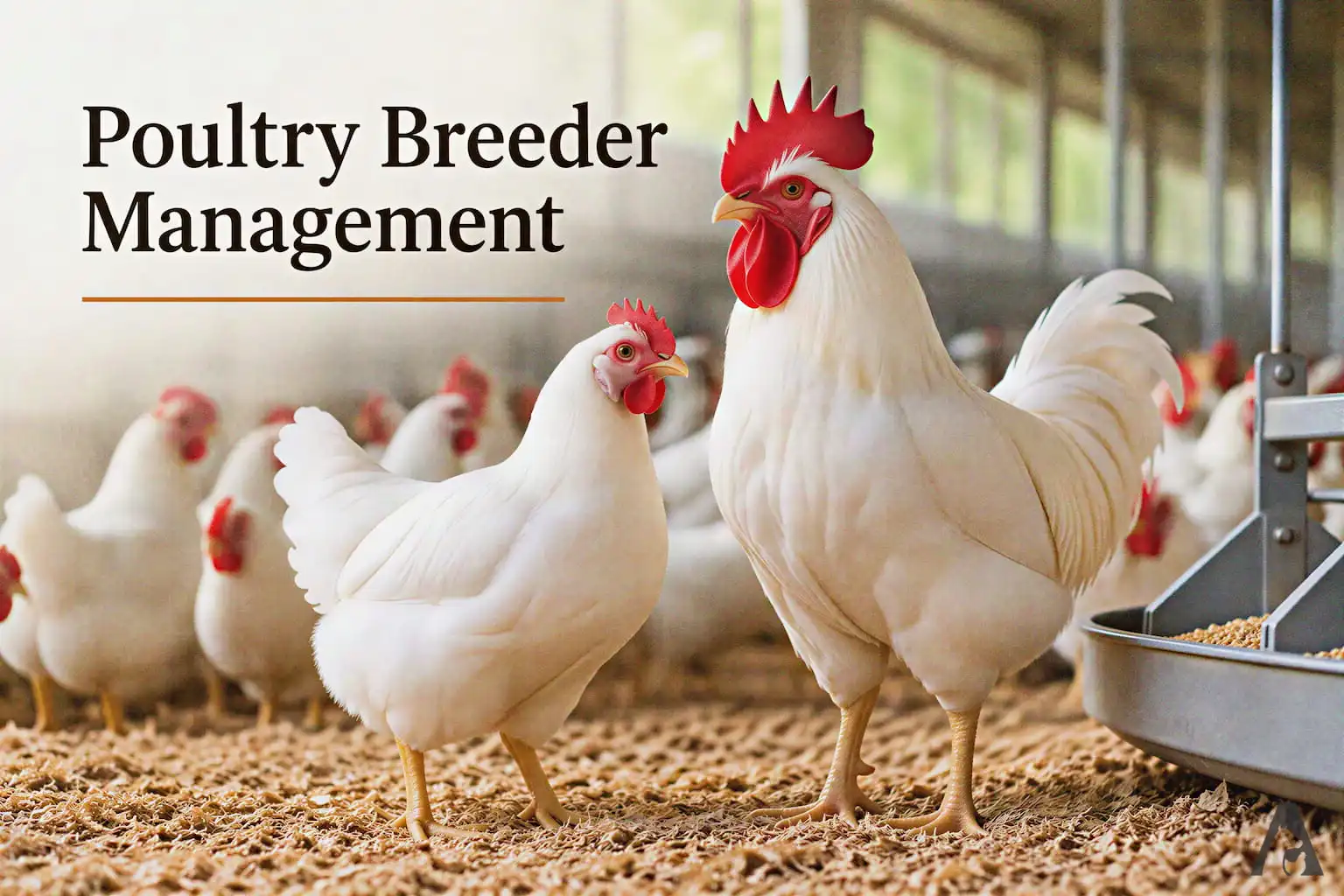
Poultry breeder management plays a critical role in maintaining reproductive performance, flock health, fertility, hatchability, and the production of high-quality hatching eggs and chicks. Although the management of breeder flocks shares several principles with commercial layer management, parent stock requires additional attention to breeding males, mating systems, nutrition, vaccination, biosecurity, and flock uniformity.
Layer breeder management is more or less similar to the management of commercial layers. Since parent stock is costly and its hatching eggs and pullet chicks generate higher income, greater care must be taken in managing the parent stock to maximize profits. Moreover, in parent stock management, the management of male breeding stock and the hatchery are additional activities that must be carried out carefully.
Rearing Systems and Space Requirements
Layer parent stock can be reared successfully on deep litter, slats, slat-cum-litter systems, or in breeder cages. The floor space requirements are 1860 cm² on deep litter, 1400 cm² on slat/wire floors, and 450 cm² in cages for females and 700 cm² in breeder cages for male breeders.
Males and A.I. (Artificial Insemination)
Day-old male parent chicks are supplied, dubbed, and detoed. Males are reared separately from 0–21 weeks of age. Start with 12% males in the case of natural mating and 8% in the case of artificial insemination. At the beginning of the breeding season (22 weeks), introduce 8 males per 100 females. Replace weak, lame, and sick males promptly.
In the case of A.I., maintain at least 5% males, which can yield at least 0.5 mL of neat semen per ejaculate with not less than 60% motility. Inseminate females once every 5 days with 0.03–0.05 mL of neat semen within 30 minutes after collection.
Debeaking
Both males and females are debeaked at 10–14 days of age and again at 15–16 weeks of age. For females, leave 2 mm of beak from the nostrils, whereas for males, cut half of the beak between the nostrils and the tip of the beak. Both upper and lower beaks are cut off straight. Give vitamin K in the drinking water 1 day before debeaking and electrolytes for 2 or 3 days starting on the day of debeaking.
Vaccination Programme and Health Care
It is more or less similar to the program followed for commercial layers. The program varies from place to place and over time, depending on the prevalence of diseases in the area. The only difference is that killed vaccines are given for diseases such as N.D., I.B.D., I.B., REO, and M.G. before the onset of egg production.
Sometimes, killed N.D., I.B.D., and I.B. vaccines are repeated at 45 weeks of age in problem areas to increase maternally acquired immunity in the chicks. Fowl cholera vaccine has to be given at about 10 weeks of age in endemic areas.
Moreover, the flock has to be tested for Mycoplasma and Salmonella at around 16 weeks of age to eliminate positive reactors.
Deworming will be performed every month or once every 6 weeks in the deep-litter system and once every two months in cage- and slat-reared breeders. LaSota vaccination will invariably be followed after deworming.
Feeding
The nutrient requirements (BIS 2007) for layer and broiler parents are given in the table below.
| Sl. No. | Age Group | Layer Breeder | Broiler Breeder | ||
|---|---|---|---|---|---|
| ME (Kcal/kg) | CP % | ME (Kcal/kg) | CP % | ||
| 1 | Chick | 2800 | 20 | 2800 | 20 |
| 2 | Grower | 2600 | 16 | 2750 | 16 |
| 3 | Layer female | 2600 | 17 | 2800 | 16 |
| 4 | Layer male | 2600 | 16 | 2750 | 15 |
The feeds given to layer parents will be more or less similar to those given to commercial layers in terms of major nutrients. However, breeder feeds, especially breeder hen feed, are enriched with micronutrients such as trace minerals and vitamins to obtain high rates of fertility and hatchability in addition to peak egg production. Moreover, breeder feeds must be practically free from all mycotoxins because mycotoxins will not only affect egg production and the health status of the birds but also fertility and hatchability.
Sex-Separate Feeding
Breeder males must be fed a low-protein diet containing only 13–14% protein because a high-protein diet can affect sperm quality as well as semen volume. Therefore, sex-separate feeding of breeder hens and cocks is followed. Females are fed an 18% protein and 3.0–3.5% calcium feed, while cocks are fed a 13–14% protein and 1–1.5% calcium feed with higher levels (40 mg/kg) of vitamin E; in other respects, both feeds are comparable.
Male and female feeds are offered in separate feed hoppers in slat and deep-litter systems. In the cage system, sex-separate feeding can be followed with 100% accuracy since males and females are reared in different cages.
Uniformity
Flock uniformity is a major goal in breeding flock management to achieve peak egg production, fewer culls, and more uniform-sized chicks. From 4 weeks of age, group the chicks according to body weight. Extra care should be taken with weak chicks to help achieve uniformity. At any stage, the flock must have at least 80% uniformity.