CONTENT
Laboratory Mouse (Mus musculus): Care, Breeding, Housing & Handling
The laboratory mouse (Mus musculus) is one of the most widely used animal models in biomedical and veterinary research. Its small size, high reproductive rate, short generation interval, and availability of numerous well-characterized strains make it particularly suitable for experimental studies.
This article covers the general parameters, anatomy, reproduction, nutrition, handling, identification, environmental requirements, housing, and bedding of laboratory mice.
General Parameters
- Body Temperature: 37.4°C (99.5°F)
- Age at Sexual Maturity: 5 weeks
- Age at First Mating: 6 weeks
- Estrous Cycle: 4–5 days
- Duration of Estrus: 10–20 hours
- Gestation: 19–21 days
- Litter Size: 8–11
- Weaning Age: 18–21 days
The mouse is the most commonly used experimental animal, probably because of its small size and fecundity. A mouse can produce a litter every 3 weeks, and 5 generations can be achieved in one year.
There are many inbred and outbred strains in a variety of coat colors; these include leukemic, spontaneous tumor-bearing, obese, blind, tailless, and athymic nude strains. The majority of mice are used for cancer research.
Anatomy
The mouse is a rodent exhibiting the typical dentition of this order. Only the female has nipples, a fact that can assist in sexing very young animals before they become obscured by hair growth.
Reproduction
The estrus period lasts for 10–20 hours in the 4–5-day estrous cycle. After mating, a copulation plug may be seen in the vagina or on the droppings tray of a wire-floor cage. Gestation is 19–21 days, and the young are born blind and naked. Fur is seen at 5 days of age, the eyes open at 14–15 days, and the ears open at 14 days.
The young may be weaned at 18–21 days. Mice return to breeding condition immediately after giving birth to their young, and if kept with a male, mating is likely to occur during postpartum estrus.
It is then essential to wean the first litter before the second is born, or the newborn litter may be smothered or cannibalism may occur. Pseudopregnancy lasts for 12–14 days and may be induced by sterile mating.
Nutrition
Food and water should be available at all times. A diet containing 18–20% protein for breeders and 15–16% for stock mice is given as pellets about 25 × 10 mm (1 × 3/8 inches) in size. Some black strains have difficulty gnawing hard pellets, possibly due to congenital tooth malformation.
Handling
The mouse should be picked up by the scruff of the neck using the thumb and forefinger, or by holding the base of the tail with one hand and gripping the scruff with the other, as described. With the mouse held this way, the handler is unlikely to be bitten, and the animal is secured. A refinement of this technique leaves one hand free for dosing or injecting.
Identification
White or light-colored mice may be individually identified by using fabric or histological dyes as a code on the coat. It has been found that some green dyes cause hair loss, and picric acid is unsuitable as it is believed to be carcinogenic.
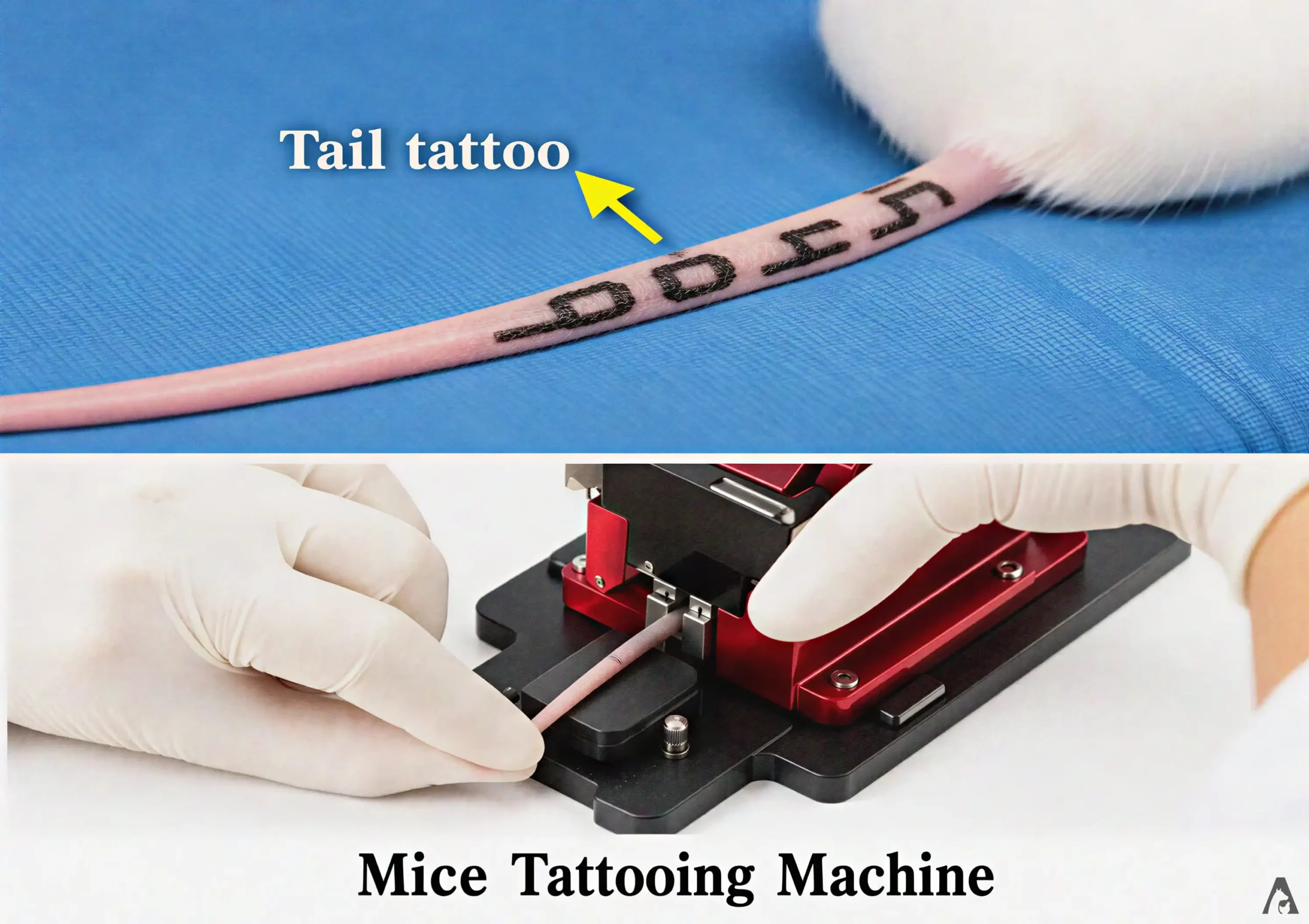
Mice may be identified by a tattoo at the base of the tail using a specialized instrument, or by punching a code of holes in the ears with a chicken toe punch.
Environment
The room temperature should be about 21°C (70°F), with a relative humidity of about 50%. There should be a defined lighting regimen of approximately 12 hours of light and 12 hours of darkness for breeding animals.
Permanent light gives rise to anestrus, and the females will not allow mating. Natural light through windows may cause seasonal variation in breeding performance.
Some strains of mice do not breed well when kept in close proximity to another particular strain. The reason for this is not known, but pheromones may be involved.
Caging and Bedding
Breeding pairs or trios are usually housed in cages measuring 25 × 13 × 13 cm (10 × 5 × 5 inches), while harems (1 male and 5 females) or stock mice (15–20) are housed in cages measuring 50 × 25 × 15 cm (20 × 10 × 6 inches). The cages are constructed of polypropylene or other heat-stable plastics, with a wire-mesh top designed to hold food and a water bottle.
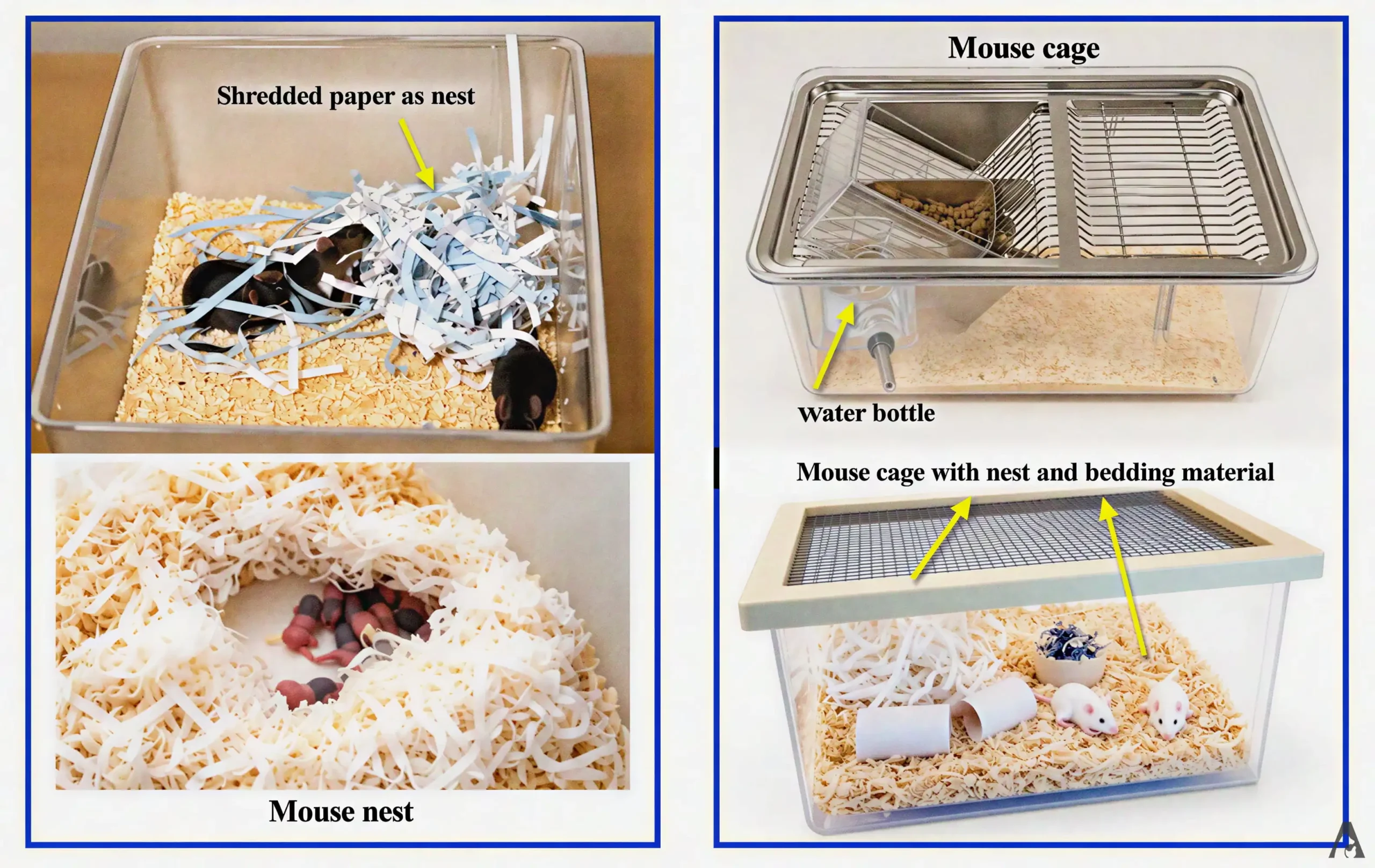
Soft whitewood shavings or sawdust may be used as bedding material, with shredded paper provided for nesting if necessary.