CONTENT
Laboratory Animal Building: Design, Construction and Management
Laboratory animal facilities require carefully controlled environmental and biosecurity measures to maintain animal health and support reliable research outcomes. Proper facility planning focuses on preventing the introduction and spread of infectious agents while providing suitable conditions for housing and handling laboratory animals, particularly those maintained under specific pathogen-free (SPF) conditions.
The building is constructed to a high specification to make it virtually airtight so that only air from the air-conditioning plant is introduced into the animal unit, which is maintained at positive pressure relative to the atmosphere. All materials entering the unit are sterilized, and staff may only enter after taking precautions against carrying in infections.
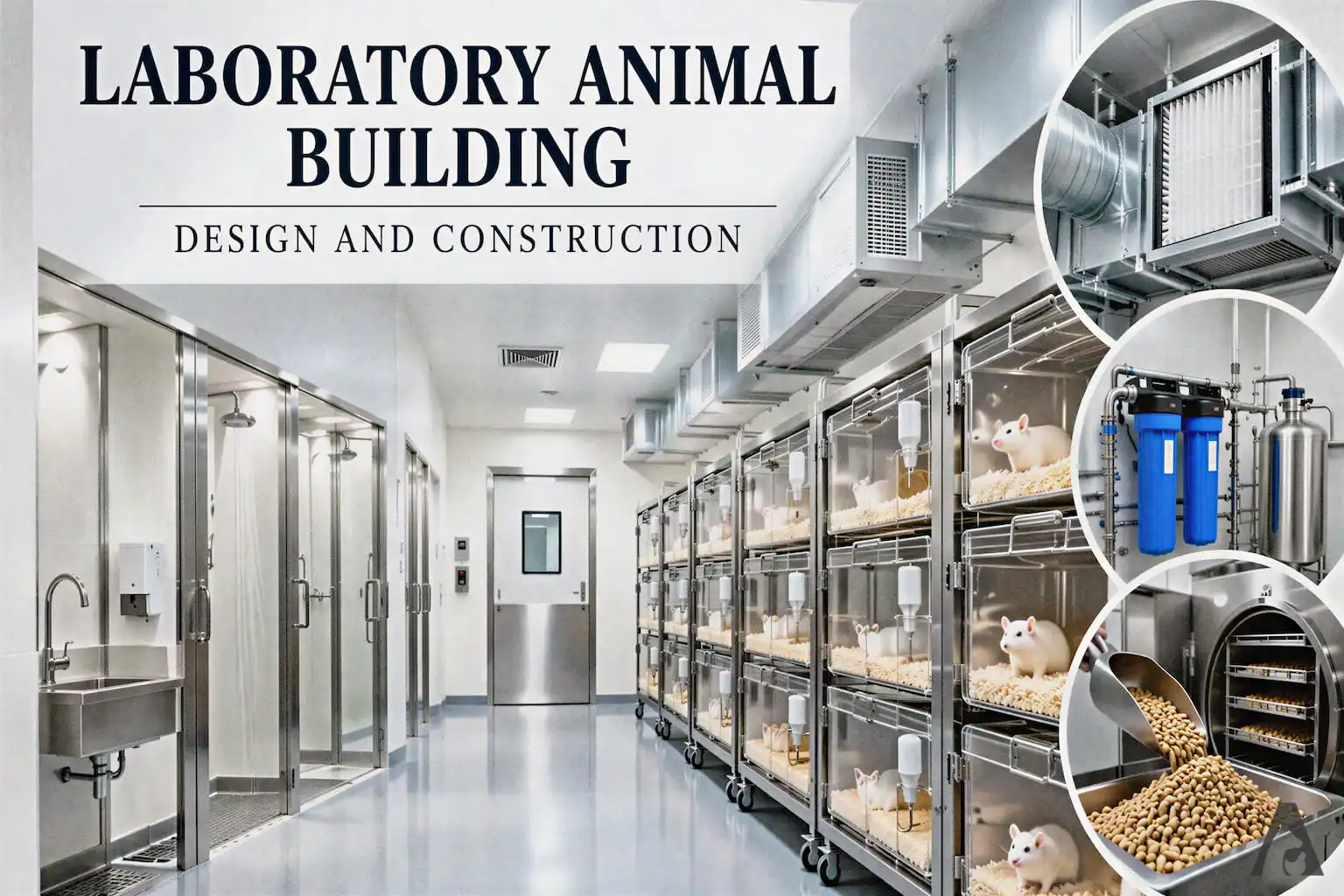
They are usually required to shower thoroughly and change into sterile clothes. Colloquially, the inside of the unit beyond the shower is known as the ‘clean’ side, and the outside is the ‘dirty’ side.
Showers
The shower suite usually consists of five sections. The first forms an airlock and should contain an insecticide dispenser or electric insect killer to prevent flies from entering the unit. The second section is where outside clothing is removed before proceeding to the third section, the shower itself.
The spray may be controlled manually or started by closing the door and will run for a preset time before the door to the next section can be opened. The fourth section is a drying and dressing area where sterile clothing (supplied daily) is put on before passing to the fifth and final section, which is an airlock leading to the animal area.
Air Filtration
Air entering the unit is sterilized by filtration. The air first passes through a roughing filter, which removes gross debris such as insects and large dust particles and requires frequent replacement, either by pulling a clean section of a roll of filter material into position across the inlet duct or by having two filters in series and changing only one at a time so that all air passes through a roughing filter.
Water Treatment
Some users consider that, as ordinary chlorinated tap water is fit for human consumption, it is adequate for SPF animals. Others prefer to add more chlorine to a level of 15 ppm or to acidify the water to pH 2.5. More sophisticated water treatments involve sterilization by filtration through porous ceramics or by using ultraviolet (UV) light.
Diet Sterilization
There are three effective methods of sterilizing diets:
- Autoclaving
- Fumigation
- Irradiation
1. Autoclaving
The autoclave may be programmed to provide a high-temperature, short-exposure cycle (130°C for 1–2 min) or a lower-temperature, long-exposure cycle (121°C for 10–15 min). The first method is preferable, as the total amount of heat applied to the diet is lower and, consequently, there is less damage to nutrients.
2. Fumigation
Fumigation employs a modified autoclave into which a sterilizing gas, such as ethylene oxide, is introduced. A serious disadvantage is that the diet has to be ventilated for up to 3 days before it is free of fumigant, and there is a concern that some toxic compounds may be formed. Therefore, this method is not widely used.
3. Irradiation
The most common method of sterilization is irradiation using gamma rays produced by the radioactive isotope cobalt-60 (⁶⁰Co). These highly penetrating rays are effective in destroying microorganisms without causing the exposed materials to become radioactive. An important advantage of this method is that nutritional and physical damage to the diet is minimized, as the temperature rise is limited to 2 or 3°C.
Drains and Lavatories
Water may be used in SPF units for hosing down and general cleaning purposes. A standard drainage system is used with an extra water trap on the main exit pipe. If a drain remains unused for an extended period, the water may evaporate sufficiently to break the seal and allow organisms from the sewer to enter the unit (though the second trap should prevent this).
Water poured down the unused drain once a week will maintain the seal. Alternatively, a small quantity of light oil poured onto the surface of the water will prevent evaporation. Dry-cleaning systems, in which few drains are used, considerably reduce this problem.
Waste Materials
Apart from wastewater, which has already been considered, the waste materials from an SPF unit are dead animals, general refuse, and large quantities of soiled bedding. These are usually passed out through the autoclave but are not sterilized. Refuse from an SPF unit is, of course, as microbiologically ‘clean’ as the unit itself.
Issue of Animals
Boxes for dispatching animals from the SPF unit are usually made of cardboard or plastic, with a pad of fine filter material stapled or taped over the wire-mesh vents.
The whole box is autoclaved into the unit, animals for dispatch are placed inside, the lid is sealed with tape, and the whole box is passed out through a special exit lock fitted with an ultraviolet lamp. Alternatively, a single flap door may be used, which relies on the outward rush of air to maintain the barrier when the box is passed out.
Introduction of Animals
Animal colonies are established within the unit by introducing stock from an SPF or germ-free source. Further pathogen-free young obtained by hysterectomy of pregnant animals outside the unit are passed aseptically through the barrier and fostered by the previously introduced pathogen-free females.