CONTENT
Laboratory Hamster (Mesocricetus auratus): Biology, Breeding, Care and Management
The laboratory hamster (Mesocricetus auratus), commonly known as the Syrian or golden hamster, is widely used as a laboratory animal in biomedical research. Its small body size, short gestation period, rapid reproductive cycle, and ease of maintenance make it suitable for a variety of experimental studies.
This article covers the biology, reproduction, breeding, nutrition, housing, handling, and general management of laboratory hamsters.
General Parameters
- Body Temperature: 37.4°C (99.3°F)
- Age at Sexual Maturity: 6 weeks
- Mating Weight: 100 g
- Estrous Cycle: 4 days
- Duration of Estrus: 12 hours
- Gestation: 16 days
- Litter Size: 7–9
- Weaning Age: 21 days
The Syrian hamster, Mesocricetus auratus, is also known as the “Golden hamster,” although this term is rather inaccurate because coat colors within this strain vary considerably.
The Syrian hamster, as its name implies, originated in Syria, where three pairs were captured in Aleppo in 1937. Hamsters are used mainly for cancer research and virological and toxicological studies.
Anatomy
An adult Syrian hamster weighs about 100 grams, and coat colors include albino, golden, ginger, and cream. Hamsters possess cheek pouches in which they gather food for later storage in their nests.
The Syrian hamster should not be confused with the large European hamster or the Chinese hamster, which is smaller, gray in color, has a dark stripe running down its back, and has a short but almost prehensile tail.
Reproduction
The hamster is a seasonal breeder and comes into estrus from February to October; in a windowless room with controlled lighting providing at least 12 hours of light, it is possible to reduce seasonal variation.
Hamsters are most active in the dark, and because of this, the lighting cycle can be reversed to provide darkness during the working day to facilitate the special mating system. The female is placed with the male, and the pair are observed to check whether mating takes place.
Mating will take place immediately if the female is in estrus, but if the female does not readily accept the male, she is not in estrus and should be removed before fighting occurs. This requires care by the handler because of the danger of being bitten. This method of mating can be time-consuming, and harems or monogamous pairs may be used instead. If hamsters are grouped at weaning, fighting rarely occurs.
On average, a ratio of 1 male to 5 females is used in the harem, and the females should be removed to a littering cage a few days before parturition and returned to the harem after the litter is weaned.
Young hamsters are approximately the same size as young mice, but they have a shorter tail. At about 12–14 days, the eyes open, and the young become active and grow steadily toward independence and weaning at 21 days.
Sexual Maturity
Female Syrian hamsters attain sexual maturity between 4 and 6 weeks of age, and males at 6 or 7 weeks of age. Males remain sexually active throughout life, but females, depending upon the strain, have a reproductive life lasting between 9 and 14 months of age.
Seasonality in Breeding
A reduction in the number of successful matings is observed in winter if the hamsters are reared under natural lighting. Under artificially controlled illumination, hamsters do not show seasonal breeding behavior.
Hamsters are polyestrous, and the length of the estrous cycle is 4 days. Ovulation occurs spontaneously between 6 and 10 hours after the beginning of estrus.
Estrus Signs
Females exhibit ‘lordosis’ just before and during estrus. This can be induced either by the attentions of the male or by stroking the animal’s rump.
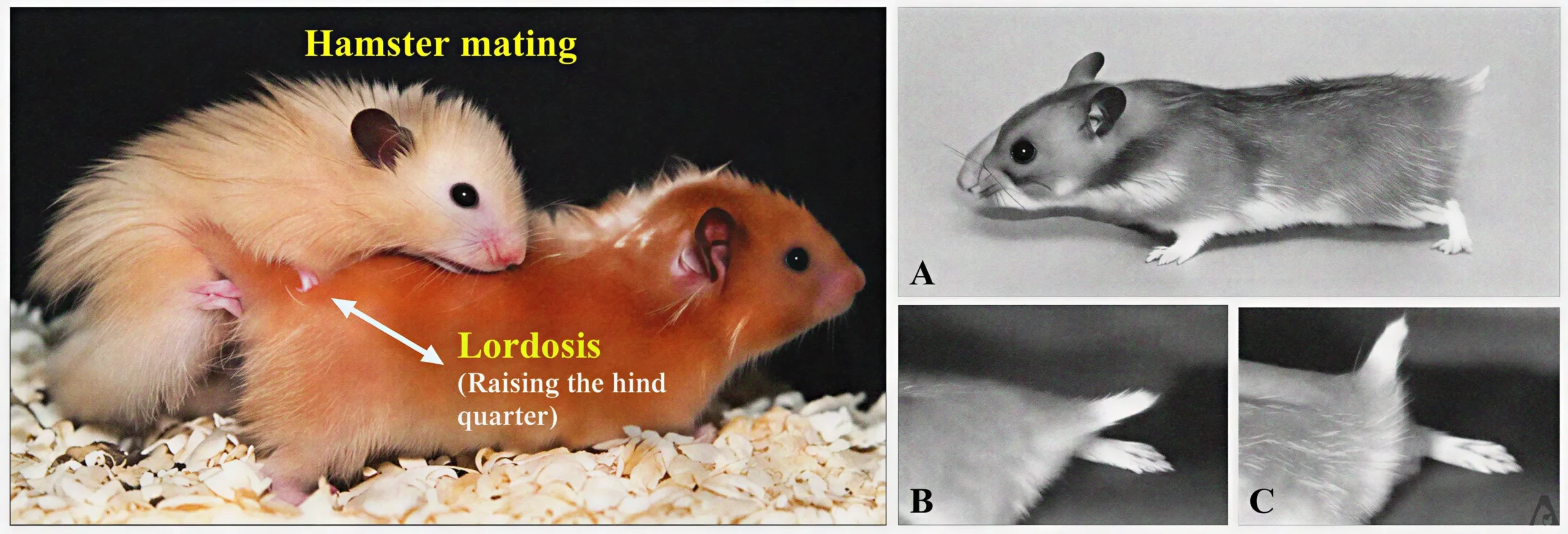
Another method of detecting estrus is to examine the animal every morning for the initial viscous discharge that normally occurs postovulation. If observed, the next estrus can be calculated by counting four subsequent nights.
Sex Ratio
1:5 in a harem.
Mating Management
After observing lordosis, males and females should be paired under dark conditions. Mating usually occurs at night, and females are most receptive to males about 5 hours after the lights are extinguished. It is advisable to adjust the lighting schedule so that the dark period occurs during working hours, and hamsters require at least 3 months to adjust to the change.
The animals should be observed using infrared light, and if the female is receptive and exhibits lordosis, they can be left together overnight. If fighting occurs, they should be separated, and pairing should be attempted on a subsequent ‘night’ until the female responds appropriately. This procedure is called ‘timed mating’.
If timed mating is not required, they can be maintained as monogamous pairs or in harem groups. Monogamous pairs should be formed soon after weaning and should not be separated subsequently. Although postpartum estrus occurs in hamsters, mating will normally not occur in a monogamous pair because the nursing female will not allow the male to mate.
Harems should also be established soon after weaning, with up to 5 females per male. If females are mated, they should be separated from the harem before parturition and allowed to raise the litter separately. When reintroducing the female to the harem, care should be taken to avoid fighting.
If fighting continues for a prolonged period, the female should be separated and kept in a separate small cage within the harem (retaining cage) and can be released when the other members accept the female.
Checking for Mating
Hamsters produce a viscous, creamy-white discharge with a pungent odor that normally occurs postovulation. It becomes a small yellowish plug during diestrus.
Mating can be confirmed by the presence of a copulatory plug in the vagina or by examination of a vaginal smear for spermatozoa. Pseudopregnancy may occur and lasts for 8–10 days.
Gestation
Pregnancy can be confirmed by the absence of postovulatory vaginal discharge. The gestation period ranges between 15 and 17 days.
The pregnant female should be separated from the male and the rest of the harem and housed separately. Sufficient bedding material should be provided.
Care and Management of Newborns
Cannibalism is a common problem that can be reduced by minimizing the handling of newborns. Fostering should not be attempted in hamsters because female hamsters are very aggressive and intolerant of fostering, and they may kill their own litter if offspring from another litter are added.
At the time of birth, the young are naked and their eyes are closed. Hair growth normally occurs by 16 days. Weaning is normally done between 21 and 25 days of age.
Sex Differentiation
Males and females can be differentiated by the anogenital distance. In males, the distance is longer.
Nutrition
Laboratory hamsters are usually fed compounded diets made into pellets; a typical rat and mouse diet is suitable. Supplements of sunflower seeds and a variety of cereals are also enjoyed by hamsters, but it is not advisable to feed fresh vegetables because diseases such as pseudotuberculosis may be introduced into the colony.
Water should always be available from bottles or automatic drinkers rather than open dishes, which easily become soiled.
Handling
A frightened hamster often appears aggressive, which it demonstrates by rolling onto its back or by standing on its hind limbs and screaming at the handler. This is little more than a defense mechanism and should be ignored.
The animal may be lifted in cupped hands if it is accustomed to being handled or by firmly grasping the loose skin at the back of the neck. The latter method of handling is preferred if manipulation is necessary; the hamster should be supported so that the fingers may be wrapped around its legs, ready for examination, injection, or dosing.
Identification
There are not many successful methods of identifying hamsters. Coat color can often serve as a method but becomes confusing when dealing with large numbers.
Tattooing the ear with forceps is a difficult and time-consuming procedure. Ear punching may be considered a useful method, but the marks can be obscured by fighting.
Environment
The optimum temperature is 20–21°C (68–70°F), with a relative humidity of 50–60%. Hamsters need at least 12 hours of light, which may be artificial, if they are to be bred successfully throughout the year.
Caging and Bedding
Rat or mouse cages are equally suitable for hamsters. The addition of an activity wheel will provide hours of exercise and help prevent the animals from becoming bored and destructive. Breeding cages should contain a small nesting area set aside to encourage good mothering, although this is not a prerequisite.
Absorbent materials such as sawdust or wood shavings should be used in solid-floor cages and may serve as both bedding and nesting material. Pregnant females will spend a considerable amount of time building nests out of wood wool or shredded paper.
Common Diseases
| Type | Common Name | Causal Agent |
|---|---|---|
| Bacterial | Salmonellosis | Salmonella enteritidis and Salmonella typhimurium |
| Bacterial | Wet Tail | Escherichia coli and Proteus vulgaris |
| Ectoparasitic Mite | Body Mange | Demodex criceti |