CONTENT
Laboratory Guinea Pig (Cavia porcellus): Biology, Breeding, Nutrition & Care
The laboratory guinea pig (Cavia porcellus) is a widely used small animal model in biomedical and veterinary research. Proper management requires an understanding of its anatomy, reproductive biology, nutritional requirements, housing, handling, and general care.
This article provides an overview of the key biological parameters, breeding practices, nutrition, husbandry, and management of laboratory guinea pigs.
General Parameters
- Body Temperature: 38.3–40°C (100–104°F)
- Age at Sexual Maturity: 60–80 days
- Mating Weight: 500 g
- Estrous Cycle: 14–16 days
- Duration of Estrus: 6–11 hours
- Gestation: 59–72 days
- Litter Size: 3–6
- Weaning Age: 14–21 days
Guinea pigs have been extensively bred by pet fanciers, and there are now three main varieties: English (smooth hair), Abyssinian (rosetted hair), and Peruvian (very long hair). There are many color variations of these, and new ones are constantly being bred.
Anatomy
The guinea pig is an herbivorous rodent, a fact that is reflected in its anatomy. It has rodent dentition, and the alimentary canal is typical of a herbivore, with a large cecum for cellulose digestion.
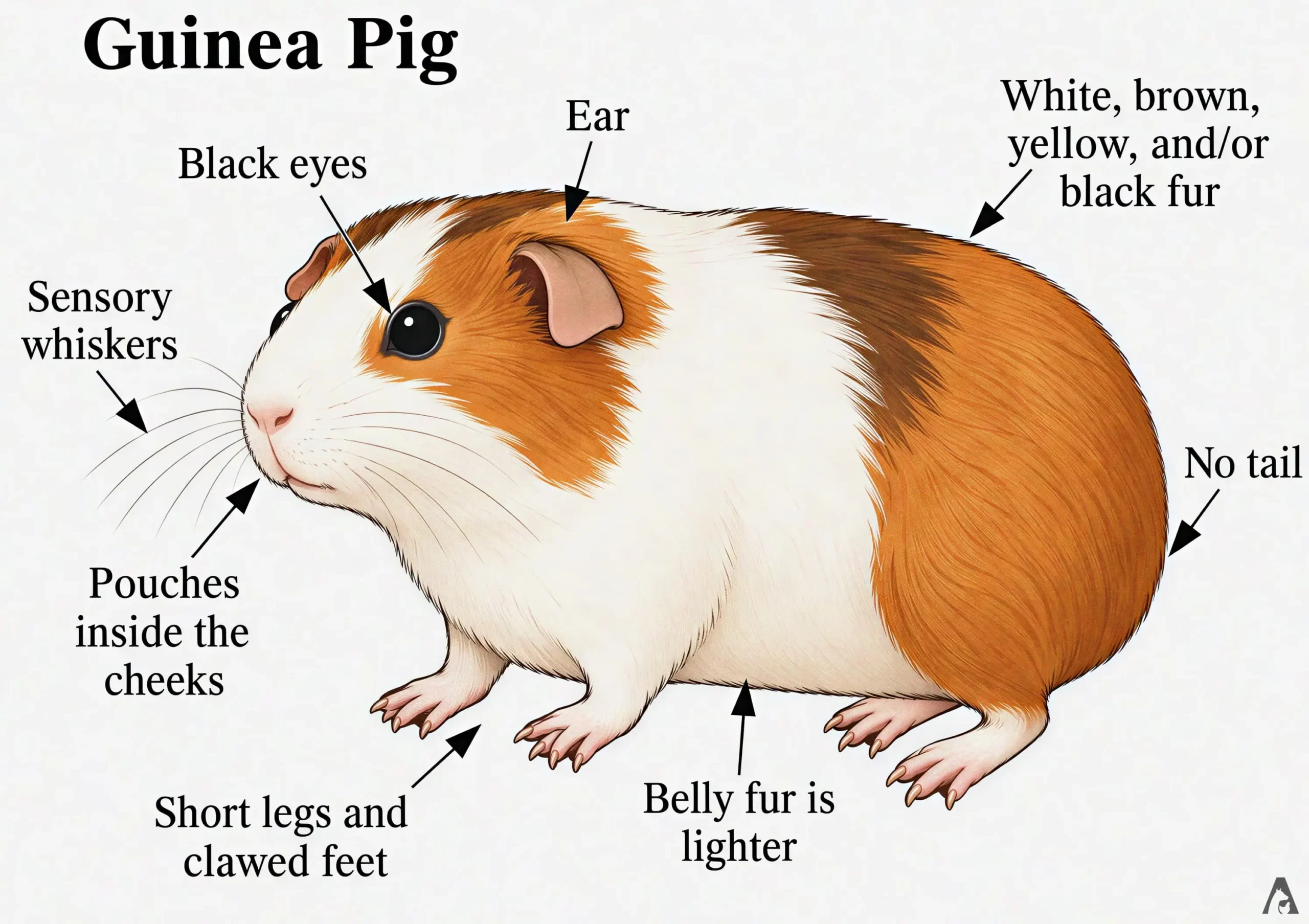
There are two mammary glands, and the nipples, situated in the groin, are found in both sexes. The guinea pig has no tail and has 4 toes on the front feet and 3 on the hind feet.
Reproduction
- There is no defined breeding season, but in an environment influenced by natural light, seasonal variation may be apparent.
- Guinea pigs are commonly bred in harem systems of 1 male to 5–7 females.
- Estrus can be observed by the degree of vaginal opening, and copulatory plugs, usually found on the floor of the cage, indicate that mating has taken place. By recording these signs, mating can be timed.
- When the guinea pig is not in estrus, the vagina is normally sealed by a membrane. However, it is possible to rupture this membrane, and it is therefore not a foolproof indication of the stage of estrus.
- Guinea pigs exhibit postpartum estrus, and if the harem is left intact, further mating will occur.
- The young are well developed at birth and will suckle from any lactating female in the harem. Accurate breeding records are difficult to keep with this system. Young are normally weaned at 14 days but, with care, can be weaned from birth.
Sexual Maturity
Guinea pigs usually show sexual activity by the 10th week, but it is better to breed them after 12 weeks of age. Their breeding life is about 2 years.
Seasonality of Breeding
- Nonseasonal breeding is observed under laboratory conditions, but females kept outdoors may show anestrus in winter.
- Guinea pigs are polyestrous. Estrus lasts for about 8 hours, and ovulation is spontaneous and occurs 1–2 hours later.
Estrus Signs
Most of the time, a thin membrane covers the vagina when the female is not in estrus, and it ruptures at the time of estrus. Sometimes, this membrane may remain intact and has to be ruptured during copulation.
The lordosis response in the female is more reliable than the membrane. A female that shows lordosis (provoked by stroking the posterior part of the dorsal surface) will mate within the following 24 hours. Metestrus bleeding from the vagina is an indicator of estrus.
Sex Ratio
A male-to-female ratio of 1:8–12 is optimal. The male should be kept with the females throughout the estrous cycle.
Checking for Mating
The vaginal membrane should be examined daily for rupture. In addition, a copulatory plug may be noticed in some cases. The presence of a copulatory plug on the floor of the cage is also an indication that mating has occurred.
Rearing Mated Females
Mated females can either be left in the breeding cage to rear their young or be moved to individual or colony cages with other females.
Leaving the female with the male has an advantage because guinea pigs have postpartum estrus, which can be utilized if females are left with the males.
Gestation
Gestation lasts between 63 and 69 days, depending on the strain and litter size. If mating occurs at postpartum estrus, the gestation length is extended by about 5 days. Pseudopregnancy does not appear to occur in guinea pigs.
Sex Differentiation and Weaning
There is no difference in the anogenital distance between males and females. In neonates, sex can be determined by the shape of the genital opening. It is round in males and appears as a longitudinal slit in females.
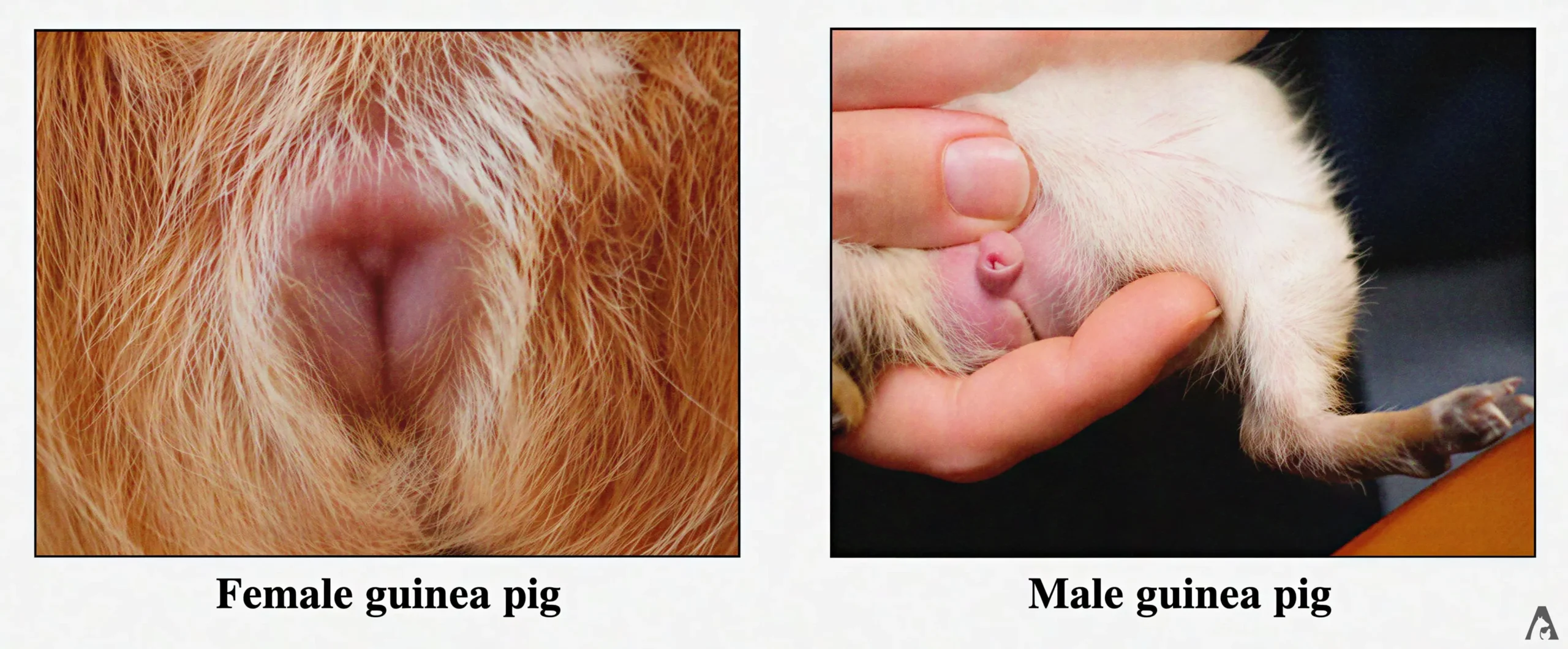
Gentle pressure anterior to the genital opening of the male will extrude the penis, and it is also possible to palpate the undescended testes. Young guinea pigs should be weaned between 3 and 4 weeks of age.
Care and Management of Newborns
Guinea pigs are born at a well-advanced stage of development, with a full coat and open eyes. They are active and begin moving on the first day and may also begin consuming solid food on the same day.
Litter size ranges from 1 to 6, with an average of 3 or 4. In communal breeding cages, all females with litters cooperate in nursing the young.
Nutrition
The most important feature of guinea pig nutrition is that, like primates, it is one of the few species unable to synthesize its own vitamin C; therefore, vitamin C must be provided in the diet or drinking water as ascorbic acid.
Vitamin C is destroyed by contact with metal; therefore, only glass drinking spouts should be used. Fresh green food can be used to provide vitamin C but may be contaminated with pathogens; 50 g of cabbage will provide a guinea pig’s daily requirement. Guinea pigs eat about 25–50 g of pelleted diet per day. They drink approximately 85 mL of water per day.
Handling
Because they rarely bite, guinea pigs tend to be mishandled. When disturbed, they will race around the cage. A guinea pig should be caught by placing one hand in front of the animal and the other behind it; it can then be lifted from the cage with its body supported by both hands.
Identification
Identification can be a problem: the ears are often colored, making tattooing difficult; tags tend to be torn out; and notches and holes in the ears can easily be confused with tears.
In albino colonies, ear tattooing is probably the best method; however, for colored animals, a punched hole is the only practicable method.
Environment
Guinea pigs require a room temperature of about 18°C (65°F). Breeding performance, for example, may be affected by high summer temperatures. Windowless rooms with time-controlled artificial lighting are advisable to prevent seasonal effects on breeding.
Caging and Bedding
The most common system is a wire-floored cage with manual or automatic cleaning and/or flushing underneath. If solid floors are used, softwood shavings and hay are suitable bedding and nesting materials.
Automatic drinkers are widely used; these should be tamper-proof and strong (preferably stainless steel), as guinea pigs will constantly chew and play with them.
Disease
It is important to note that many antibiotics are reported to be toxic to guinea pigs, especially penicillin, streptomycin, and tetracycline, and should not normally be used for the treatment of this species.