CONTENT
Environmentally Controlled Poultry House: Advantages, Disadvantages & Floor Space Requirements
An environmentally controlled poultry house is a housing system in which key environmental factors, including temperature, humidity, ventilation, and lighting, are regulated to provide optimal conditions for poultry. These houses use automated systems to maintain the desired microenvironment, improve production efficiency, and reduce the impact of external environmental conditions on bird performance. This article covers the major features, advantages, disadvantages, and floor space requirements of environmentally controlled poultry houses.
In environmentally controlled houses, the total microenvironment is automatically controlled and maintained within the optimum range. Environmental factors such as temperature, humidity, lighting, and ventilation are automatically controlled.
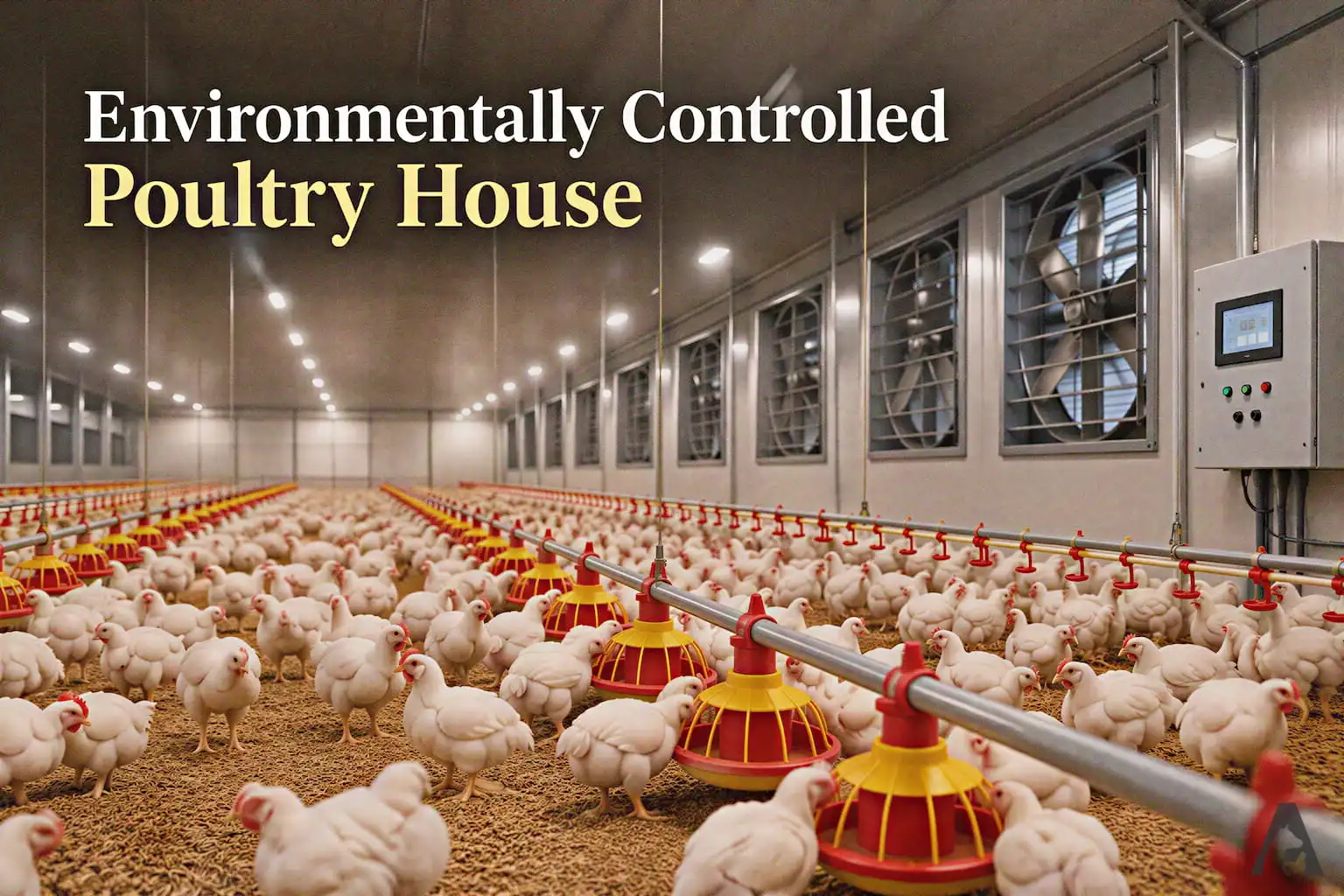
The temperature is maintained at around 24°C, and the humidity is maintained at around 50%. Such houses have no windows. Hot air is removed by exhaust systems, and fresh air is introduced through inlets by negative pressure, thereby controlling ventilation. Lighting is also fully controlled, and daylight has no effect on the birds.
Therefore, a non-24-hour (shorter or longer day) lighting schedule is possible. A non-24-hour lighting schedule is called ahemeral lighting. All operations are computer-controlled and can be monitored from outside the house.
Advantages
- Highly hygienic among all housing systems
- Reduced problems with ammonia and flies
- Reduced labor requirements due to automation
- Complete control over photoperiod for optimum maturity and production
- Higher production
- Fewer diseases
Disadvantages
- Higher investment than other housing systems
- Higher operating costs increase the cost of production
- Failure of temperature and humidity control can cause heavy mortality
Floor Space Requirements
| Type | Age (in weeks) | Deep-litter (ft²) | Cages (ft²) |
|---|---|---|---|
| Egg-type chicken | 0–8 | 0.60 | 0.20 |
| 9–18 | 1.25 | 0.30 | |
| >18 | 1.50 | 0.50 | |
| Meat-type chicken | 0–4 | 0.30 | – |
| 4–8 | 0.75 | – |