CONTENT
Practical Feeding of Lab Animals: Diets, Practices and Nutrition
Practical feeding of laboratory animals involves providing nutritionally adequate and acceptable diets according to the species, physiological state, and experimental requirements. Proper feeding practices are essential for maintaining animal health and ensuring reliable research outcomes. This includes appropriate diet formulation and feeding methods, as well as specialized approaches such as purified and chemically defined diets, germ-free diets, hand rearing, and paired feeding.
Many of the smaller or more common laboratory animals are fed diets ad libitum; however, there is a tendency, particularly when the animal is not growing or reproducing, for them to eat more than they require and consequently become somewhat obese and more prone to diseases and conditions associated with obesity, such as kidney failure, liver necrosis, and arteriosclerosis.
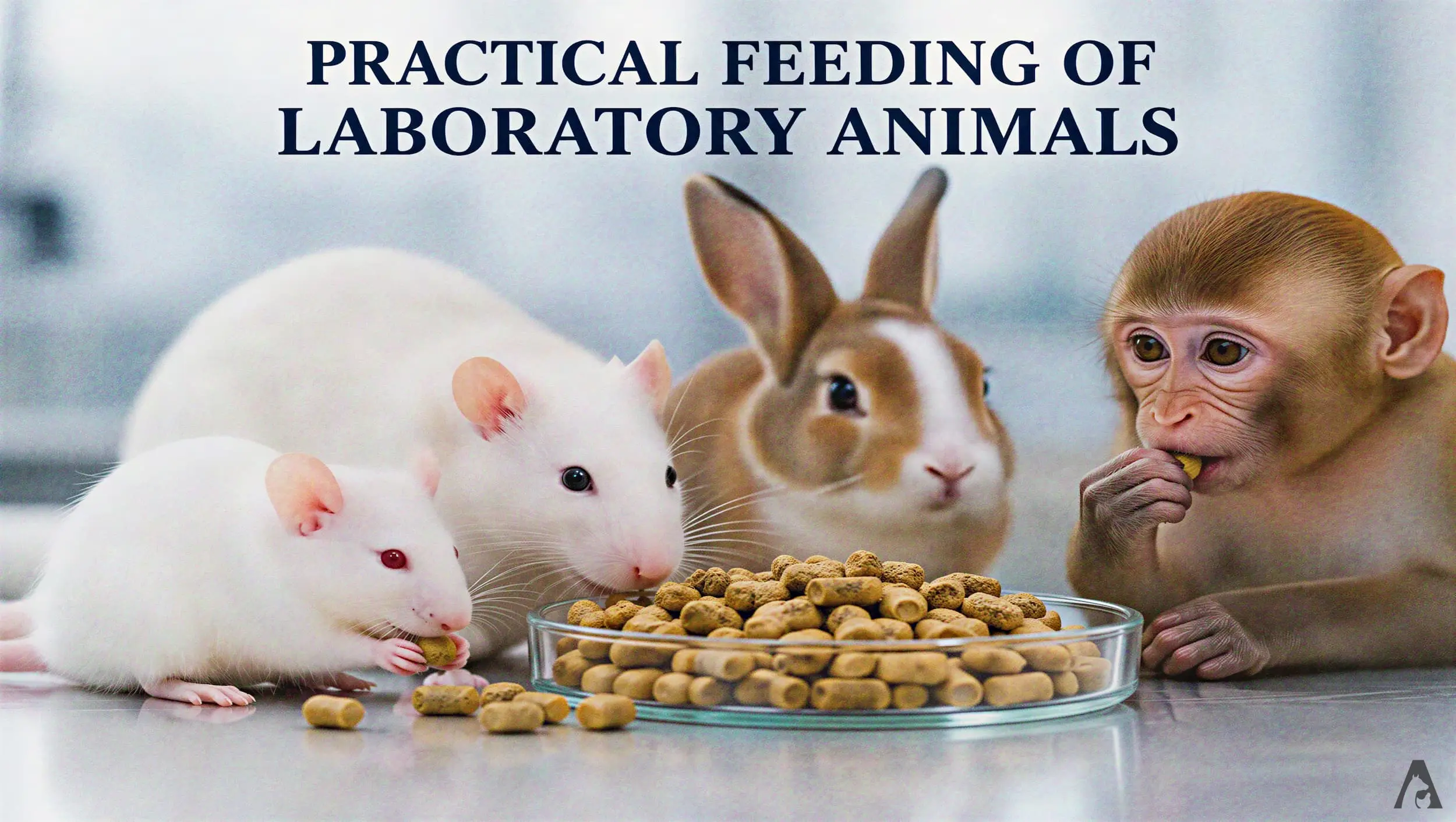
This may be controlled in one of two ways, both designed to reduce nutrient intake. First, by physically controlling food intake, and second, by designing diets with a lower nutrient density so that, although it eats to satiation, the animal ingests fewer nutrients than it would on a more concentrated diet.
Large quantities of uneaten food left in the cage may create health hazards by decaying or becoming contaminated with feces. This danger can be overcome by feeding a measured quantity of food once or twice a day.
Formulation of Diets
Designing a satisfactory diet for any species requires an awareness of a number of practical and theoretical factors. Primary consideration must be given to the purpose for which the diet is required (for example, maintenance or breeding), the available raw materials, whether it needs to be sterilized, and how long it may be stored before use.
The diet formulation is usually based on the protein content, which is supplied by a combination of ‘high-quality’ sources such as fish meal and soybean meal, while cereals supply proteins of a ‘lower quality’. These sources are adjusted to provide a dietary protein combination that meets the requirements as closely as possible.
Acceptability of the Diet
Another aspect of great importance is the acceptability of the diet to the animal. For certain species, such as cats and primates, and to a lesser extent dogs, taste and texture are of greater importance than for others, such as rodents.
Texture, as well as taste, aids acceptability, and diets are produced in a variety of forms, from moist, canned, and soft-moist diets for dogs and cats and soft diets for monkeys to various forms of pelleted and expanded diets for all species. Even in rodents, the physical form of a diet can influence food intake.
Rodents have been shown to eat less of an unpelleted meal diet than of the same diet following pelleting. Pelleted diets should not be too hard, as this can restrict food intake, particularly in smaller, weaker animals.
Specialized Diets and Practices
Laboratory animals require some specific diets and feeding practices to meet their nutritional requirements. These include:
- Purified diets
- Chemically defined diets
- Germ-free diets
- Hand rearing
- Paired feeding
Purified Diets
A purified diet is defined as a feed in which purified components such as carbohydrates (starch, sucrose), purified protein sources (casein, lactalbumin), refined oils, synthetic vitamins, and refined mineral supplements are used as ingredients.
Such diets have sometimes been referred to as ‘semisynthetic diets,’ but the accepted terminology is purified diets. They have been used in nutritional studies and other research.
Chemically Defined Diets
For certain experimental purposes, even the degree of refinement achieved by purified diets is inadequate, so “chemically defined diets” may be required.
These are made from basic nutrients, e.g., glucose, triglycerides, essential fatty acids, individual amino acids, vitamins, and minerals, which can be obtained in a chemically pure form. They are normally used in nutritional studies and immunological research.
Germ-Free Diets
The gut microflora has a significant influence on the synthesis of certain vitamins (B vitamins and vitamin K). Germ-free and other types of gnotobiotic animals cannot, therefore, benefit from this source of nutrients.
Because diets for gnotobiotic animals must be sterilized, they require supplementation with those vitamins supplied by the flora, in addition to nutrients that may have been destroyed by the sterilization process.
Hand Rearing
Rearing laboratory animals by hand is a costly and labor-intensive process. Hand rearing is employed, however, to produce valuable or rare animals and in circumstances where maternal rearing is impossible or contrary to experimental requirements (cesarean-derived germ-free or SPF animals, or where a study of immune factors derived from milk is being carried out).
Paired Feeding
Under many experimental conditions, interpretation may be obscured by a supplementary effect resulting from differences in food intake between experimental and control groups. If, for example, a group of animals undergoing treatment began to lose weight and food intake was also reduced, it would be difficult to determine whether the effect resulted from the treatment or the reduced food intake.
Paired feeding allows food intake to be eliminated as a potential cause and allows researchers to concentrate on the treatment. The simplest form of paired feeding is one in which each control is paired with a treated animal and fed the amount of food that the experimental animal consumed on the previous day, so that fluctuations in food intake in the experimental group are accurately reflected in the controls.
Coprophagy
Coprophagy, practiced by all rodents and lagomorphs, is the process of reingesting some of the fecal material. Its value to the animal is that it allows more efficient absorption of nutrients, particularly those, e.g., B-group vitamins, that may be synthesized by the gut microflora in the lower part of the intestine, beyond the area of maximal absorption.
Coprophagy can seriously interfere with certain experimental procedures that involve tracing the absorption and utilization of administered materials. The practice may be eliminated by using certain devices designed to prevent the animal from consuming fecal pellets either from the floor or directly from the anus.