CONTENT
Poultry Nutrition: Nutrients, Protein, Vitamins, Minerals & Requirements
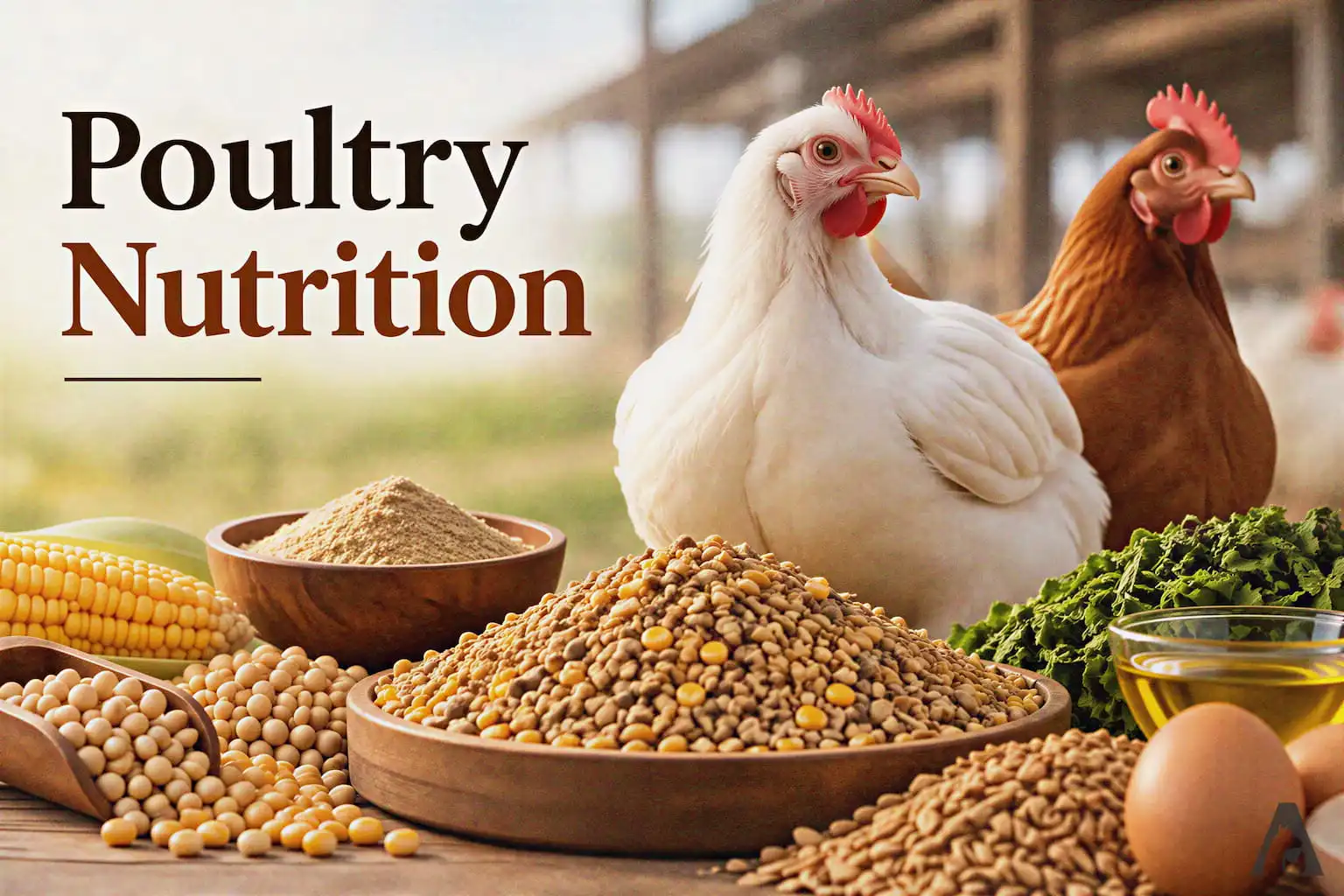
Poultry nutrition is essential for maintaining health, supporting growth, optimizing production, and improving feed efficiency. A balanced poultry diet must provide adequate protein and amino acids, energy, vitamins, minerals, and water according to the bird’s age, production stage, and environmental conditions.
Feed is the single largest item of expenditure, accounting for more than two-thirds of the total cost of production of broilers and eggs at prevailing prices. Moreover, the cost per kilogram of feed is increasing day by day without any proportionate increase in the selling prices of broilers or eggs.
A major portion of feed is prepared on the farm or by custom mixing. Only about 20 percent of the requirement is met by the organized sector. If both feed formulation and mixing are practiced scientifically, the current production level of all birds can be improved substantially.
Poultry farms can be made more remunerative by preparing their own feed. Before a farmer plans to mix their own feed, they should understand what nutrients are, as well as the nutrient requirements of different categories of birds.
Nutrients
Nutrients are essential substances present in different types of foods that perform various life-sustaining functions in the body. They are required for growth, maintenance, and productive processes. A deficiency of nutrients in the feed below the required level results in the development of diseases referred to as “deficiency diseases.”
Poultry require more than 40 such nutrients, which are classified into six major groups based on their chemical nature, functions or roles, and the methods used to determine them.
The groups of nutrients are:
- Proteins
- Carbohydrates
- Fats
- Vitamins
- Minerals
- Water
These groups of nutrients are present both in poultry feed and in the bodies of birds. However, they are not directly transferred from the feed to the tissues but are broken down in the bird’s body during digestion, absorption, and metabolism. The various functions performed by each nutrient and the nutrient requirements of poultry vary from one nutrient to another.
Proteins
Proteins are considered the building blocks of the body. They are essential for proper growth and for maintaining health. Most materials used as ingredients in poultry feeds contain some protein.
Grains generally contain 8–9 percent crude protein but cannot meet the bird’s total protein requirement. It is therefore necessary to include other ingredients that contribute higher levels of protein. Oilseed meals are good sources of vegetable protein, while dried fish and meat meal supply animal protein.
The amount of protein required by broilers varies considerably according to age and level of performance. There is a high demand for protein during the early stages of development. Moreover, the energy level of the ration also determines the protein requirement; the higher the energy level, the greater the percentage of protein required.
| Amino Acids | |||
|---|---|---|---|
| Nonessential | Essential | Critical | Limiting |
| Alanine | Lysine | Lysine | Lysine |
| Aspartic acid | Methionine | Methionine | Methionine |
| Glutamic acid | Methionine + Cystine | Methionine + Cystine | Threonine |
| Hydroxyproline | Tryptophan | Tryptophan | Tryptophan |
| Proline | Threonine | Threonine | |
| Glycine + Serine | Arginine | Arginine | |
| Isoleucine | Isoleucine | ||
| Leucine | |||
| Valine | |||
| Histidine | |||
| Phenylalanine | |||
| Phenylalanine + Tyrosine | |||
Protein is made up of several amino acids, and it is necessary to know the composition of any protein-rich ingredient in terms of its constituent amino acids and their requirements.
Carbohydrates and Fats
Birds require energy or fuel to maintain their body temperature, keep body systems functioning continuously, and perform different types of functions.
Birds derive their energy primarily from two major groups of nutrients—carbohydrates and fats or oils. Carbohydrates and fats are not actually taken into consideration when defining nutrient requirements for poultry. Instead, the metabolizable energy (ME) value is the one most frequently used to describe the energy value of ingredients and complete feeds for poultry.
The ME values of most feed ingredients have been compiled and are available for ready use. These are calculated as gross energy minus energy excreted through droppings (feces + urine) and gases, and are expressed as kilocalories per kilogram of feed (1 kcal = 4.18 kJ). The energy content of the feed determines the quantity of feed consumed by birds. If the energy level is lower, the amount of feed consumed per day is higher, and vice versa.
The total intake of other nutrients in the feed is therefore also influenced by the energy content of the feed. It is then necessary to adjust the density of different nutrients present in poultry feed, not only according to the requirements of the bird but also according to the expected feed intake per day, which is determined by the energy content of the feed.
Since most vitamins and minerals are normally provided in poultry feed well in excess of the daily requirement, it is customary to adjust only the protein content to the energy content. This relationship is referred to as the calorie-to-protein ratio or C:P ratio, which is more important than the total requirement for energy or protein.
Vitamins
Vitamins are complex compounds that play an important role in metabolism. Even though they are required in relatively small amounts, the presence or absence of vitamins can make a significant difference between profit and loss in poultry farming.
Good growth, prevention of leg weakness, and proper eggshell thickness all require adequate vitamin levels. Vitamins occur in many naturally available feed ingredients. They can also be added as supplements to meet the birds’ requirements.
Vitamins are classified into two groups: fat-soluble vitamins and water-soluble vitamins. The fat-soluble vitamins are vitamins A, D, E, and K. The water-soluble vitamins include the B-complex group and vitamin C.
Vitamins in the B-complex group include thiamine (B₁), riboflavin (B₂), niacin, pantothenic acid, pyridoxine (B₆), biotin, choline, folic acid, and cobalamin (B₁₂). Vitamins A, B₂, and D₃ are called “critical vitamins” for poultry, as deficiencies in their availability can severely impair growth rate and egg production.
Minerals
About one percent of broiler meat and 11 percent of eggs are made up of minerals, while bones contain about 40 percent minerals. Minerals are also found in all body tissues and fluids and perform many important functions, such as bone and eggshell formation and blood clotting.
Feed ingredients of animal origin contain more minerals, while those of vegetable origin have a lower proportion. As minerals found in common feedstuffs may not supply the birds’ requirements, mineral supplements are added to the ration to prevent the development of deficiency symptoms.
The minerals required by poultry are classified as “macro,” “micro,” and “trace” minerals, depending on their required levels. The macrominerals are calcium, phosphorus, potassium, sodium, and magnesium; the microminerals are iron, manganese, zinc, copper, and iodine; and the trace minerals include cobalt, fluorine, selenium, molybdenum, etc.
Water
Water makes up about 60 percent of the composition of a bird’s body. Birds can survive for a limited period, even two to three days, without consuming solid feed, but suffer very quickly, within 12 hours, if there is a shortage of water.
A free supply of cool, fresh, clear, potable water should therefore be ensured throughout the day.
Nutrient Requirements
As birds are fed in groups, nutrient requirements are not expressed on an individual basis but are expressed per unit weight of feed; hence, feed intake by the bird influences nutrient requirements.
Nutrient requirements of birds are also influenced by the age and size of the bird, production level, energy content of the ration, physical form of the diet, sex of the bird, nutritional adequacy of the diet, and environmental temperature.
Prescribing a common list of nutrient quantities for birds across all seasons, ages, and environmental conditions is therefore an extremely difficult task. To allow for variations in the composition of feed ingredients, avoid losses during storage, account for nutrients destroyed in the digestive tract, and ensure nutrient stability, the supply of nutrients is increased above the minimum requirement as a safety margin.
Minerals and vitamins are more prone to destruction, as stated earlier. For the majority of vitamins, usually twice the required amount is added as a safety margin. The minimum requirement of trace minerals may be supplemented above any safety level present in the feed ingredients.