CONTENT
Poultry Industry: Development, Production, and Importance
The poultry industry is an important component of animal agriculture, involving the production and management of domesticated birds for eggs, meat, feathers, and other valuable products. Chicken is the most widely raised poultry species, while turkey, duck, Japanese quail, guinea fowl, geese, pigeon, ostrich, and emu also contribute to poultry production. Poultry farming has developed considerably with advances in breeding, nutrition, management, disease control, and production systems, making it an efficient and commercially important livestock enterprise.
The term “Poultry” refers to all domesticated species of birds, such as chicken, duck, turkey, Japanese quail, guinea fowl, geese, pigeon, ostrich, emu, etc. Chicken is the most numerous and popular among domesticated poultry species. The study of these poultry species is called Poultry Science, while the study of birds collectively is called Ornithology.
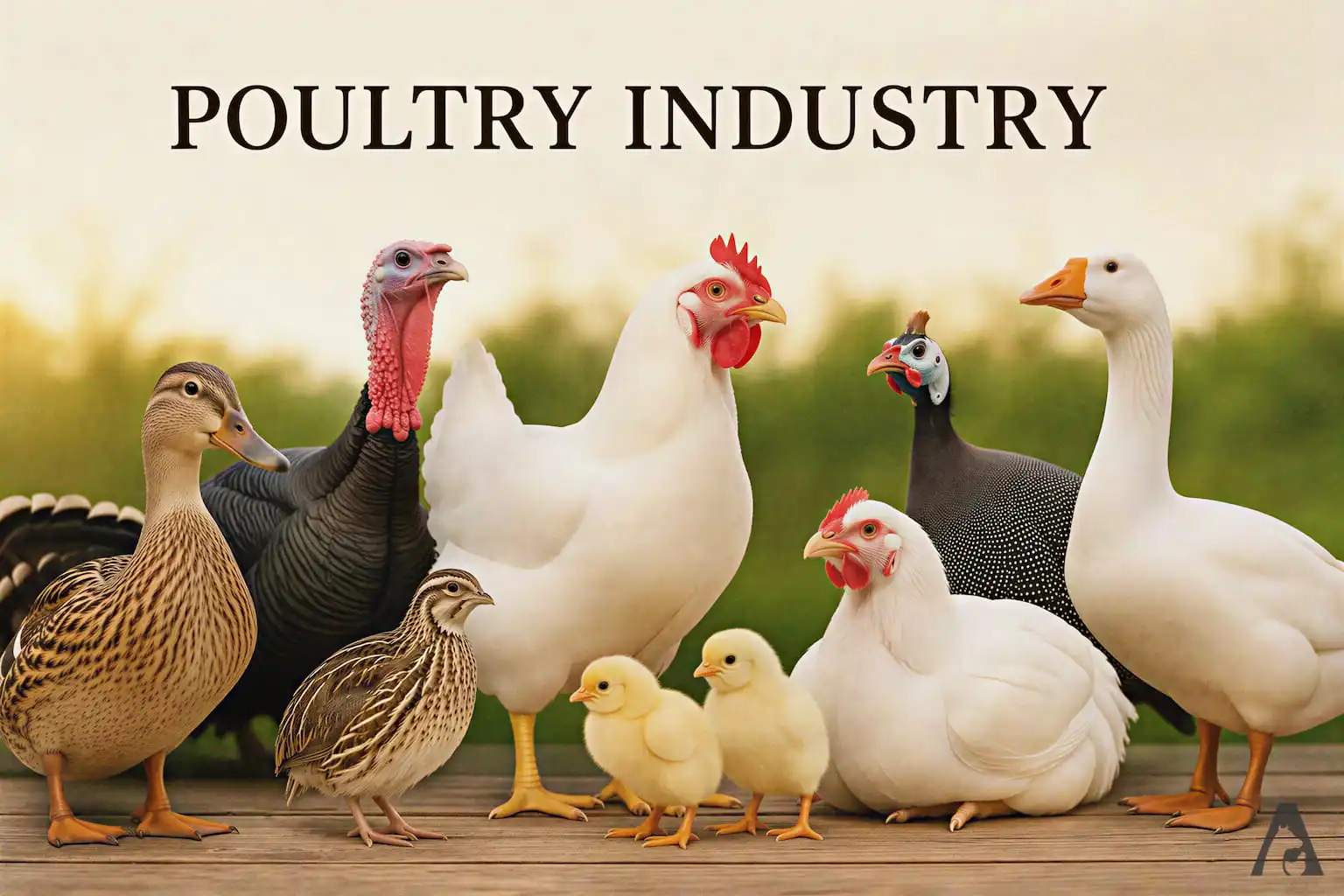
Chicken is the most popular domesticated poultry species.
Japanese quail meat and eggs have become popular. The development of meat-type Japanese quail with better feed efficiency and lower production costs favors its growth.
Turkey, guinea fowl, and goose farming are still in their early stages due to a lack of consumer awareness.
Emu and ostrich farming have recently been initiated for the production of:
- Leather/Skin (for the production of various products)
- Feathers/Plumage (for ornamental purposes)
- Oil (high medicinal value)
- Cornea/Tendon (for surgical transplantation)
Development of Poultry Industry
The organized effort to develop the poultry industry in India was first started in 1957, when the IInd Five-Year Plan (1956–61) was launched. An All India Poultry Development Project was initiated by setting up regional poultry farms at Bangalore, Mumbai, Bhubaneswar, Delhi, and Shimla to acclimatize imported, good-quality stock under their respective agro-climatic conditions and propagate them extensively in these regions. Almost all poultry farm equipment was also imported and supplied to regional poultry farms.
Besides this, 269 poultry extension-cum-development centers, each with a unit of 100 layers of improved breeds, were set up in different parts of the country. The period between the IInd and IVth Five-Year Plans was actually the turning point in the history of the poultry industry in India.
Central Poultry Breeding Farms at Mumbai, Bhubaneswar, and Hassarghata produced high egg-producing strains, while the Chandigarh farm evolved fast-growing broiler strains.
Random Sample Units at Hassarghata, Mumbai, and Bhubaneswar conduct egg-laying and broiler quality tests and thereby provide useful information to poultry farmers and breeders regarding the performance of various stocks available in the country.
The Central Training Institute for Poultry Production and Management at Hassarghata, as well as the Central Avian Research Institute (CARI) at Izatnagar, impart training to officers of state agricultural and veterinary universities engaged in various aspects of poultry farming.
The Indian Council of Agricultural Research (ICAR) has sponsored All India Coordinated Research Projects on poultry breeding and poultry nutrition at several research institutes, including agricultural and veterinary universities across the country. The National Agricultural Cooperative Marketing Federation of India (NAFED) handles the marketing of eggs and poultry meat at national and regional levels.
In general, the development of the poultry industry in India has been brought about in the following ways:
- Developing new, more productive layer and broiler strains.
- Development of vaccines.
- Giving poultry farmers the freedom to determine prices for eggs and meat through organizations such as the National Egg Coordination Committee (NECC) and Broiler Coordination Committee (BCC).
- Financing of poultry schemes.
Eggs and chicken were considered “agricultural produce” a few years ago but are considered “food items” today. Food safety has become a priority. Besides maintaining production efficiency, producers have to focus on the nutritional value, adulterants, and contaminants present in their products. The Ministry of Food Processing Industries at the central government level and food inspection authorities at the local level have started monitoring egg and chicken production in India for quality and nutritional standards.
Poultry farming holds a prominent place for a variety of reasons. Various factors responsible for the commercialization and growth of poultry farming in the country include:
- Highly prolific in nature (one hen can produce 250 chicks in a year)
- Short generation interval in poultry compared with other livestock species (Chicken – 2 generations per year; J. quail – 6 generations per year)
- Adaptable to various agro-climatic conditions (0 to 40°C temperature)
- Can be reared at high stocking densities (number of birds per unit area)
- Lower capital investment
- Availability of quality chicks
- Availability of trained manpower
- Better understanding and knowledge of improved and scientific methods of feeding, management, and health control.
- Government measures for easy availability of loans.
- Eggs have a very well-balanced amino acid profile with the required minerals and vitamins. Egg protein has a high biological value and is easily digestible and highly bioavailable.
- High dressing percentage (72–75%) (Cattle – 50–55%; Pig – 68–72%; Sheep and goat – 40–48%)
- Poultry meat and eggs are widely accepted as food products without being prohibited by religious dietary restrictions.
- Chicken is one of the most efficient converters of feed into meat and eggs. It requires approximately 1.6 kg of feed to produce 1 kg of body weight and, in the case of eggs, approximately 2.0 kg of feed to produce 1 kg of eggs.
Poultry Segments
Poultry Production has three segments:
- Layers
- Broilers
- Backyard/Family Production (Both eggs and chicken)
1. Layers
Approximately 70% of layer birds are raised in the states of Andhra Pradesh, Telangana, Tamil Nadu, Karnataka, and Maharashtra in southern India, and Haryana in northern India.
2. Broilers
Feed (65%) and chicks (25%) account for 90% of broiler inputs, and consolidation is being observed in the market. Smaller producers engage in “contract farming.”
3. Backyard/Family Production
At one time, 30% of the eggs produced in India were produced in backyards. Improved varieties of “low-technology-input birds,” which are dual-purpose birds producing both eggs and meat, are now being bred in India for backyard/family production. The final food products, i.e., eggs and chicken, are not exported in huge quantities because there is a large gap between supply and demand.