CONTENT
Poultry Cage Housing System: Types, Advantages, Disadvantages and Management
The poultry cage housing system is a widely used method of rearing poultry in which birds are housed in raised wire cages with integrated feeding and watering systems. It allows efficient use of housing space, facilitates feed and egg management, and reduces contact with manure and soil. This article discusses the types of poultry cages, their advantages and disadvantages, and the specifications and arrangements of cages used for chicks, growers, layers, and broilers.
This system involves rearing poultry on raised wire-netting floors in smaller compartments, called cages, either fitted with stands on the floor of the house or hung from the roof. It has been proven very efficient for layer operations, from day-old chicks until disposal. At present, 75% of commercial layers in the world are kept in cages.
Feeders and waterers are attached to the cages from outside, except nipple waterers, for which a pipeline is installed through or above the cages. Automatic feeding trolleys and egg collection belts can also be used in this rearing system. The droppings are either collected in trays underneath the cages, on belts, on the floor, or in a deep pit under the cages, depending on the type of cage.
Advantages
- Minimum floor space is needed
- More eggs per hen can be obtained
- Less feed wastage
- Better feed efficiency
- Protection from internal parasites and soil-borne illnesses
- Sick and unproductive birds can be easily identified and eliminated.
- Clean egg production
- Vices like egg eating and pecking are minimal.
- Broodiness is minimal
- No need for litter material
- Artificial insemination (AI) can be adopted.
Disadvantages
- High initial investment cost.
- Handling manure may be a problem. Generally, flies become a greater nuisance.
- The incidence of blood spots in eggs is higher.
- Problem of cage layer fatigue. (It is a condition in which laying birds in cages develop lameness. It may be due to Ca and P deficiency, but the exact reason is not known.)
- In broilers, the incidence of breast blisters is higher, especially when the broilers’ weight is more than 1.5 kg.
Types of Cages
Based on the number of birds in a cage, they are classified as:
- Single or individual bird cage (Only one bird in a cage)
- Multiple bird cage (From 2 to 10 birds, usually 3 or 4 birds per cage)
- Colony cages (Holding more than 11 birds per cage)
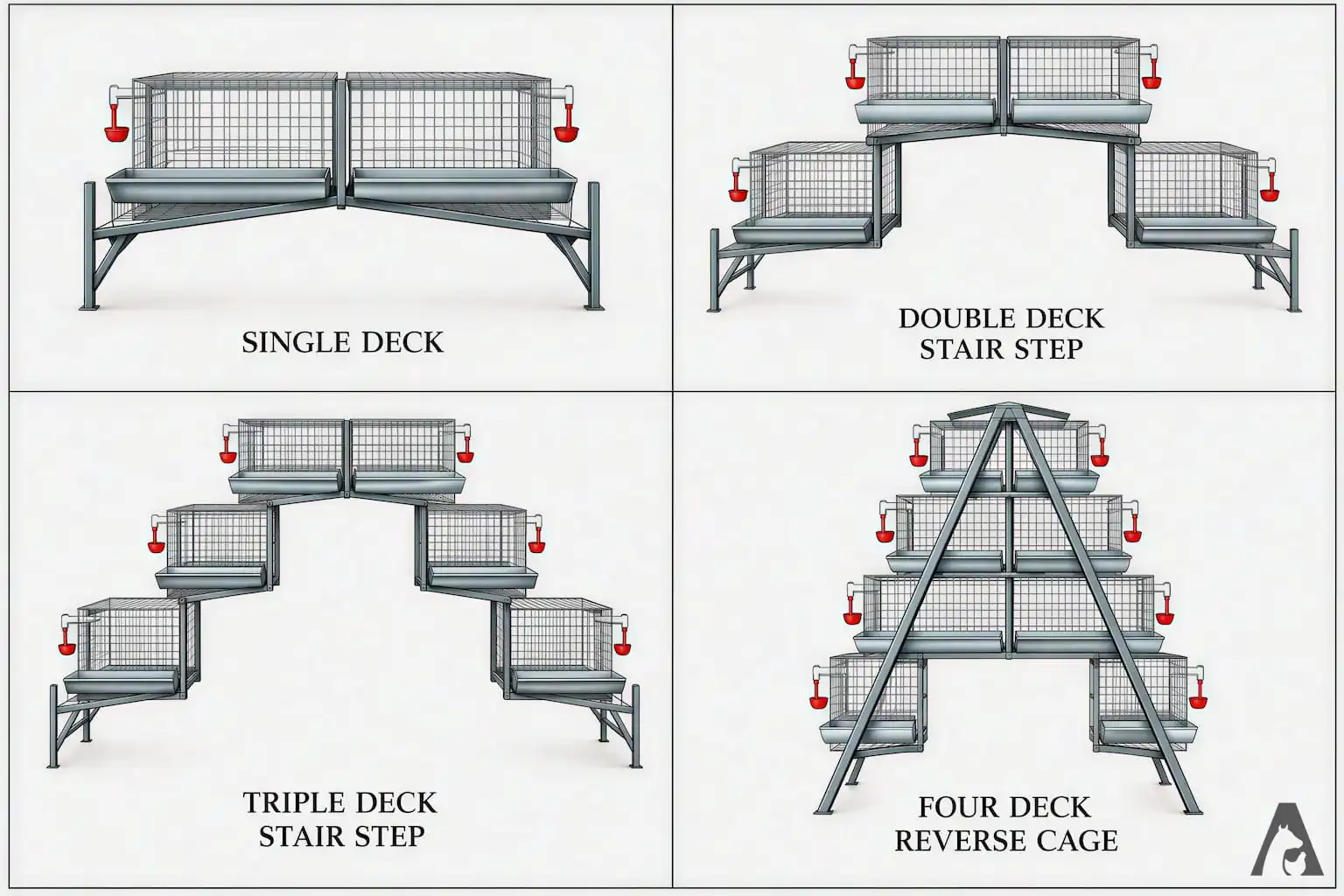
Based on the number of rows:
- Single-deck
- Double-deck
- Triple-deck
- Four-deck
- Flat-deck
Based on the arrangement of cages:
- Stair-step cages
- M-type cages
- L-type cages
- Battery cages (Vertical cages)
Based on the type of bird reared:
- Brooder/chick cages
- Grower cages
- Layer cages
- Breeder cages
- Broiler cages
1. Brooder Cage/Chick Cage
- Specifications: Front feeding length: 60 inches
- Front & Back Height: 12 inches
- Depth: 36 inches
- No. of chicks (0-8 weeks) accommodated per box: 60
Chick cages are arranged either as single-deck or double-deck systems. The feeders and waterers are arranged on the outside. Nowadays, nipple drinker systems are used from day-old. Newspaper may be spread over the cage floor for the first 7 or 10 days. Feed is usually provided inside the cage during the first week of age.
2. Grower Cage
- Specifications: Front feeding length: 30 inches
- Front & Back Height: 15 inches
- Depth: 18 inches
- No. of growers (9 to 18 weeks) accommodated per box: 10
3. Layer Cage
Two types of stair-step layer cages are commonly used in open-sided poultry houses:
- Conventional cages
- Reverse cages (Californian cages)
Conventional Cages
- Specifications for each box: Front feeding length: 15 inches
- Front height: 18 inches
- Back height: 15 inches
- Depth: 18 inches
Reverse Cages
- Specifications for each box: Front feeding length: 18 inches
- Front height: 18 inches
- Back height: 15 inches
- Depth: 15 inches
These cages can hold 3 to 4 birds. They are arranged either in 2-tier or 3-tier systems. A slope of 1/6 is provided in conventional cages, whereas in reverse cages, the slope is 1/5.
Advantages of reverse cages over conventional cages:
- More feeding space is available in reverse cages. Therefore, all 4 birds can take feed at a time.
- Whereas in conventional cages, 3 birds can take feed and the other one is waiting at the back.
- Number of cracked eggs is lower due to a shorter rolling distance.
- Better ventilation in reverse cages than in conventional cages.