
Behaviour of Chicks in Brooder: Signs of Comfort, Heat Stress and Management
Proper brooder management is essential for maintaining chick health, growth, and survival during the early stages of life. Observing chick behavior provides a practical indication of whether the temperature, feed, water, and overall brooding conditions are appropriate. This article discusses the characteristic behavior of chicks in the brooder and the management practices used to assess chick comfort and maintain suitable brooding conditions.
As the chicks arrive, check whether they are healthy and of uniform weight within the suggested range of 40–48 g each. Count the chicks, moisten each chick’s beak by dipping it in water containing vitamins, electrolytes, and/or antibiotics, and place it gently into the brooder arrangement.
Check that the chicks move actively, scratch, and consume feed and water. Return weak, inactive, or unhealthy chicks with matted feathers on the back, as well as dead chicks, and request replacements.
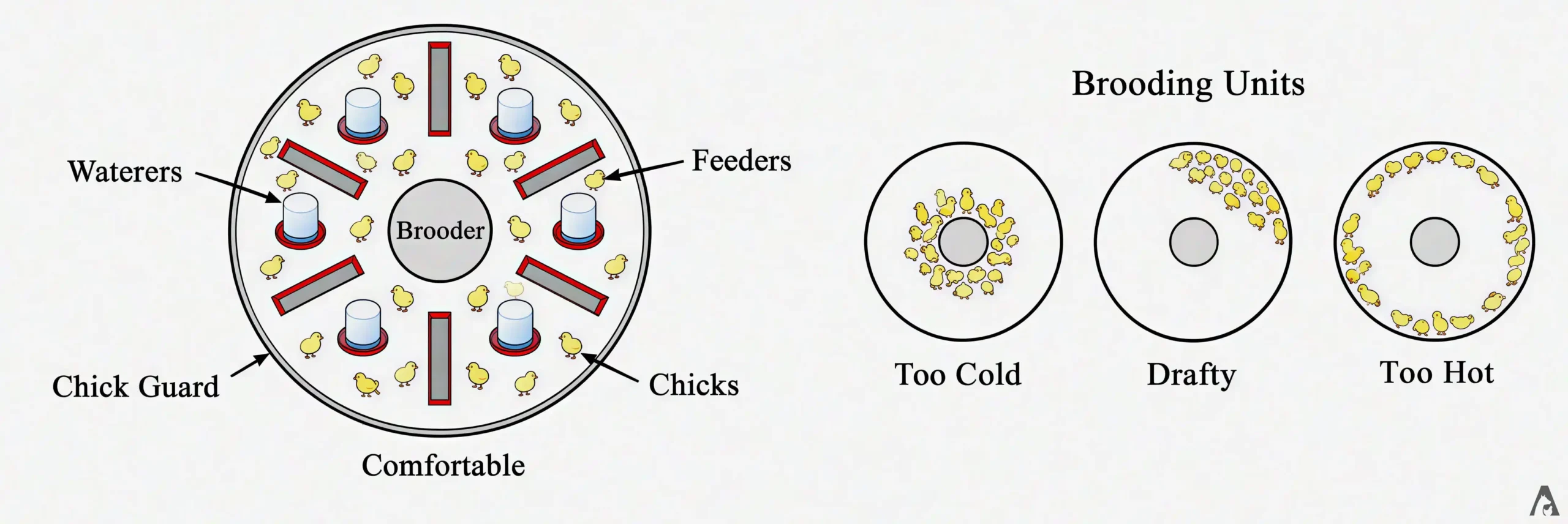
It is necessary to verify whether the warmth provided is sufficient for the chicks. A thermometer kept at bird level will indicate the temperature. However, a more practical way of assessing the adequacy of the warmth provided is by observing the distribution of the chicks within the brooder guard. If they crowd under or near the heat source, the warmth provided is insufficient. A bulb may then be added to the hover, or the height of the hover may be lowered. If the chicks move to the periphery and are reluctant to come to the center under the heat source, the environmental temperature is higher than required.
The hover may then be raised or a bulb removed. If the chicks are comfortable at the given temperature, they walk actively throughout the area, apparently unaffected by the heat provided, while some rest with their heads down to the side. This posture is referred to as “chick comfort.” Thus, the heat source should be placed at the appropriate height at the center, and the temperature should be assessed by observing the chick comfort zone.
The newspaper should be removed after 3 or 4 days and must be burned. The chick or brooder guards should be removed after 7–10 days. The corners of the room should be rounded off, and the litter material spread out. As the chicks grow, the initial chick feeders and waterers may be replaced with larger ones to accommodate their growth.