CONTENT
Animal Disaster Management: Veterinary Care, Preparedness, and Welfare
Disasters such as floods, earthquakes, cyclones, fires, epidemics, and other emergencies can have serious consequences for animal health and welfare. Effective disaster management requires proper preparedness, veterinary care, disease control, resource planning, rescue, rehabilitation, and coordinated response to protect animals and minimize losses.
Disaster and Veterinary Management Plan
Natural or human-made calamities may occur due to earthquakes, floods, cyclones, droughts, famines, extreme cold, landslides, fires, industrial and technological accidents, pollution, gas releases, epidemics, and other hazards.
The impact of disasters is obviously high, yet the vulnerability of animals has not been sufficiently highlighted for a long time. It is apparent that even though animals are a major source of livelihood for many economically disadvantaged and landless communities, concrete steps toward disaster management for livestock and other animals need to be taken.
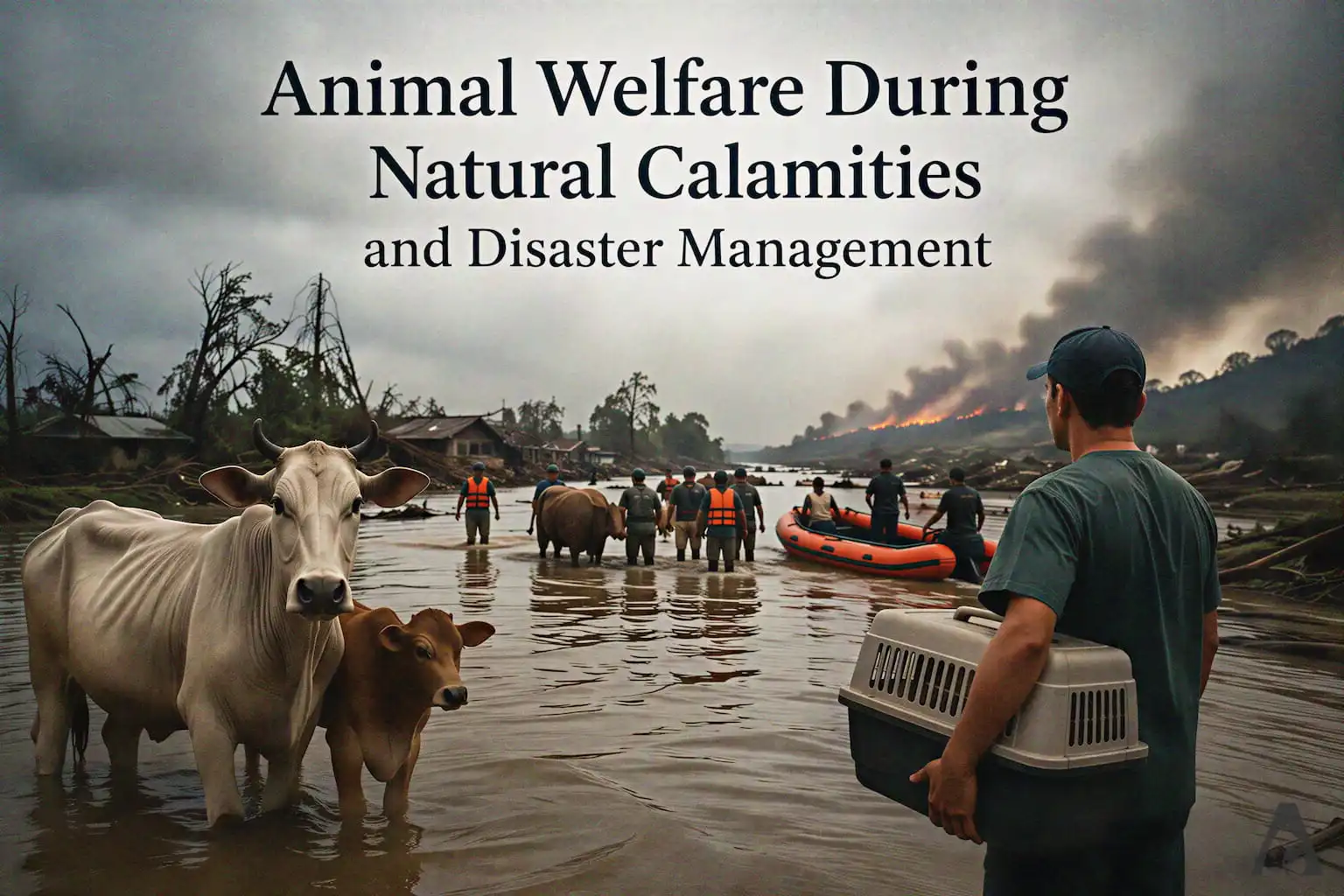
The following steps should be taken to minimize the effects of natural disasters on animals:
- Preparedness
- Disaster Management Plan for Animals
- Outline
- Basic Components of a Veterinary Disaster Management Facility
- Action-Oriented Recommendations
1. Preparedness
Event Preparedness
It should contain a checklist of basic materials and expertise required. For instance, a veterinary surgeon could provide input on traumatic injuries that might occur during an earthquake, and a list of basic first-aid equipment could be provided for reference.
Institutional Preparedness
The following aspects are important under institutional preparedness:
- Hazard identification
- Listing of potential impacts, outlining methods of mitigation and control using professional expertise.
- Drawing up specific action plans
- Rehearsal of plans.
2. Disaster Management Plan for Animals
The most important features of such plans would be:
- A clear, valid, and viable outline of the specific emergency actions necessary in specific situations related to specific hazards, along with the designation of a coordinator or lead agency.
- Documentation of the material and human resources required and accessible during emergency situations.
3. Outline
A basic outline of a disaster management plan for zoo animals should essentially include:
Retrospective Epidemiological Survey Study
A retrospective epidemiological study of disasters in the area should include:
- Data collected, interpreted, and analyzed (i.e., information) on the basis of which predictions can be made.
- Disaster Vignetting: A means by which mapping is performed on the basis of incidence, frequency, magnitude, epicenter, and vulnerable areas.
- Zoo Profile: The total captive animal population, including the number of vulnerable animals according to species, age, sex, physiological status, etc.
- Community profile, including the total zoo staff population, their age, sex, socioeconomic status, education, cultural distribution, etc.
- Animals at risk; the nature of the hazard, the intensity of its impact, and the mortality rate (immediate or delayed).
- Risk Factor Analysis: Analysis of the type and level of risk (identification and analysis).
Management and Action Plan
Following a disaster, animals are to be rescued and collected in relief camps or other suitable spaces. The immediate priority would be controlling and combating disease. The animal health component of disaster mitigation will include:
- Preventive and priority health care, such as nutrition, care of pregnant animals, and care of newborn and young animals.
- Prevention of risks through waste disposal, hygiene, vaccination, pest and vector control, sanitation, etc.
- Specific therapy through early diagnosis and treatment.
- Rehabilitation: Helping animals recover from trauma, stress, or fear.
- Disposal of Dead Animals: Carcass utilization is one method. Animals for which treatment is unlikely to be beneficial may have to be evaluated based on their condition and scheduled for euthanasia (humane euthanasia).
Resource Planning
- Assessment of available personnel, including veterinarians, veterinary technicians, ancillary staff, and volunteers.
- Stores and equipment should include medicines, surgical and essential medical appliances, diagnostic equipment, life-saving equipment, etc.
- Logistical Needs: The needs for zoo animal food, water, fuel, lighting equipment, tents or shelters, grass or bedding, trolleys, sanitation materials, and storage for feed, forage, and water for subsequent days.
- Ambulance and Outreach Facility: Transporting animals can be very cumbersome when they are sick, injured, or nonambulatory.
- Veterinary medical facilities, such as veterinary hospitals and mobile veterinary units.
Planning of Training
- Training veterinary personnel, veterinary technicians, zoo keepers, animal care attendants, etc.
- Training administrators such as local government officials, emergency communications personnel, fire service personnel, civil defense personnel, emergency management officials, municipal or wildlife officers, and other administrators.
- Animal health awareness training for social workers, volunteers, and personnel from nongovernmental organizations (NGOs).
Allied Supportive Planning (Organization)
- Augmenting political and administrative support.
- Involving NGOs, media, animal welfare organizations, and other volunteer groups.
- Eliciting commitments and allocating funds.
- Formation of veterinary service groups at state and federal government levels.
- Organization of district- or area-level bodies, assigning specific tasks and responsibilities to the appropriate animal health authorities.
- Establishing communication channels, including alternative channels such as amateur radio.
- Establishing alternative sources of power and energy.
- Planning for monitoring and supervision.
- Publicity and public relations activities (Vet-PR).
- Planning for the mitigation and rehabilitation of animal owners along with their animals.
Execution of Short- and Long-Term Plans
Short- and long-term plan implementation includes estimating the number of animals involved and assessing damage through local and central-level committees. Media may be used to help locate remote areas where organizers’ attention may not easily reach. Monitoring is an essential part of implementation.
Impact Assessment
Experience gained from similar hazards in nearby areas can be highly useful. This is especially important in animal disaster management, which is still in its infancy.
Post-Execution Evaluation of the Plan
Follow-up of disaster management, especially animal management, provides valuable experience that needs to be shared among disaster-prone areas. Unfortunately, this is not always done.
Linking with Allied Agencies for Uniformity in All Regions
This is an important part of a disaster management program, as unbiased and uniform measures help promote transparency and, consequently, instill confidence in the community regarding the system.
4. Basic Components of a Veterinary Disaster Management Facility
Camp-Site Veterinary Hospital
The necessary equipment and other infrastructure should be provided along with stockpiles of emergency equipment and drugs. All veterinary personnel may not be required at the same time. It would be important to plan shifts to avoid mental and physical fatigue. The early phases would require a larger workforce across all departments and areas of activity.
Supervision and monitoring would be important and would require all the qualities of leadership, such as confidence, competence, experience, patience, communication skills, etc. As search and rescue operations are completed, relief and rehabilitation would become increasingly important.
Recovery and Rehabilitation
The impact of a disaster can be calamitous, and one may encounter a number of cases involving more than physical injuries or contagious diseases. Mental trauma due to the loss of a companion or other bonded animal may also be encountered and will have to be addressed appropriately.
Many cases involving extensive trauma that cannot be adequately managed may have to be euthanized. Performing euthanasia under full public view, when the public is already distressed by losses of life and property, may contribute to emotional distress or even public outcry. Overenthusiastic or inadequately trained animal activists may sometimes escalate such situations, particularly where strong cultural or emotional attachments to certain animals exist.
Control Rooms
Control rooms are used for information exchange and coordination of veterinary support. They facilitate coordination and information sharing among animal health authorities, district veterinary hospitals, rural veterinary facilities, and other facilities in the affected area.
Control rooms maintain communication with and coordinate supplies from various agencies. The control room would operate based on feedback from affected areas regarding the extent and nature of the emergency and the need for special equipment, etc. The role of a veterinary public relations officer (Vet-PR) assumes significance.
Control of Epidemics/Diseases
The immediate task after the first emergency treatments are completed would be to address diseases that may spread. Armed with retrospective epidemiological information, authorities would identify priority diseases and implement sanitation measures. These may include digging manure pits, establishing drainage facilities (particularly important during floods and cyclones), and providing safe drinking water and water troughs. These measures will have to be established simultaneously in hospitals, temporary shelter camps, and affected areas, according to need and priority.
Health care operations require discipline, and public cooperation is also essential. Animal welfare agencies working in the affected areas can help arrange stockpiles. The media can help by providing feedback from the field.
SWOT Approach
Strengths, weaknesses, objectives/outcomes, and threats associated with planning such a program should be outlined. Some factors that may hamper health and veterinary support include:
- Lack of communication among officials.
- Shortage of space for various activities, such as laboratories, medical stores, etc.
- Uncontrolled demand for additional materials, particularly when a shortage of any material is perceived.
- Inadequate or inefficient equipment, such as equipment that does not operate on battery power.
- Lack of trained staff in veterinary extension and public relations to handle anxiety and public concerns.
- Lack of aftercare facilities.
- Lapses in coordination and duplication of efforts.
- Absence of comprehensive training in disaster management.
Post-Disaster Phase and Reconstruction
Apart from reconstructing damaged or lost veterinary and animal health facilities, one can learn from the experience of disaster response and identify shortcomings in zoo husbandry and veterinary services. This experience would help during the rebuilding of damaged or lost facilities. Some equipment and medications would also be identified and prioritized according to need.
Role of Existing Structures
With the cultural and social importance of animals in many communities, there are already many zoos established with consideration of local needs and past experience. The Vadodara Zoo, with its centrally elevated area and tree plantation, provides an example of an open-moated system for herbivores that helped save the lives of many deer and antelopes during the July 2005 floods in Gujarat.
Carcass Disposal
The methods of animal waste disposal and recycling vary among animal species and facilities. Improper disposal can increase pest and vector problems. Composting or digging manure pits may be considered outside the zoo area. Manure pits should be layered with dry waste and lime at regular intervals.
During prolonged stagnation of floodwater, duck rearing and fish farming may be considered as naturalistic methods of pest control, but these approaches are not suitable for zoos. The disposal of dead animals poses acute problems during floods and cyclones because the number of animal deaths may be enormous.
5. Action-Oriented Recommendations
Immediate Availability and Awareness of SOS Documents
- In most zoos, disaster management plans, do’s and don’ts, lists of emergency items and alternatives, guidelines, materials, records, resource persons, key storage locations, and important telephone numbers and addresses of relevant institutions and associations should be readily available in written form.
- They should be kept in a safe, fireproof, and quickly accessible location with other important documents and taken along if it becomes necessary to evacuate the facility.
- Each member of the animal care team and animal husbandry personnel should know and practice the plan so that action may be taken even in the absence of key management personnel.
Creating a Reference Document/Manual
It is possible to tap the expertise of veterinary professionals to create a document that would contain information on:
- Hazard identification in different situations, e.g., research institutions, zoos, etc.
- Potential impacts on animals in specific situations, e.g., epidemics, fires, and floods.
- Veterinary aspects of these impacts from the perspectives of veterinary surgeons, epidemiologists, animal nutrition experts, ethologists, and zoologists.
Application-Oriented and Online (Internet) Information
Information on disaster preparedness should be more application-oriented, with input from experts. If a sustained flow of information is available, it may be possible to consider publishing a regular column.
Online resources, including lists of important websites and addresses, should be known to zoo officers. These resources could also provide a much-needed forum for victims, eyewitnesses, and workers to discuss real-life situations and provide information on practical problems encountered by zoo personnel, citing examples and challenges faced in the field.