CONTENT
Human and Animal Welfare in Relation to Environmental Factors: Moral, Health, and Economic Aspects
Human and animal welfare are closely interconnected with the environment and the conditions within ecosystems. Environmental degradation, pollution, biodiversity loss, animal health, and welfare can have significant moral, health, and economic implications for both animals and human populations.
The concept of the environment has changed considerably in recent years. The traditional anthropocentric view of the environment (considering human beings as the most significant entity in the universe) is reinforced by modern man’s ability to manipulate the environment through modern technology. According to this approach, the environment is nothing more than a collection of components placed at man’s disposal.
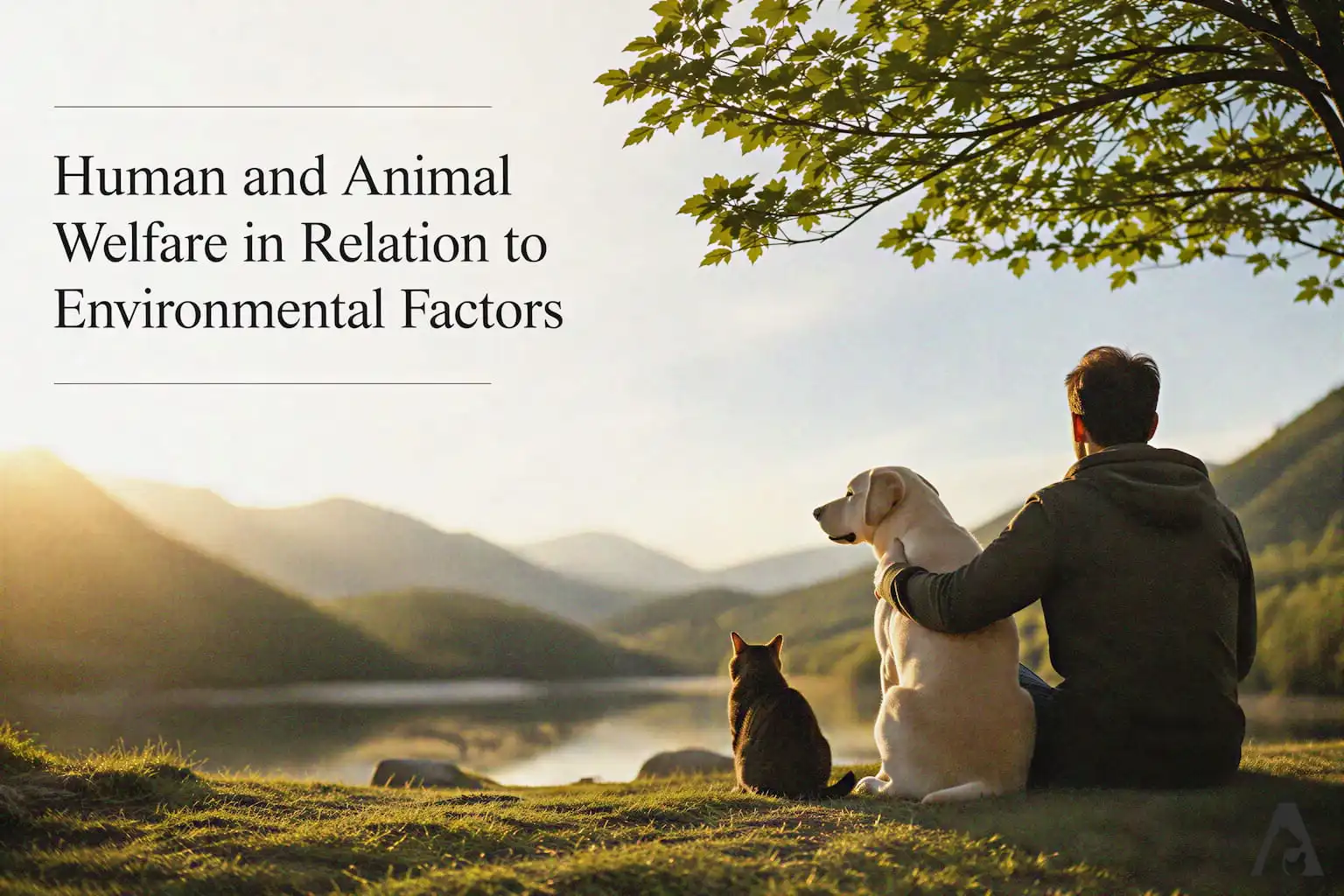
Western science has moved away from identifying absolute values and has started to focus on approaches that might help define what is morally right or wrong. This approach has helped people move away from a purely anthropocentric point of view toward a much more complex system, which has led to greater respect for the environment and a greater sense of responsibility toward it. In this way, the environment cannot be considered the subject of a right, but rather the object of a duty.
Moral Aspects
Being responsible means being morally involved, and it also means that there is an interdependency between human well-being and the condition of the environment, including animals.
A statistically significant negative correlation was found between environmental degradation and well-being (around 81% of individuals expressed concern about the ozone layer), along with a statistically significant positive association between concern about animal extinction and well-being (about 85% of individuals expressed concern about species extinction).
Thus, a system that results in poor welfare is unsustainable because it is unacceptable to many people. It is considered morally important to protect animals. The moral dimension and concept of nonhuman factors (the environment and animals) have emerged.
A higher level of animal welfare is associated with a higher level of human moral development. Thus, there is evidently a connection between the well-being of nonhuman animals and the moral and psychological aspects of human well-being.
Health Aspects
There is a much more evident link between animal and human well-being, which can be found directly among the five dimensions of human well-being. About 75 percent of new diseases that have recently affected humans are caused by pathogens originating from animals or products of animal origin.
Moreover, the causal relationship between animal welfare problems and animal diseases has also been demonstrated. Like humans, when experiencing severe stress, animals can succumb to disease or fail to reproduce or develop properly. One of the Five Freedoms is freedom from fear and distress. These harmful effects of stress highlight the importance of stress to animal well-being (Biology of Animal Stress). If we look at the production side, animal health care statistics demonstrate that the large majority of losses in livestock production (mortality, compulsory slaughter, disease, poor reproductive performance and body mass index (BMI) results, medical expenses, etc.) are not caused by obligate pathogens.
Most losses are the direct result of diseases caused by unfavorable conditions related to animal breeding, feeding, and management, or by other external factors (power failures, hail damage, etc.). In summary, animal health and welfare are invariably linked to human health.
Economic Aspects
The economic aspects are directly linked to the first dimension of human well-being. Animal welfare regulations generally require enterprises to move from the usual minimum-cost-to-maximum-return intersection, so animal protection may appear costly at first.
However, in the long term, in most cases, they do not result in lower revenues because applying new—often more expensive—methods or technologies can boost productivity, and the loss of competitors due to compliance failures may increase the market share of companies that comply with the regulations.
Consumer behavior is paradoxical: on the one hand, consumers are becoming increasingly aware of the environmental impacts of their daily lives, whereas on the other hand, concern for the ethical treatment of animals does not always translate into changes in purchasing habits.
In recent years, there have been increasing concerns about the adequacy of traditional macroeconomic statistics, such as GDP, as measures of people’s current and future living conditions and national or societal well-being. GDP does not measure human health, environmental health or degradation, destruction of the natural environment, or lack of concern for future generations. As GDP increases, well-being does not necessarily increase along with it.
Alternative economic indicators were developed primarily to measure either a single aspect of human well-being or, through subjective approaches, well-being as a whole.
Alternative Economic Indicators and Animal Welfare
Many alternative economic indexes also contain environmental issues. Based on the presumption that animals are an integral part of the environment, animal welfare can also be incorporated into an indicator.
Pollution
Pollution as a link to animal welfare: although the majority of existing environmental-type alternative economic indicators are influenced by animal welfare issues only indirectly, these indicators contain certain aspects of pollution, which also have a strong link to animal well-being at the individual level.
Environmental pollutants can adversely affect animal health and reproductive function through either direct or indirect effects on numerous organs and systems. These effects are not generally reflected in visible reductions in animal performance, but subclinical effects may result in reduced animal performance, with associated economic consequences.
Degradation of Biodiversity
Degradation of biodiversity as a link to animal welfare: besides pollution, degradation of biodiversity is also a possible factor in alternative economic indicators.
According to some authors, massive losses of biodiversity are also a form of animal abuse. Moreover, recent trends in animal husbandry raise serious sustainability issues, affecting both animal welfare and biodiversity.
The expansion of markets and economic globalization has contributed significantly to the loss of domestic breeds, especially livestock breeds.