CONTENT
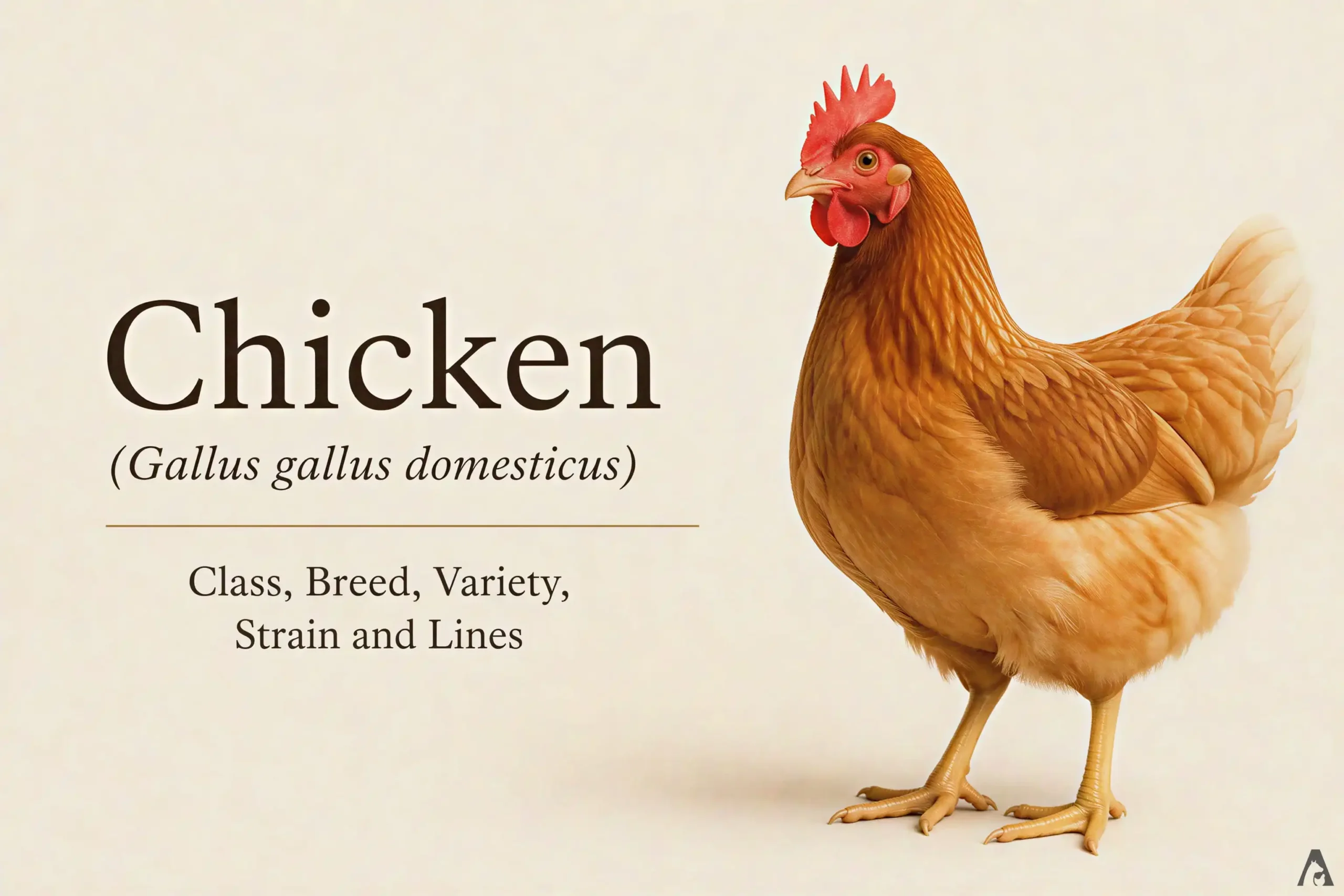
Chicken (Gallus gallus domesticus): Class, Breed, Variety, Strain and Lines
Chicken (Gallus gallus domesticus) is one of the most important domesticated poultry species, with numerous breeds and commercial strains developed for different production purposes. Its classification includes several levels, such as class, breed, variety, strain, and line, which help describe groups of birds based on geographic origin, physical characteristics, breeding history, and productive traits.
Two scientific names are in use for chicken, namely Gallus gallus and Gallus domesticus. The first implies that chickens were domesticated exclusively from the red jungle fowl (Gallus gallus), while the second suggests that more than one of the wild jungle fowl species, namely the gray jungle fowl (Gallus sonnerati), Ceylon jungle fowl (Gallus lafayettei), and green jungle fowl (Gallus varius), contributed to the evolution of the domestic fowl. However, the red jungle fowl is the species that most closely resembles the chicken, so there is no doubt that it was the main ancestor, although it may have been the only one.
Historical and scientific documentation suggests that the domestication of chicken originated on the Asian continent. China, India, Bangladesh, Myanmar (Burma), Thailand, Sri Lanka, Malaysia, and other Southeast Asian countries were home to the ancient jungle fowls from which modern-day breeds and commercial strains of chicken evolved.
Class
The term “class” is used to designate a group of birds developed in certain regions or geographical areas, such as American, Asiatic, Mediterranean, English, etc.
Breed
The breed refers to an established group of birds related by breeding, possessing a distinctive shape, conformation, plumage color, comb type, general body weight, etc., and breeding true. (E.g.) Aseel, Rhode Island Red, Leghorn, Cornish.
Variety
It is the term used to subclassify breeds. There may be many varieties within a breed, differentiated by plumage color, pattern, and comb type (E.g.) White Leghorn, Black Leghorn, Brown Leghorn, Barred Plymouth Rock, etc.
Strain
Strains of birds are subclasses of a breed. Strains are closely related, inbred flocks with defined economic characteristics. Normally, a strain is named after the person who developed it, or it may also be named after the research station. A breed or variety may have several strains that may be phenotypically alike but often differ in production performance depending upon their breeding history. They are developed with emphasis on specific traits such as egg production, early maturity, improved feed efficiency, egg weight, etc.
For example:
- Babcock, Bovans, Hy-Line, Hisex, Lohmann (Layer strain)
- Cobb, Hubbard, Ross, Hybro (Broiler strain)
- Meyer strain of White Leghorn, Forsgate strain of White Leghorn.
Lines
These are subclasses of strains that are used for the production of commercial hybrids.