CONTENT
Administration of Medicines in Livestock Animals
Administration of medicines in livestock animals is an important part of veterinary treatment and animal management. Medicines are administered to prevent and treat diseases, improve animal health, and maintain productivity in livestock farms.
Medicines are administered in two ways:
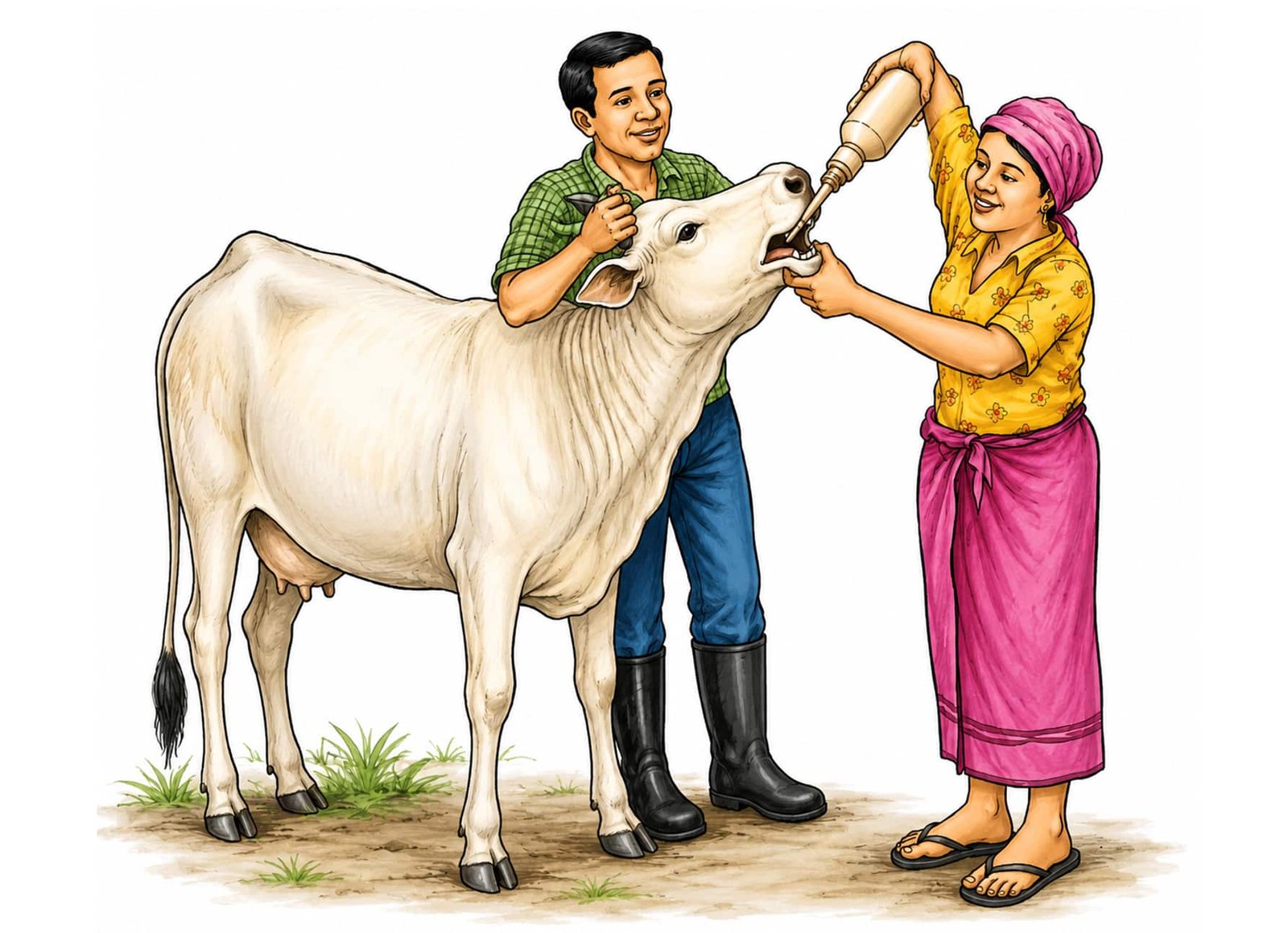
- Oral administration: It is the administration of medicines through the mouth. By oral method, medicines can be administered in liquid, solid and semi-solid form.
- Parenteral administration: Any other route of administration other than oral route is called parenteral administration.
Oral Administration of Medicines
Oral administration includes drenches, boluses, pills, and electuaries.
1. Drenches
Drenches are medicines given in liquid form. Drenches may be given by mouth or through a stomach tube. For the administration of fluid medicines to horses, the stomach tube is used. A stomach tube is better than the use of a drenching bottle and drenching bit.
Cattle
A metal drencher and stomach tube can be used for administering fluid medicines to cattle. The tube can be passed through the nostril as in horses. A stronger stomach tube may be passed by mouth with the aid of a probang gag. Careless drenching leads to aspiration pneumonia.
Sheep and Goat
A stomach tube or drenching cup may be used for the administration of medicines. The nostrils are too small for the introduction of a tube for administering medicine. A mouth gag is required to prevent the tube from being chewed during the introduction of the stomach tube through the mouth.
2. Bolus and Pills
Boluses and pills are solid forms of medicine.
Horses
The tongue is held between the upper and lower jaws, the operator’s hand is protected, and the mouth is kept open. The bolus, held between the first and second fingers of the right hand, is inserted into the left side of the horse’s mouth, quickly passed along the roof of the mouth as far back as possible, and dropped into the throat. The right hand is quickly withdrawn and the tongue released.
Cattle
The mouth should be opened by hand or gag, and the bolus, pills, and capsules can be deposited on the back of the tongue. A balling gun may be necessary for calves and young cattle.
Sheep and Goat
Tablets, pills, and small boluses are dropped on the back of the tongue by hand or by a balling gun.
3. Electuaries
Electuaries are semi-solid forms of medicine. These are thick viscid mixtures prepared with treacle and placed on the back of the tongue. Powders are often given by this method. It is a common way of giving medicines for respiratory complaints or when swallowing is difficult.
Cattle
The nostrils are held by an assistant, and the operator opens the mouth of the animal. The electuaries can be smeared on the tongue.
Sheep and Goat
The sheep/goat is held as for drenching, and the electuaries can be smeared on the tongue.
Parenteral Administration of Medicines
Parenteral administration includes injections such as subcutaneous, intramuscular, intravenous, and other specialized routes.
1. Hypodermic or Subcutaneous Injections
Medicine is injected under the skin with a sterilized hypodermic needle and syringe. The rate of absorption is slow as compared to intramuscular and/or intravenous routes.
| Species | Site of S/C Injection |
|---|---|
| Horse and Cattle | Neck Region |
| Sheep and Goat | Flank Region |
2. Intramuscular Injection
Medicines that are not suitable for administration through the subcutaneous route are administered directly into a muscle. A longer and stouter needle is desirable.
The site of intramuscular injection in horses, cattle, sheep, and goats is the muscles of the breast, neck, triceps, and buttock.
3. Intravenous Injection
In this method, the medicine is injected directly into the blood stream.
| Species | Site of I/V Injection |
|---|---|
| Cattle | Jugular vein and Mammary vein |
| Horse, Sheep and Goat | Jugular vein |
4. Intraperitoneal Injection
In intraperitoneal injection, the drug is injected into the peritoneal cavity in large animals by means of a trocar and cannula inserted into the upper part of the left flank. In small animals, a hypodermic syringe with a long needle is used.
5. Intratracheal Injection
In intratracheal injection, the drug is injected directly into the trachea with a specially made intratracheal needle or cannula in certain conditions like parasitic bronchitis in young cattle and sheep.
6. Intramammary Infusions
A special syringe or teat siphon is used, and the infusion is pressed into the teat canal in cases of mastitis. First, the milk in the udder is removed, and then the appropriate antibiotic is infused.
7. Intra-Uterine Irrigation
Antiseptic solutions are injected into the uterus so as to irrigate the uterine cavity with a two-way catheter. Otherwise, a specially designed metal catheter for cows, rubber tubing and a pump for mares, and a syringe for bitches and cats may be used.
8. Intraruminal Injection
Medicines are sometimes given directly into the rumen. A trocar and cannula are introduced into the rumen through the hollow of the left flank. Some antiparasitic medicines are given through this route.
Other Forms of Medicine Administration
- Pessaries: These are solid forms of medicines for insertion into the uterus and vagina of large animals.
- Inhalation: Medicaments are added to boiling water and the resulting vapour is inhaled. It is useful for all animals for respiratory diseases.
- Enema: It is given for evacuation of bowel. Sometimes nutrient enema may be given to animal which are unable to take nourishment in the ordinary way.
- Poultices: Glycerine and kaolin with turpentine are taken in a semi solid form (paste) and applied on the part of the body.
- Fomentation: This is a first aid treatment for many types of sprains. It may be used in the form of either hot or ice-cold fomentation.
- Baths: Animal suffering from hoof diseases e.g. foot rot in sheep may be driven through a shallow trough or foot bath containing antiseptics.