CONTENT
Organic Livestock Production in Animal Husbandry
Organic livestock production is a system of livestock farming that aims to produce animal products such as milk, meat, eggs, and wool by using natural methods, organic feed, good animal welfare practices, and avoiding the use of synthetic chemicals, antibiotics, hormones, and genetically modified organisms.
Organic grassland is the foundation stone of organic livestock farming. In organic farming, the components of the whole farm system interact closely, and grassland plays a central role in this intricate system, including the arable cropping phase.
Grassland is important particularly in relation to nitrogen supply via its influence on nitrogen fixation, soil organic matter, structure, and biological activity. It also has a major role to play in restricting the build-up of arable weeds and soil-borne crop diseases in arable rotations.
Ruminant livestock share this central role with grassland on most successful organic farms, and the success of the livestock enterprise is intimately tied to the management and productivity of the grassland.
Considerations for Organic Livestock Production
Origin of Livestock
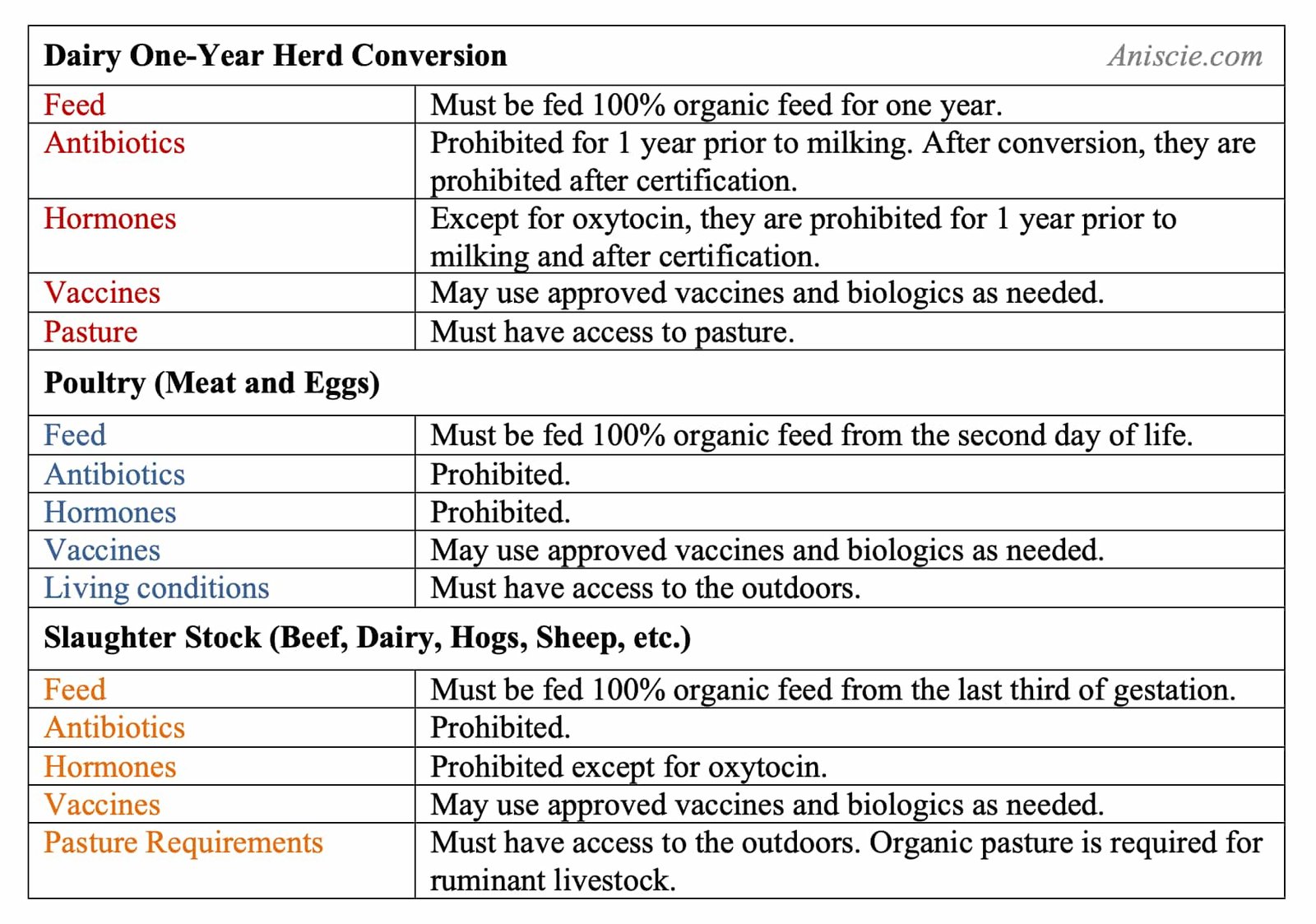
Livestock and products from livestock that are sold, labeled, or advertised as organic must originate from animals that have been managed under continuous organic management from the last third of gestation or from hatching.
Livestock Feed
Livestock that are produced under organic management must have a total ration comprised of agricultural products, including pasture, forage, and crops that are organically produced and handled organically.
There are certain non-synthetic and synthetic substances that can be used as feed additives and supplements.
Dairy cattle under 9 months of age are allowed to have 20% of their feed from non-organic sources. Plastic pellets, urea, manure, and mammalian or poultry slaughter by-products are not allowed.
Living Conditions
An organic livestock producer must create and maintain living conditions that accommodate the natural behaviour and health of the animals.
The living conditions must include access to the outdoors, shade, shelter, fresh air, direct sunlight suitable to the species, and access to pasture for ruminants.
Waste Management
Organic livestock producers are mandated to manage manure so that it does not contribute to the contamination of crops, soil, or water and optimizes the recycling of nutrients.
Health Care
Organic livestock production practices require the producer to establish preventive health care practices.
The health care practices include selecting the appropriate species and type of livestock, providing adequate feed, creating an appropriate environment that minimizes stress, disease, and parasites, administration of vaccines and veterinary biologics, and animal husbandry practices that promote animal wellbeing in a manner that minimizes pain and stress.
Producers cannot provide preventive antibiotics. Producers are encouraged to treat animals with appropriate treatments, including antibiotics and other conventional medicines, when needed, but treated animals cannot be sold or labeled as organic. Producers cannot administer hormones or other drugs for growth promotion.
Record Keeping/Audit Trail
Organic livestock operations need to maintain records for a number of reasons. Certainly, records are important for the financial management of the organic livestock enterprise.
Likewise, records are important for the verification of the organic status of animals, production, harvesting, and handling practices associated with organic products and animals. Records are mandated to be maintained for 5 years and must demonstrate compliance with the Organic Food Production Act.
Organic vs Conventional Livestock Farming
| Index | Organic Livestock Farming | Conventional Livestock Farming |
|---|---|---|
| Feed | Animals are fed certified organic feed without synthetic additives | Animals may be fed conventional feed with synthetic additives |
| Use of Antibiotics | Routine use is prohibited | Commonly used for disease prevention and treatment |
| Use of Hormones | Mostly prohibited except under specific conditions | Hormones may be used to improve growth and production |
| Vaccination | Approved vaccines and biologics are allowed | Vaccines are commonly used |
| Grazing | Animals must have access to pasture or outdoors | Grazing may or may not be provided |
| Housing | Emphasis on animal welfare and natural behaviour | Intensive housing systems are common |
| Disease Control | Focus on preventive management and natural methods | Relies more on medicines and chemicals |
| Fertilizers | Organic manure and compost are preferred | Chemical fertilizers are commonly used |
| Environmental Impact | More eco-friendly and sustainable | Greater risk of environmental pollution |
| Productivity | Usually lower but considered healthier and sustainable | Higher productivity and faster growth |
| Cost of Production | Generally higher due to organic feed and management | Comparatively lower production cost |
| Product Price | Organic products are usually more expensive | Conventional products are relatively cheaper |
| Animal Welfare | High importance is given to animal welfare | Welfare standards may vary |
| Consumer Preference | Preferred by health-conscious consumers | Preferred for affordability and availability |
Organic livestock production is an eco-friendly livestock farming system that emphasizes natural feeding, animal welfare, organic management practices, and environmental sustainability. It avoids the use of synthetic chemicals, hormones, and preventive antibiotics while promoting healthy animal production.