CONTENT
Common Farm Management Practices
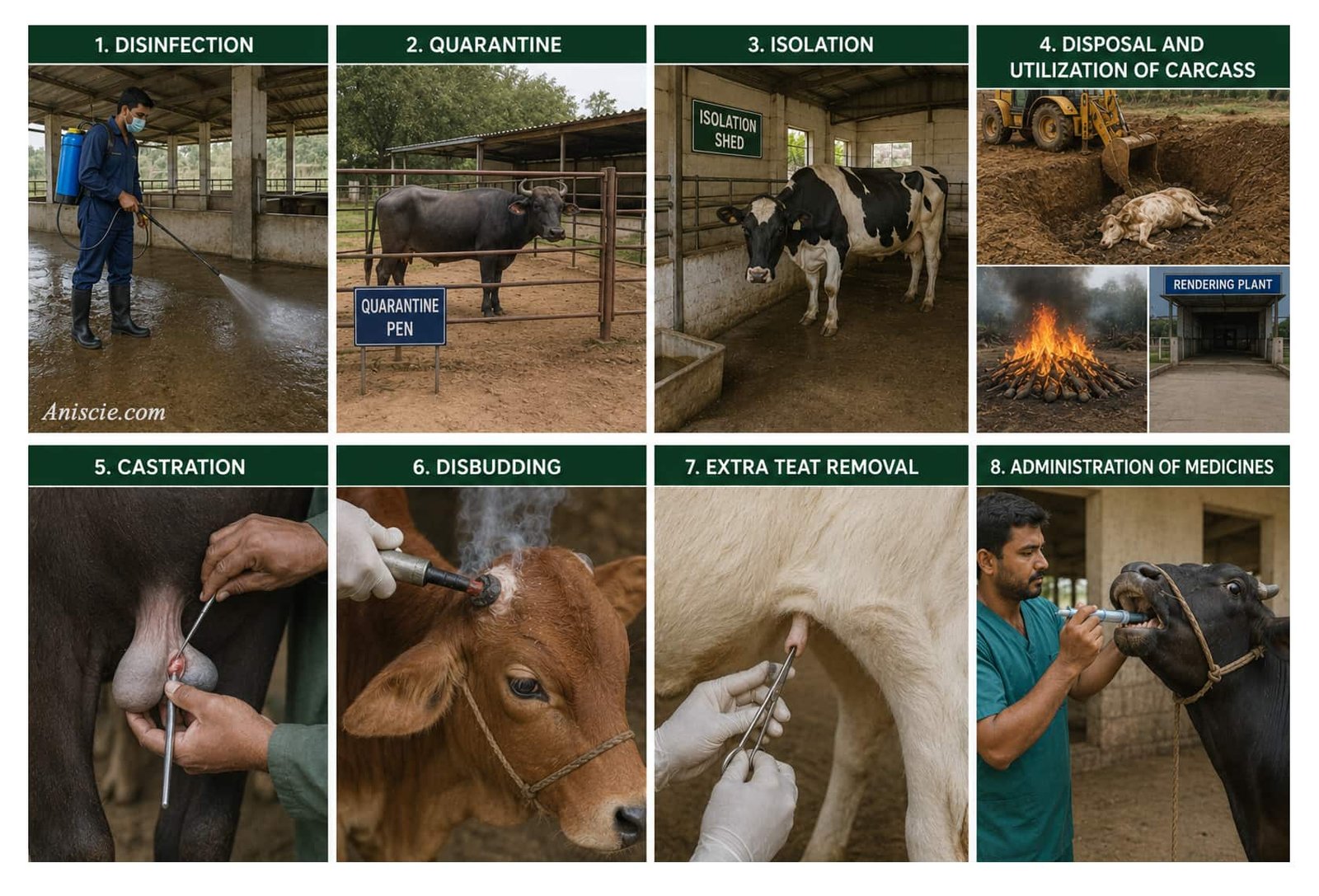
Common farm management practices (routine farm operations) are disinfection, isolation, quarantine, disposal and utilization of carcasses, castration, dehorning, and extra teat removal.
Common farm management practices or routine farm operations at organized and sustainable livestock farms are:
- Disinfection
- Quarantine
- Isolation
- Disposal and Utilization of Carcass
- Castration
- Dehorning and Disbudding
- Extra Teat Removal
- Administration of Medicines
1. Disinfection
Disinfection means the destruction of pathogenic micro-organisms from a place so that the place becomes free from infection.
A disinfectant, germicide, or antiseptic is a substance able to kill organisms and their spores. The methods of disinfection mainly include physical, chemical, and gaseous methods. Most disinfectants are chemical agents.
2. Quarantine
Quarantine is the process of segregating apparently healthy animals (especially animals being introduced into a herd or into the country for the first time) which have been exposed to the risk of infection.
The quarantine period depends on the incubation period of diseases. In practice, a minimum period of 30 to 40 days has been generally accepted as a reasonable period; but in the case of diseases like rabies, this period is up to 6 months.
During this period, the animals should be screened for internal parasites by faecal examination, and deworming should be carried out on the 23rd/24th day, if the need arises. They should be dipped or sprayed on the 25th/26th day to remove the ectoparasites.
3. Isolation
Isolation is the process of segregation of affected and in-contact animals from the apparently healthy ones in the event of an outbreak of a contagious disease. Such segregated animals should preferably be housed in a separate isolation shed situated far away from the normal animal house. If a separate shed is not available, the animals for isolation should be tied at one end of the shed as far away from the apparently healthy stock as possible.
Attendants and equipment for sick animals should ideally be separate. If, due to practical reasons, this is not possible, the sick animals should be attended only after the healthy stock. The equipment should be thoroughly disinfected after use in the isolation group.
The attendant should wash his hands, feet, and gumboots in antiseptic lotions and change his clothes. The isolated animals are brought back to the healthy herd only after they are fully recovered and the chance of passing on infection is removed.
4. Disposal and Utilization of Carcasses
Disposal and utilization of carcasses refer to the safe handling, destruction, or processing of dead animal bodies to prevent the spread of infectious diseases and environmental contamination. Proper carcass disposal is an important biosecurity measure in livestock farms.
5. Castration
Castration is the process of making a male animal incapable of reproduction by removing or inactivating the testes.
In South-East Asian countries, bullocks are extensively used for agricultural operations. Buffaloes are particularly valued as draught animals in rice-growing areas. Male cattle and buffaloes meant for work should be castrated.
6. Dehorning and Disbudding
Dehorning means the removal of well-grown horns. Disbudding means arresting horn growth at an early age, when the horn root is in the bud stage.
7. Extra Teat Removal
A normal udder should have four properly placed teats of uniform size. But animals with one or even two extra teats are also seen. Such extra teats may be blind or leaky. They should be removed before the calf attains 6 months of age.
After restrtaining the calf, the region is thoroughly cleaned and disinfected with tincture iodine, and the extra teats are marked before removal. These teats are clipped off with scissors. Some more tincture is applied after finishing the process. In older heifers, sutures are put in order to arrest bleeding.
8. Administration of Medicines
Administration of medicines is the process of giving drugs or therapeutic substances to animals through different routes, such as oral, topical, intramuscular, intravenous, or subcutaneous routes, for the prevention, control, and treatment of diseases and to maintain the health and productivity of livestock.